Llm

How Grounded Synthetic Data is Saving the Publishing Industry // Robert Caulk

How Grounded Synthetic Data is Saving the Publishing Industry // Robert Caulk

Robert from Emergent Methods discusses how grounded synthetic news data can solve the publisher revenue crisis in the AI era. He details the process of 'Context Engineering' news into token-optimized, objective data for high-stakes AI agent tasks, covering their open-source models for entity extraction and bias mitigation, and the on-premise infrastructure that protects publisher content.
913: LLM Pre-Training and Post-Training 101 — with Julien Launay

913: LLM Pre-Training and Post-Training 101 — with Julien Launay

Julien Launay, CEO of Adaptive ML, discusses the evolution of Large Language Model (LLM) training, detailing the critical shift from pre-training to post-training with Reinforcement Learning (RL). He explains the nuances of RL feedback mechanisms (RLHF, RLEF, RLAIF), the role of synthetic data, and how his company provides the "RLOps" tooling to make these powerful techniques accessible to enterprises. The conversation also explores the future of AI, including scaling beyond data limitations and the path to a "spiky" AGI.

Designing AI-Intensive Applications - swyx

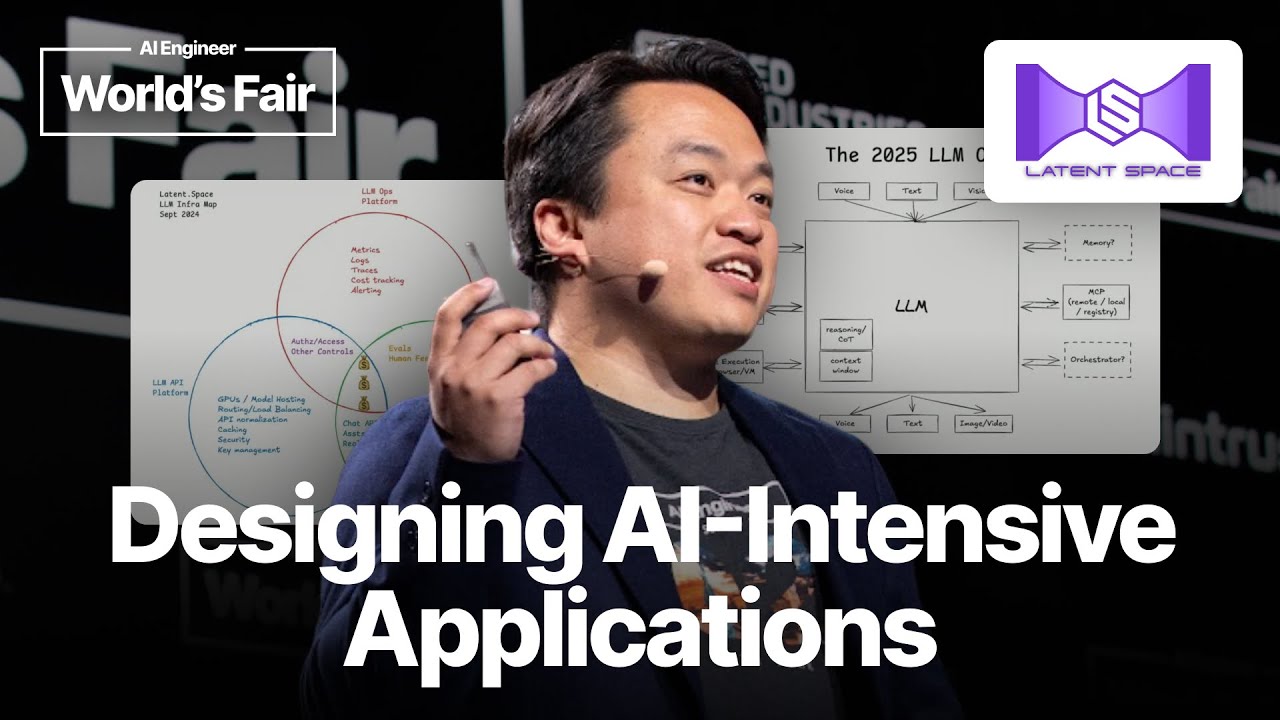
Designing AI-Intensive Applications - swyx

The field of AI Engineering is evolving from simple 1:1 applications to complex, AI-intensive systems with high LLM-call ratios. This talk explores the search for a 'Standard Model' for AI engineering, analogous to MVC or ETL in traditional software, proposing several candidates including LLM OS, LLM SDLC, and a new SPADE (Sync, Plan, Analyze, Deliver, Evaluate) model for building robust applications.

The Truth About LLM Training

The Truth About LLM Training

Paul van der Boor and Zulkuf Genc from Prosus discuss the practical realities of deploying AI agents in production. They cover their in-house evaluation framework, strategies for navigating the GPU market, the importance of fine-tuning over building from scratch, and how they use AI to analyze usage patterns in a privacy-preserving manner.

The AI-Native Notebook That Thinks Like a Spreadsheet

The AI-Native Notebook That Thinks Like a Spreadsheet

Akshay Agrawal, CEO of Marimo, discusses how Marimo addresses the critical flaws of traditional notebooks like Jupyter. He explains its reactive architecture, the benefits of storing notebooks as pure Python files for version control and reusability, and its AI-native features that leverage runtime context for more intelligent LLM-assisted coding.

How to look at your data — Jeff Huber (Choma) + Jason Liu (567)

How to look at your data — Jeff Huber (Choma) + Jason Liu (567)

A detailed summary of a talk by Jeff Huber (Chroma) and Jason Liu on systematically improving AI applications. The talk covers using fast, inexpensive evaluations for retrieval systems (inputs) and applying structured data analysis and clustering to conversational logs (outputs) to derive actionable product insights.