Llm

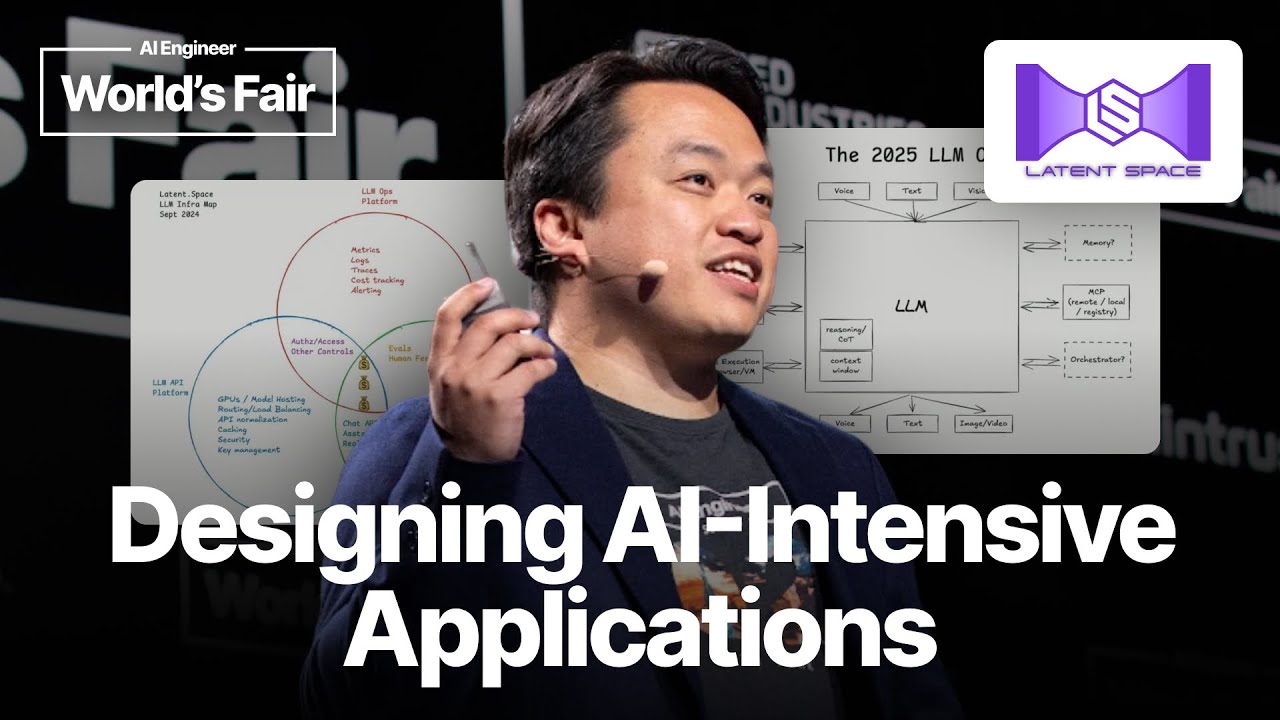
Designing AI-Intensive Applications - swyx

Designing AI-Intensive Applications - swyx

The field of AI Engineering is evolving from simple 1:1 applications to complex, AI-intensive systems with high LLM-call ratios. This talk explores the search for a 'Standard Model' for AI engineering, analogous to MVC or ETL in traditional software, proposing several candidates including LLM OS, LLM SDLC, and a new SPADE (Sync, Plan, Analyze, Deliver, Evaluate) model for building robust applications.

The Truth About LLM Training

The Truth About LLM Training

Paul van der Boor and Zulkuf Genc from Prosus discuss the practical realities of deploying AI agents in production. They cover their in-house evaluation framework, strategies for navigating the GPU market, the importance of fine-tuning over building from scratch, and how they use AI to analyze usage patterns in a privacy-preserving manner.

The AI-Native Notebook That Thinks Like a Spreadsheet

The AI-Native Notebook That Thinks Like a Spreadsheet

Akshay Agrawal, CEO of Marimo, discusses how Marimo addresses the critical flaws of traditional notebooks like Jupyter. He explains its reactive architecture, the benefits of storing notebooks as pure Python files for version control and reusability, and its AI-native features that leverage runtime context for more intelligent LLM-assisted coding.

How to look at your data — Jeff Huber (Choma) + Jason Liu (567)

How to look at your data — Jeff Huber (Choma) + Jason Liu (567)

A detailed summary of a talk by Jeff Huber (Chroma) and Jason Liu on systematically improving AI applications. The talk covers using fast, inexpensive evaluations for retrieval systems (inputs) and applying structured data analysis and clustering to conversational logs (outputs) to derive actionable product insights.

Evals Are Not Unit Tests — Ido Pesok, Vercel v0

Evals Are Not Unit Tests — Ido Pesok, Vercel v0

Ido Pesok from Vercel explains why LLM-based applications often fail in production despite successful demos, and presents a systematic framework for building reliable AI systems using application-layer evaluations ("evals").

The Hidden Bottlenecks Slowing Down AI Agents

The Hidden Bottlenecks Slowing Down AI Agents

Paul van der Boor and Bruce Martens from Prosus discuss the real bottlenecks in AI agent development, arguing that the primary challenges are not tools, but rather evaluation, data quality, and feedback loops. They detail their 'buy-first' philosophy, the practical reasons they often build in-house, and how new coding agents like Devon and Cursor are changing their development workflows.