Designing AI-Intensive Applications - swyx
The field of AI Engineering is evolving from simple 1:1 applications to complex, AI-intensive systems with high LLM-call ratios. This talk explores the search for a 'Standard Model' for AI engineering, analogous to MVC or ETL in traditional software, proposing several candidates including LLM OS, LLM SDLC, and a new SPADE (Sync, Plan, Analyze, Deliver, Evaluate) model for building robust applications.
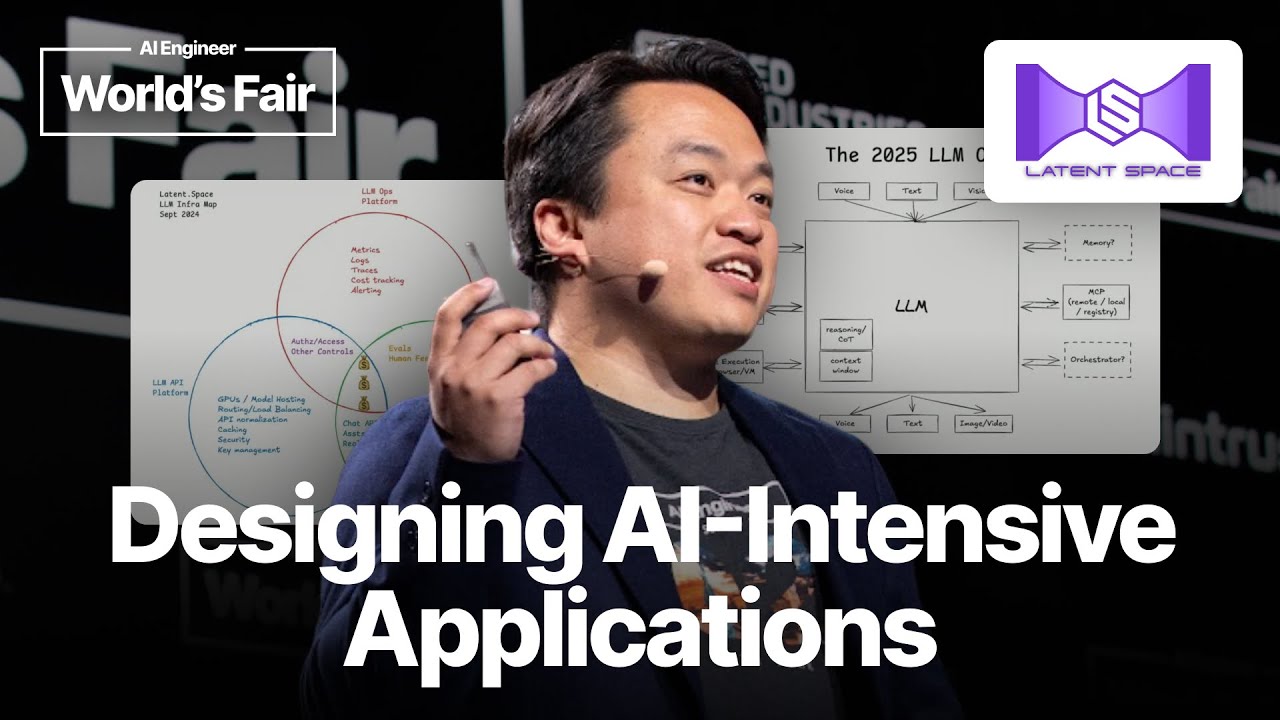
The nature of AI Engineering is undergoing a significant transformation, moving from the early days of simple “GPT wrappers” to a more mature, multi-disciplinary field focused on agent engineering and production-grade systems. This evolution reflects a growing complexity in AI applications, where the ratio of user input to LLM calls is shifting dramatically from 1:1 in chatbots to 1:100 in research tools, and even 0:N in proactive, ambient agents.
The Search for a “Standard Model”
A consistent lesson from practitioners at companies like Anthropic and OpenAI is the importance of simplicity. However, as the field matures, there’s a pressing need to establish foundational patterns and principles, much like the “Standard Model” in physics that unified the field for decades. AI Engineering is in a similar formative stage, seeking its own equivalents of established software engineering patterns like ETL, MVC, or CRUD. While RAG was an early contender, its role is being challenged by long-context models and fine-tuning, indicating it is not the complete answer.
The central question for the community is: What is the standard model for AI Engineering?
Candidate Standard Models
Several candidate models are emerging to structure the development of complex AI systems:
- LLM OS (Updated): Originally proposed by Andrej Karpathy, this model is updated for 2025 to include multimodality, a standard set of tools, and MCP (Model-Component-Protocol) as a default for interacting with the external world.
- LLM SDLC (Software Development Life Cycle): This model observes that the initial stages of the development lifecycle (prototyping, basic monitoring, RAG) are becoming commoditized. The real engineering value and monetization opportunities are shifting towards more complex, production-focused areas like evaluations, security, and orchestration.
- Effective Agents: Building on popular frameworks from Anthropic and OpenAI, this model provides definitions and structures for building agents. It incorporates concepts like OpenAI’s “swarm” architecture and descriptive, top-down models that define agents by their
intent,control flow,memory,planning, andtool use.
From Terminology Debates to a Practical Framework
Rather than getting stuck on the definition of an “agent” versus a “workflow,” a more useful mental model is to analyze the ratio of human input to valuable AI output. This framework helps track the increasing autonomy and capability of AI systems:
- 1:1 (Copilot/ChatGPT): One user query results in one AI response.
- 1:10 (Reasoning Models): One user query triggers a chain of thought or multiple tool calls.
- 1:100 (Deep Research): A single input can launch an extensive research process, like generating a full research notebook.
- 0:N (Ambient Agents): The system operates proactively with no direct human input to generate valuable AI output.
The SPADE Model for AI-Intensive Applications
Drawing from the experience of building AI News, which runs thousands of LLM calls daily, a new generalized model for AI-intensive applications is proposed: SPADE.
The SPADE model is a five-step process:
- Sync: Ingest and synchronize data from multiple sources (e.g., scraping Discord, Reddit, Twitter). This raw data can be processed into a knowledge graph.
- Plan: Map out the required steps for processing the data.
- Analyze: Execute the plan in parallel. This is the core “many-to-one” step, involving recursive summarization and reduction of information into structured outputs.
- Deliver: Present the final, synthesized content to the user. This output is not limited to text; it can be a code artifact, a user interface, or other structured data.
- Evaluate: Continuously assess the quality of the delivered content to refine the process.
This model provides a concrete architecture for building applications that go beyond simple request-response patterns and systematically leverage LLMs at scale to create significant value. The ultimate goal is to define and share these models to collectively advance the frontier of AI engineering and build products that people want to use.