Llm

A Common-Sense Guide to AI Engineering • Jay Wengrow & Kris Jenkins • GOTO 2026

A Common-Sense Guide to AI Engineering • Jay Wengrow & Kris Jenkins • GOTO 2026

Jay Wengrow, author of “A Common-Sense Guide to AI Engineering,” breaks down how AI agents work, describing the 'clever hack' of intercepting LLM output to trigger functions. The discussion covers multi-agent architectures for complex tasks, implementing guardrails with regex and judge LLMs, and a pragmatic take on when to use frameworks versus building from scratch. Wengrow emphasizes understanding fundamentals over specific tools to create robust, production-ready AI applications.

Everything We Got Wrong About Research-Plan-Implement -  Dexter Horthy

Everything We Got Wrong About Research-Plan-Implement - Dexter Horthy

Dexter Horthy of HumanLayer critiques the initial Research-Plan-Implement (RPI) framework for AI coding agents, revealing its tendency to encourage 'outsourcing thinking'. He introduces CRISPR, a new structured methodology that emphasizes smaller, focused prompts, human-agent alignment through artifacts like Design Discussions, and engineer ownership to combat 'slop' and improve code quality in complex projects.

Beyond the Hype: What AI Actually Can (and Can't) Do • Jodie Burchell & Michelle Frost • GOTO 2026

Beyond the Hype: What AI Actually Can (and Can't) Do • Jodie Burchell & Michelle Frost • GOTO 2026

Jodie Burchell and Michelle Frost of JetBrains offer a measured, research-grounded perspective on the state of generative AI. They discuss the shifting definitions of AI, the enduring importance of foundational machine learning principles, historical parallels to previous 'AI summers,' the measurement problem of AGI, and what the evidence actually says about AI's impact on developer productivity.

Solving the Wrong Problem Works Better - Robert Lange

Solving the Wrong Problem Works Better - Robert Lange

Robert Lange from Sakana AI discusses Shinka Evolve, a framework combining LLMs with evolutionary algorithms for open-ended program search. The conversation explores how Shinka Evolve addresses the limitations of systems like AlphaEvolve by co-evolving problems and solutions, its sample-efficient architecture using UCB bandits and quality-diversity search, and its applications in circle packing, competitive programming, and evolving MoE loss functions. The discussion also delves into the philosophical debate on whether these systems produce true novelty or are parasitic on their starting conditions, and the future role of the "AI Scientist" as a human co-pilot.

Is RAG Still Needed? Choosing the Best Approach for LLMs

Is RAG Still Needed? Choosing the Best Approach for LLMs

Martin Keen compares Retrieval Augmented Generation (RAG) with the emerging long context window approach in LLMs. He analyzes the pros and cons of each, from infrastructure simplicity and retrieval accuracy to computational costs and the 'needle in the haystack' problem, providing guidance on when to use each solution.

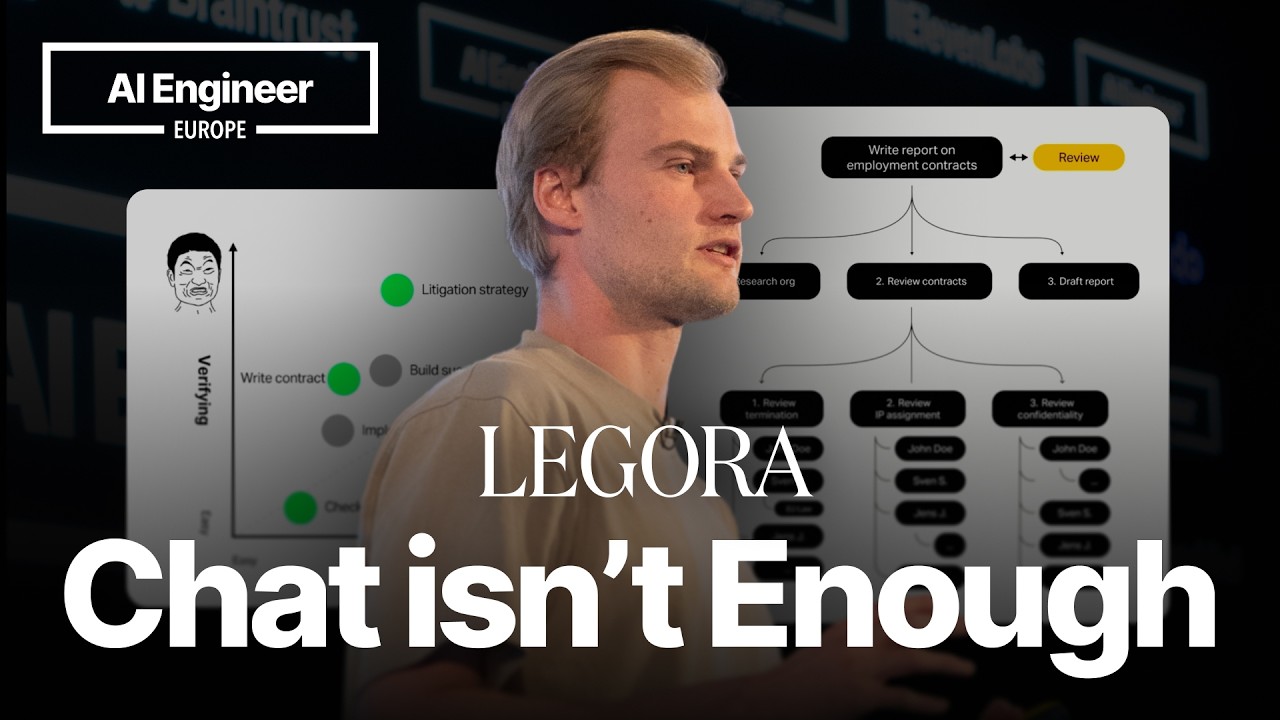
From Chat Fatigue to Instant Action // Donné Stevenson

From Chat Fatigue to Instant Action // Donné Stevenson

A discussion on the evolution of AI agent interaction, moving beyond simple text-based chat to create intuitive, GUI-driven experiences. The talk covers the practical challenges and solutions in building an impactful agent for busy professionals, focusing on quick actions, efficient data streaming, and enhanced interactivity.