Human in the loop

Your AI Agent Has No Nervous System — Matt Gibiec, Dynatrace

Your AI Agent Has No Nervous System — Matt Gibiec, Dynatrace

Matt Gibiec of Dynatrace argues that coding agents are fast but blind without real context about how services run in production, and introduces Bluebox, an observability agent that brings dependency maps, production baselines, and change history into local testing, issue detection, fix suggestions, and pre-build planning, with a human approving the final result.
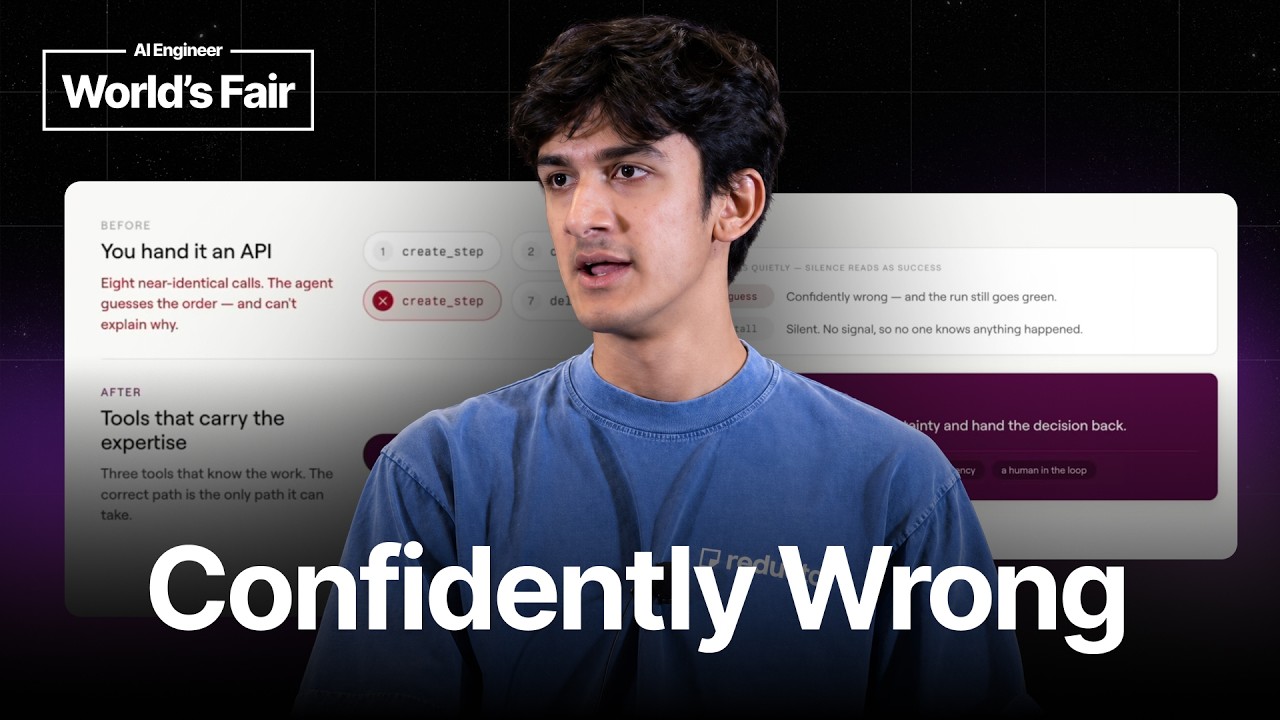

Why We Deleted Our MCP Server and Rebuilt It — Abhi Arya, Reducto

Why We Deleted Our MCP Server and Rebuilt It — Abhi Arya, Reducto

Abhi Arya from Reducto shares how the team went from a one-tool-per-endpoint MCP server that confidently built workflows nobody could explain to a design that makes uncertainty visible, asks instead of guessing, and improves itself through instrumentation. The talk centers on one question: who pays when the agent is wrong?

Giving AI Agents Memory That Learns — Jake Broekhuizen, LangChain

Giving AI Agents Memory That Learns — Jake Broekhuizen, LangChain

Jake Broekhuizen of LangChain Labs argues that observability alone does not make agents improve. Using a financial services agent whose tone drifted from advisory to pushy, he shows how traces only become useful memory when a filtered lesson is written back as durable context the agent reads on its next run. The talk covers semantic, episodic, and procedural memory, the working versus long-term memory distinction, the read-write cycle, and how LangSmith and Context Hub support capture, analysis, and updates, along with lessons about keeping only signal, caching, and human review of procedural changes.

Rapidly Deploying Useful General-Purpose Robots at Walden Robotics

Rapidly Deploying Useful General-Purpose Robots at Walden Robotics

A talk from Walden on deployment-first physical AI: getting general-purpose robots into real manufacturing production, using remote assistance as a human-in-the-loop safety and learning mechanism, and building a data flywheel in which operational data drives continuous improvement of large behavior models.

Why Building an AI Agent Is Easier Than Deploying One

Why Building an AI Agent Is Easier Than Deploying One

Vladimir Keil, co-founder and CEO of Lio, joins Seema Amble and Elena Burger to explain why AI-native startups can beat incumbent software vendors even when those vendors own the customer, the data, and the system of record. The discussion covers the work that happens outside systems of record in enterprise procurement, Lio's multi-agent architecture spanning retrieval through principal agents, how buyers learn to trust agents with consequential negotiations, and what happens when suppliers and buyers both run agents.

Your Agents Are in Solitary Confinement: Why MCP & A2A Aren't Enough — Vlad Luzin, Band

Your Agents Are in Solitary Confinement: Why MCP & A2A Aren't Enough — Vlad Luzin, Band

Vlad Luzin, co-founder and CTO of Band, argues that connecting AI agents is a distributed systems problem that current tools such as MCP, A2A and messaging platforms do not solve. He lays out what is required for real agent collaboration, including ordered real-time transport, persistence, runtime binding, agent-first abstractions and governance, then demonstrates Codex, LangGraph and Claude Code agents finding and working with each other under full human-in-the-loop visibility.