Fine tuning

AI That Learns While You Use It

AI That Learns While You Use It

Sudip Roy, Co-founder & CTO of Adaption Labs, discusses how "Adaptation" using gradient-free, inference-time techniques can solve the last 5% reliability gap that stalls enterprise AI adoption, offering a more dynamic and cost-effective alternative to traditional fine-tuning or simply waiting for the next frontier model.

"Vibe Coding is a Slot Machine" - Jeremy Howard

"Vibe Coding is a Slot Machine" - Jeremy Howard

fast.ai founder Jeremy Howard critiques the 'vibe coding' illusion, arguing that AI-assisted tools create a slot machine-like experience that erodes true software engineering skills. He revisits the origins of ULMFiT, champions interactive programming for building intuition, and reframes AI risk from existential threats to the dangers of power centralization and human enfeeblement.

How A Team Of 7 Keeps Breaking AI Benchmark Records

How A Team Of 7 Keeps Breaking AI Benchmark Records

Poetiq, a startup by former DeepMind researchers, has developed a recursive self-improvement meta-system that builds "reasoning harnesses" on top of existing LLMs. This approach avoids the costly "fine-tuning trap" and has achieved state-of-the-art results on benchmarks like ARC-AGI and Humanity's Last Exam by automatically optimizing prompts and discovering novel reasoning strategies.

Simple AI Upsells 30% Better Than Trained Reps

Simple AI Upsells 30% Better Than Trained Reps

Founders of Simple AI, Catheryn Li & Zach Kamran, discuss their journey from building consumer apps to creating an AI sales agent that handles inbound calls for major brands. They cover their pivot, the technical challenges of integrating with legacy systems, and how their AI outperforms human reps by leveraging hyper-personalization and rapid A/B testing.

Lessons from Building Open Source Libraries

Lessons from Building Open Source Libraries

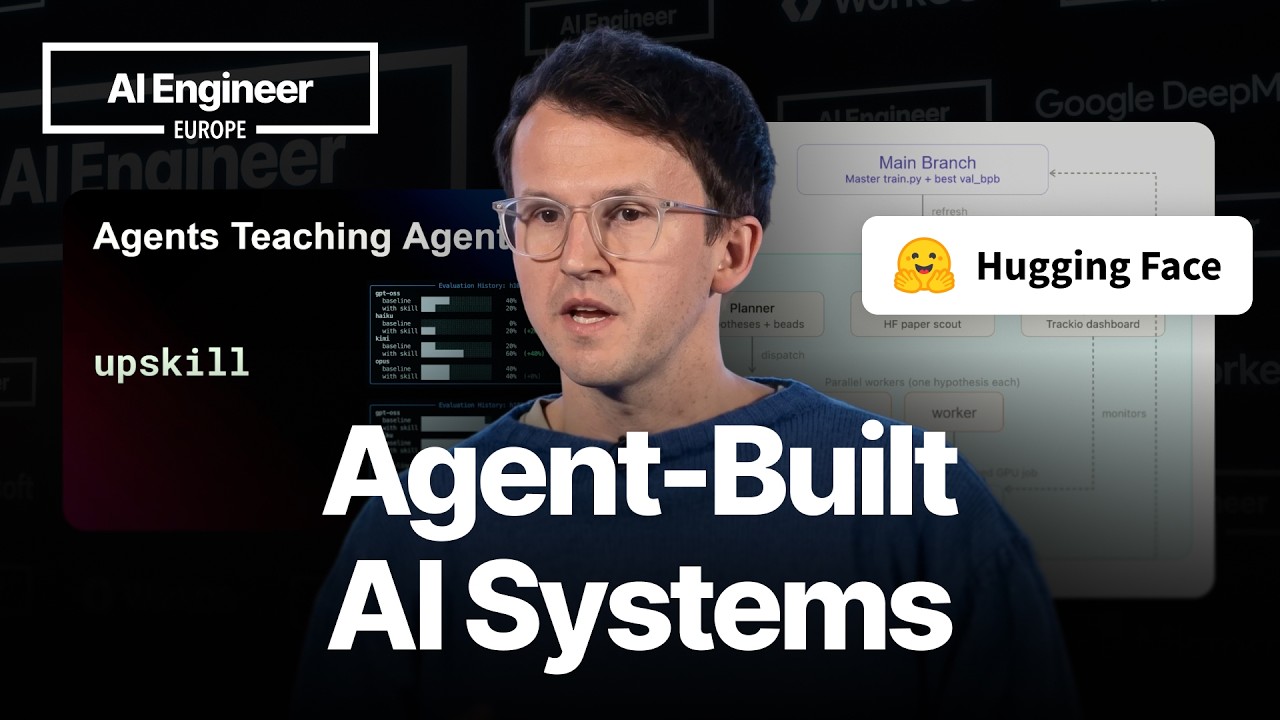
Thomas Wolf, co-founder of Hugging Face, discusses his journey from physics to AI, the power of open-source models to accelerate innovation, the practical challenges of productionalizing AI demos, and why the biggest opportunities for founders now lie in the application layer on top of powerful foundation models.

Introducing Our Approach to Design Document Review Using Business-Specific Large Language Models

Introducing Our Approach to Design Document Review Using Business-Specific Large Language Models

Hitachi's Financial Business Unit developed a specialized LLM to automate the review of system design documents, addressing the inadequacy of general-purpose AI for mission-critical systems. This presentation details the model's development using Continued Pre-training and LoRA on proprietary data, its integration into a multi-agent architecture, and the use of Weights & Biases for MLOps, which led to a 70% reduction in manual review workload.