Mistral: Voxtral TTS, Forge, Leanstral, & Mistral 4 — w/ Pavan Kumar Reddy & Guillaume Lample
Mistral's Pavan (Voxtral lead) and Guillaume (Chief Scientist) discuss the new Voxtral TTS model, its novel architecture using flow matching for efficient, high-quality speech generation. They elaborate on Mistral's strategy of delivering specialized, open-weight models and the Mistral Forge platform, which empowers enterprises to leverage their proprietary data through fine-tuning for privacy, cost-effectiveness, and superior performance. The conversation also covers Mistral Small, the future of AI for science, and the company's commitment to open-source and foundational research, including formal proving as a proxy for long-horizon reasoning.
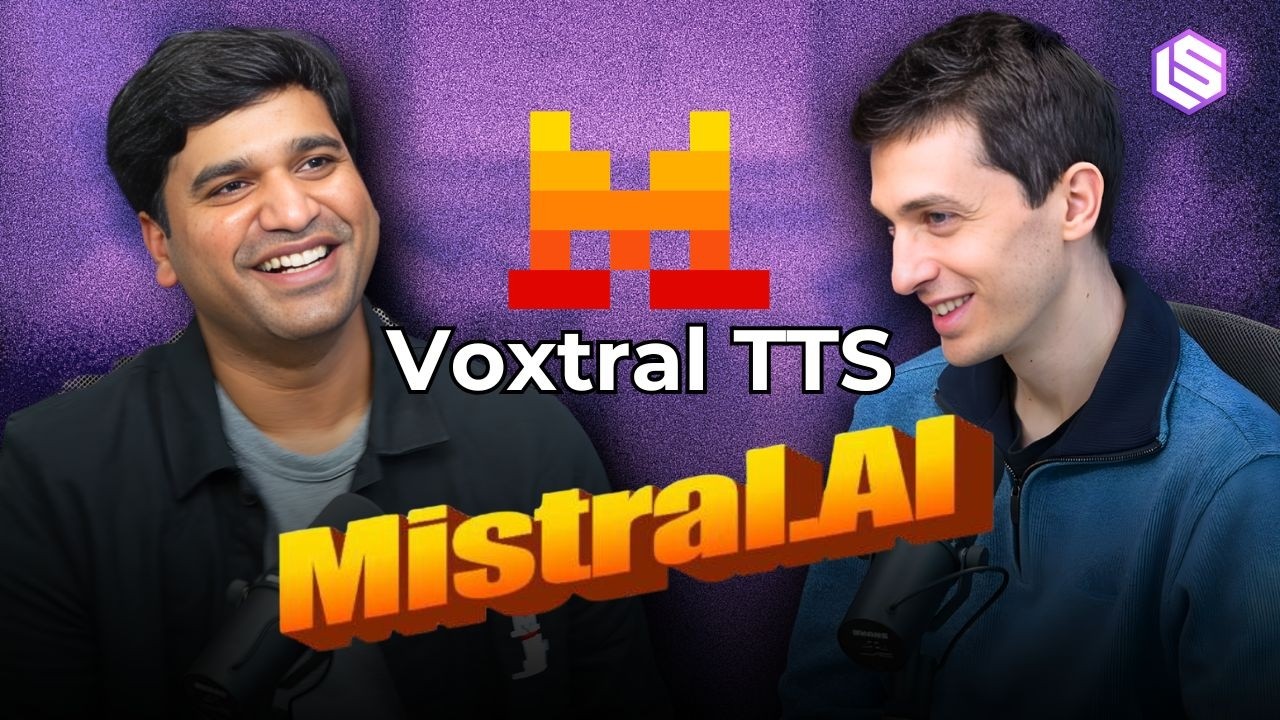
Mistral’s Pavan (Voxtral lead) and Guillaume (Chief Scientist) unveil Voxtral TTS, their latest audio model for speech generation, highlighting its technical advancements and strategic importance within Mistral’s vision.
Voxtral TTS: A Leap in Audio Generation
- Model Overview: Voxtral TTS is Mistral’s first audio generation model, supporting nine languages. It’s a compact 3-billion-parameter (3B) model, praised for its speed, efficiency, and state-of-the-art performance comparable to the best models, but at a significantly lower cost.
- Novel Architecture: The model employs a proprietary, in-house developed architecture featuring an autoregressive flow matching approach. This is paired with a new neural audio codec that converts audio into 12.5 Hz latent tokens, comprising both semantic and acoustic information. The flow matching head takes latent representations from the main transformer, effectively estimating velocity to transform noised latents into 80ms audio frames, which are then passed through a vocoder.
- Addressing Audio Entropy: Unlike text, audio has high entropy due to the diverse ways a single word can be inflected. Traditional depth transformers, which predict multiple tokens autoregressively, can be computationally heavy. Voxtral TTS’s flow matching addresses this by modeling the distribution of possible inflections, allowing for more efficient inference (e.g., in 4 or 16 steps) and better handling of the continuous nature of speech. This specific combination of flow matching in audio is considered novel.
- Real-time Applications: A primary design goal for Voxtral TTS is real-time streaming for applications like voice agents. The autoregressive approach was chosen to facilitate this, processing audio at 12.5 Hz and allowing for long-context generation (e.g., 10 minutes in an 8K context window, 30 minutes in 32K, and potentially hours with 128K context).
Mistral’s Broader Audio Strategy
- Evolution of Audio Models: Mistral’s journey in audio began with audio understanding models like Voxtral ASR (transcription) and real-time transcription models supporting multiple languages and features like context biasing and diarization. Voxtral TTS is seen as a natural extension into speech generation.
- Step-by-Step Development: The long-term goal is to build full-duplex models (simultaneous speaking and listening). Mistral adopts a phased approach, focusing on core capabilities like transcription and speech generation before merging them into a more complex, unified system.
- Unified Modeling: The aim is to treat audio generation as an additional head to their transformer decoder models, simplifying eventual end-to-end audio-text native modeling.
Mistral’s Approach to Enterprise AI and Open Source
- Specialized vs. General Models: Mistral believes in building specialized, efficient models for specific use cases (e.g., a 3B model for TTS) rather than a single, expensive, general-purpose model. This allows for cost-effective solutions for customers.
- Mistral Forge Platform: This platform provides customers with tools for data processing, fine-tuning, and deployment, either on-premise or in private clouds. This addresses critical privacy and data sensitivity concerns, ensuring data remains within the company.
- Leveraging Proprietary Data: A core value proposition is enabling customers to fine-tune Mistral models on their unique, often decades-worth of proprietary data (sometimes trillions of tokens). This dramatically improves model performance beyond generic closed models, providing a significant competitive advantage and avoiding the need for large context windows at inference.
- Custom Solutions: Mistral actively builds tailored solutions, such as models trained specifically for low-resource or specific dialects, offline models for environments like cars, and models with advanced function-calling capabilities.
- Cost Efficiency: By fine-tuning, customers can achieve comparable or superior performance at significantly lower costs (e.g., 10x cheaper) compared to relying on expensive closed-source APIs for production.
- Commitment to Open Source: Mistral is a strong proponent of the open-source ecosystem, releasing models and detailed technical reports (e.g., for Mistral of Experts and real-time audio models). They believe in democratizing access to powerful AI, fostering scientific advancement, and avoiding a future where intelligence is controlled by a few.
Mistral Small and Future Research Directions
- Mistral Small: This model represents a significant step in Mistral’s strategy, merging previously separate specialized models (for instruction following, coding, reasoning, and even vision via Pextral) into a single, more capable unit. It features a sparse 6B active parameters and a 256K context window.
- AI for Science: Mistral is actively exploring the application of AI in scientific domains like physics and material science, partnering with companies (e.g., ISM Electrónica) to find