Feature

Research to Reality: Bringing Frontier ML Research to Production - Vaidas Razgaitis, Higharc

Research to Reality: Bringing Frontier ML Research to Production - Vaidas Razgaitis, Higharc

Vaidas Razgaitis, Senior Research Engineer at Higharc, shares three tactical tips to accelerate the transition of novel AI/ML research into production-ready features. He emphasizes addressing the critical handoff challenge between ML researchers and software engineers through structured documentation (Research Prototype Taxonomy Document), a well-organized monorepo utilizing decoupled microservices, and a systematic approach to code decomposition and PR review. These strategies aim to improve legibility, maintainability, and delivery speed for ML-driven products.

Using Spec-Driven Development for Production Workflows - Erik Hanchett, AWS

Using Spec-Driven Development for Production Workflows - Erik Hanchett, AWS

Erik Hanchett discusses spec-driven development (SDD) as a structured approach to building complex software features with AI coding assistants. He explains how to guide AI "interns" through distinct phases of requirements, design, and implementation, emphasizing context management, the use of "skills," and the crucial role of the human in the loop for review. Hanchett highlights AWS's Kiro tool, which automates much of this process, and the Model Context Protocol (MCP) for integrating external data sources, offering a pathway to higher-quality code and more effective AI collaboration.

OpenAI Codex lead on the new shape of product work | Andrew Ambrosino

OpenAI Codex lead on the new shape of product work | Andrew Ambrosino

Andrew Ambrosino, Product and Engineering Lead for the Codex app at OpenAI, details how AI is transforming product development, shifting focus from implementation to curation and the crucial role of "taste." He discusses AI's current limitations in design, the evolving nature of product roles, and OpenAI's "zone defense" approach to product management. Ambrosino shares his personal workflow with Codex and outlines the vision for it as an intelligent "home base" that orchestrates work across various applications, exemplified by a story of Codex building a Premiere Pro extension.

The Promptware Kill Chain: How Prompt Injection Becomes AI Malware

The Promptware Kill Chain: How Prompt Injection Becomes AI Malware

Promptware introduces a new class of AI malware leveraging prompt injections to exploit architectural flaws in LLMs. This summary details The Promptware Kill Chain, covering stages from initial access and jailbreaking to persistence, lateral movement, and real-world impact. It emphasizes the critical need for a Zero Trust approach, treating AI agents as hostile runtimes to defend against these sophisticated AI-native threats.

India Can Create The Largest AI Companies

India Can Create The Largest AI Companies

This panel from Startup School India explores why India's technical talent is poised to lead the global AI wave, challenging traditional career advice. It highlights Y Combinator's focus on young, high-agency founders who leverage AI for rapid prototyping and embrace 'second mover advantage' to build global companies, emphasizing customer obsession and relentless resourcefulness.

Plenary Talk 3: Challenges and Research Opportunities for Global Hyperscale Services

Plenary Talk 3: Challenges and Research Opportunities for Global Hyperscale Services

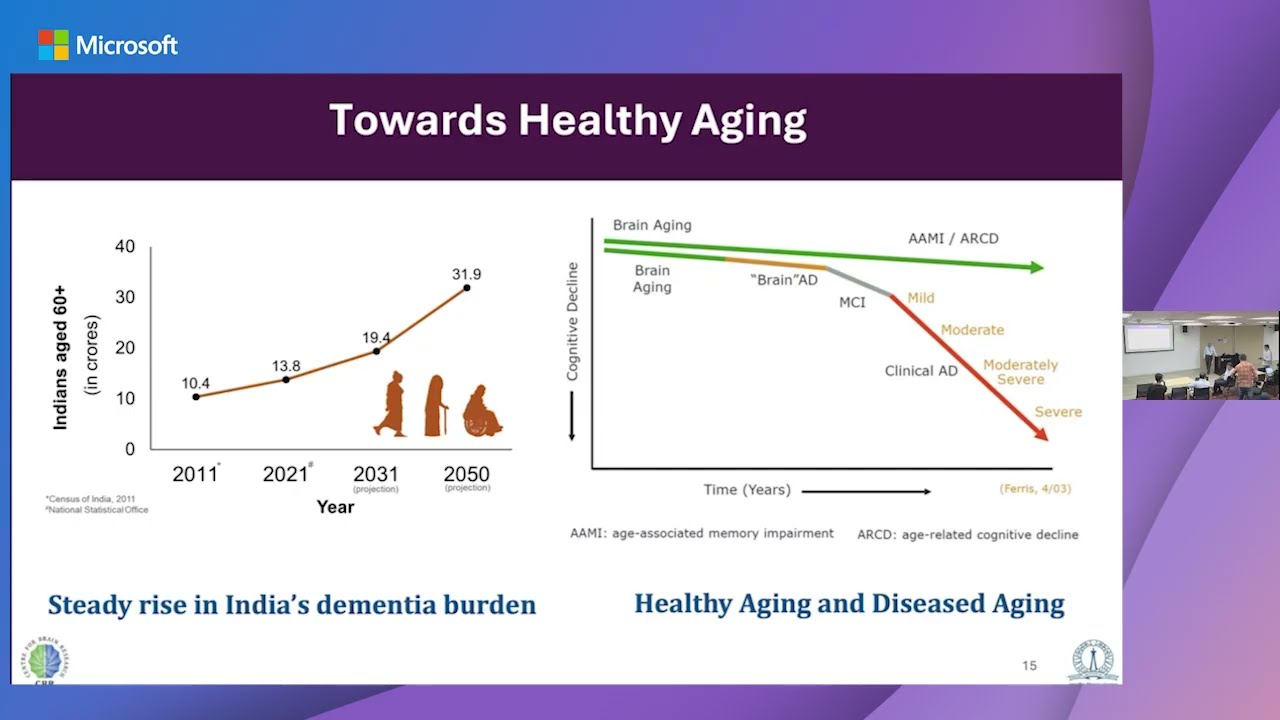
This talk provides a comprehensive overview of cellular aging, brain function, and the mechanisms of cognitive decline, particularly focusing on Alzheimer's disease. It delves into the role of various cell types, neural communication, and methods for assessing cognition. The speaker highlights research challenges, the limitations of current pharmacological interventions, and the critical importance of non-pharmacological lifestyle interventions. A significant portion of the discussion is dedicated to the Centre for Brain Research's (CBR) multi-disciplinary efforts in India, including large-scale cohort studies, multimodal data collection, and the development of AI-driven tools and a localized foundation model for the Indian brain to address neurodegeneration.