Plenary Talk 3: Challenges and Research Opportunities for Global Hyperscale Services
This talk provides a comprehensive overview of cellular aging, brain function, and the mechanisms of cognitive decline, particularly focusing on Alzheimer's disease. It delves into the role of various cell types, neural communication, and methods for assessing cognition. The speaker highlights research challenges, the limitations of current pharmacological interventions, and the critical importance of non-pharmacological lifestyle interventions. A significant portion of the discussion is dedicated to the Centre for Brain Research's (CBR) multi-disciplinary efforts in India, including large-scale cohort studies, multimodal data collection, and the development of AI-driven tools and a localized foundation model for the Indian brain to address neurodegeneration.
Understanding Cellular Aging and Neurodegeneration
The talk differentiates between healthy and senescent cells. Healthy cells can divide, produce energy, and perform metabolic functions. The Hayflick Limit defines the finite divisions for human cells (40-60). Senescent cells stop dividing but remain metabolically active, secreting substances harmful to healthy cells. Telomere shortening is a key indicator of cellular aging.
Crucially, neurons largely do not divide after birth; most are formed pre-birth. Brain growth after birth is primarily due to glial cells (astrocytes for nutrition, oligodendrocytes for myelin, and microglia for waste removal), which are vital support systems. Demyelination, for instance, leads to slower neural responses.
Neural Communication and Cognition
Neural communication within a cell (intracellular) is “wired,” involving ion channels (sodium, potassium) and action potentials. A neuron fires only if its resting potential (-70mV) is raised to a threshold (-55mV), spiking to +40mV. This spike propagates along the axon, accelerated by myelin. Communication across cells (intercellular) at synapses is akin to “wireless” transfer.
Cognition is broadly defined as all forms of knowing and awareness, including perception, reasoning, and problem-solving. Cognitive decline in healthy aging is not neuron death, but failure of the glial environment; sleep is vital for waste removal.
Cognitive Decline: Measurement and Indian Context
Cognition is measured using assessment tools like MoCA, CDR, and MMSE (including Indian versions), which yield scores. The Clinical Dementia Rating (CDR) classifies individuals: 0 (healthy), 0.5 (Mild Cognitive Impairment - MCI), and >0.5 (diseased). This is viewed as a classification problem from an engineering perspective.
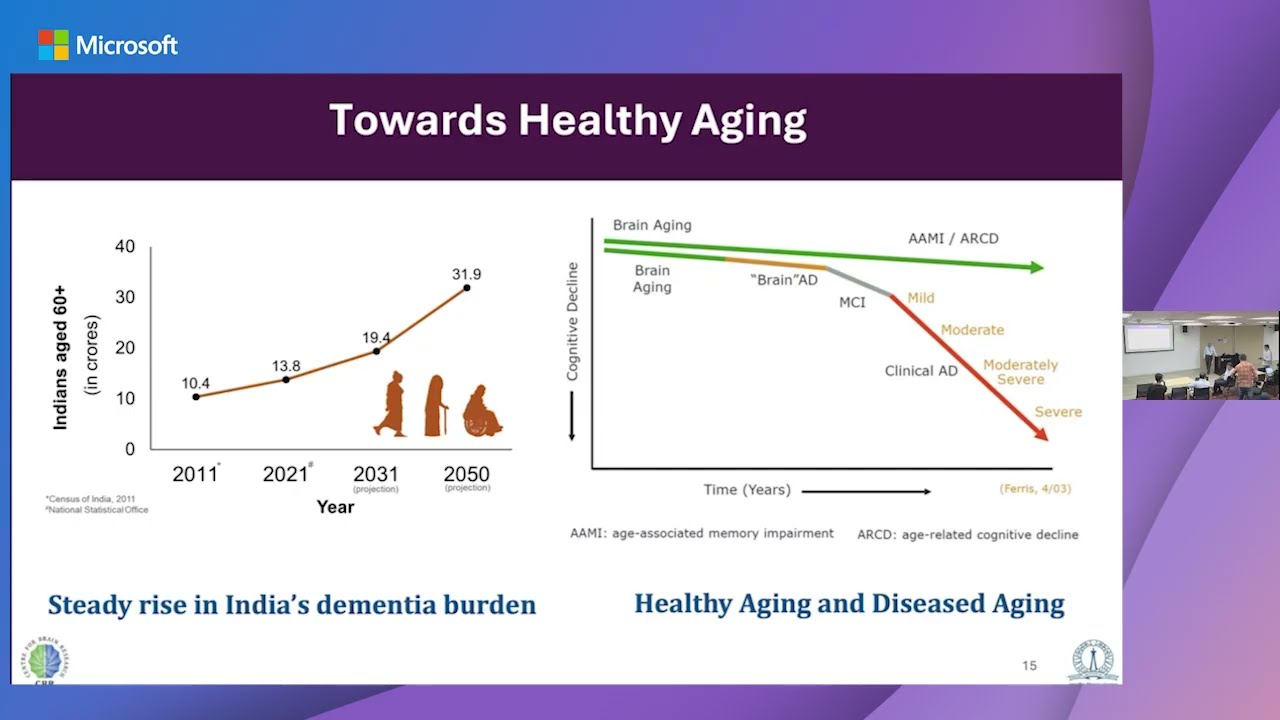
In India, increased life expectancy and co-morbidities (occurring ~10 years earlier than in Caucasian populations) accelerate pathology. Early detection is crucial to prevent the steep decline from MCI. Dementia is an umbrella term encompassing various conditions, not just occasional forgetfulness.
Alzheimer’s Pathology and Biomarkers
Alzheimer’s pathology involves amyloid-beta plaques (protein aggregates outside neurons) and tau tangles (malformed tau proteins inside neurons), both disrupting neural communication. Plaques develop over 15-20 years before clinical manifestation; their cause is unknown. Detection traditionally used Cerebrospinal Fluid (CSF) analysis and PET amyloid imaging (expensive, radioactive). Recent advancements enable blood-based biomarkers by amplifying extremely low protein concentrations (picograms per milliliter).
Research Framework, Interventions, and Challenges
The WHO blueprint for aging brain research emphasizes population data, disease mechanisms, biomarkers, and risk factors (e.g., cardiovascular health, stress). Non-pharmacological interventions are currently the most promising: diet, sleep, exercise, and diverse social connectedness. Current pharmacological interventions only slow decline (e.g., 6 months delay for a $25,000 drug), underscoring that prevention is better than cure. A major challenge is that drugs successful in rodent models often fail in human clinical trials.
CBR’s Multi-disciplinary Approach and the Indian Brain Project
Addressing neurodegeneration requires a multi-disciplinary effort involving clinicians, neurobiologists, genomics, proteomics, neuroimaging, AI, and data scientists. The Centre for Brain Research (CBR) at IISc is building multimodal data cohorts: 1,000 urban (since 2015) and 10,000 rural subjects (since 2018), collecting 5GB per visit, totaling 2 petabytes. Preliminary findings show higher MCI in rural cohorts (20% vs. 8% urban), potentially due to undiagnosed co-morbidities. Reduced hippocampal volume correlates with MCI.
Protective factors include diverse social networks, multilingualism, Karnatic music training, and regular physical activity. Hearing loss is an early indicator of neurodegeneration, highlighting the need for affordable, high-quality hearing aids. A significant challenge is the lack of extensive diseased data in India; CBR plans a national cohort network.
Digital Biomarkers and the Future of Brain Health
The speaker advocates for digital biomarkers (“digital is the new blood”) through high-frequency data collection from wearables, recognizing cognition as highly personalized. Digital assessments can include speech, facial expressions, pupillary dilation, and fine motor skills. CBR’s future pillars include a national cohort network, AI integration (AI Conclave, AI Challenge), and a Foundation Model for the Indian Brain. This localized AI model is crucial because existing Western models often fail on Indian neuroimaging and clinical data. Translational activities focus on developing affordable, point-of-care screening and diagnostic tools. The ultimate goal is to generate risk scores, diagnostics, and trajectory trackers for cognitive health, enabling personalized, data-driven lifestyle interventions.