Feature

Inside a Game Where AI Agents Never Sleep

Inside a Game Where AI Agents Never Sleep

Isaac Lee of NEXUS explains why he wants to fill MMORPGs with agent players instead of scripted NPCs to bootstrap multiplayer worlds, and walks through NEXUS's AI lab: text-to-3D world building, novel-to-video pipelines, pixel animation loops, the Da Vinci multi-agent dev framework, self-hosted inference after Kimi, the Bob meeting assistant, and the implications of agentic shopping for e-commerce.

Why We Deleted Our MCP Server and Rebuilt It — Abhi Arya, Reducto

Why We Deleted Our MCP Server and Rebuilt It — Abhi Arya, Reducto

Abhi Arya from Reducto shares how the team went from a one-tool-per-endpoint MCP server that confidently built workflows nobody could explain to a design that makes uncertainty visible, asks instead of guessing, and improves itself through instrumentation. The talk centers on one question: who pays when the agent is wrong?

NVIDIA Vera CPU: The Foundation for Agentic AI

NVIDIA Vera CPU: The Foundation for Agentic AI

NVIDIA presents Vera, a CPU designed for agentic AI workloads such as tool calls, code execution, sandboxes and reinforcement learning loops. The talk traces how cloud economics shaped CPU design toward high core counts at the expense of per-core speed, then explains how Vera's Olympus core, monolithic fabric and LPDDR5X memory deliver high single-threaded performance at scale. CoreWeave then shares its early results running Vera for sandboxes and agent workloads.

Building the Cloud for AI Agents | AWS CEO Matt Garman

Building the Cloud for AI Agents | AWS CEO Matt Garman

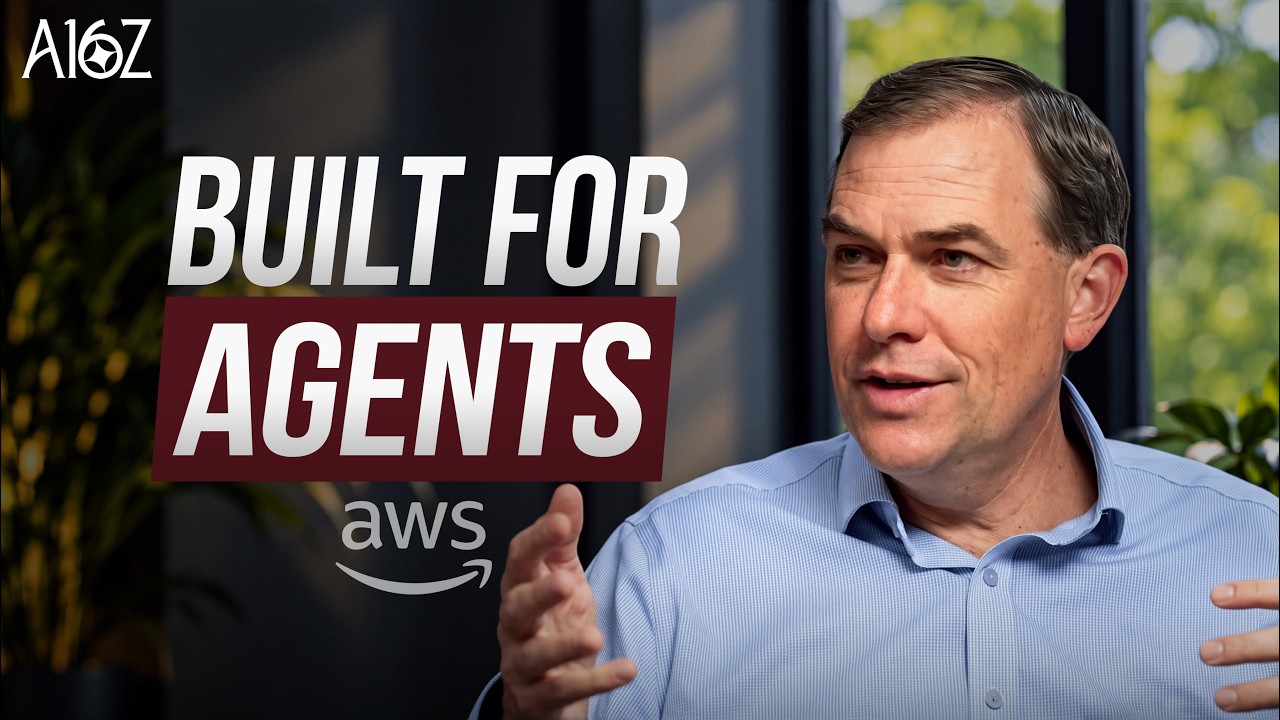
a16z's Raghu Raghuram interviews AWS CEO Matt Garman about how AI is reshaping cloud infrastructure: why startups remain central to AWS, how cloud primitives like databases, permissions, and sandboxes must be rethought for agents, how GPU capacity is allocated amid $220B in capex, and how Graviton and Trainium fit into the AI stack. The discussion also covers enterprise barriers to autonomous agents, data privacy with Bedrock, and AWS's own internal use of agents.

Giving AI Agents Memory That Learns — Jake Broekhuizen, LangChain

Giving AI Agents Memory That Learns — Jake Broekhuizen, LangChain

Jake Broekhuizen of LangChain Labs argues that observability alone does not make agents improve. Using a financial services agent whose tone drifted from advisory to pushy, he shows how traces only become useful memory when a filtered lesson is written back as durable context the agent reads on its next run. The talk covers semantic, episodic, and procedural memory, the working versus long-term memory distinction, the read-write cycle, and how LangSmith and Context Hub support capture, analysis, and updates, along with lessons about keeping only signal, caching, and human review of procedural changes.

AI Tokenomics Explained

AI Tokenomics Explained

A product and go-to-market lead at NVIDIA examines the economics of AI inference as agentic AI multiplies token demand. The talk covers matching premium versus efficient models to use cases, model routing, open models, sizing token demand, and extreme co-design across mixture-of-experts models, NVLink systems, KV caching, software stacks, and CPUs to maximize tokens per watt and minimize cost per token.