Feature

Every Software Org is Dysfunctional • R. Parsons, G. Hohpe, B. O'Reilly & A. Harmel-Law • GOTO 2025

Every Software Org is Dysfunctional • R. Parsons, G. Hohpe, B. O'Reilly & A. Harmel-Law • GOTO 2025

A panel of distinguished architects—Rebecca Parsons, Gregor Hohpe, Barry O'Reilly, and Andrew Harmel-Law—discuss the multifaceted world of software architecture. They explore the inevitability of organizational dysfunction, the critical role of architects in decision-making, and the impact of non-deterministic technologies like Generative AI and quantum computing on system design and organizational change.
The most successful AI company you’ve never heard of | Qasar Younis

The most successful AI company you’ve never heard of | Qasar Younis

Qasar Younis, CEO of Applied Intuition, discusses the future of AI, arguing its most significant near-term impact will be in physical industries like farming, mining, and construction. He shares his philosophy on building a company quietly, the importance of early traction, and the core values that drive Applied Intuition, while also offering a nuanced perspective on China's AI capabilities and how to develop leadership taste.

4 Ways AI Agents Should Behave for Smarter Systems

4 Ways AI Agents Should Behave for Smarter Systems

Grant Miller challenges the "Hollywood view" of AI super agents, proposing a shift towards collaborative, specialized agentic systems. He introduces a framework for categorizing agents based on their risk and capability, detailing how to design safer, more effective AI applications by minimizing access, implementing dynamic controls, and incorporating a human-in-the-loop for high-risk tasks.

AI Won't Replace You—But Someone Using AI Will

AI Won't Replace You—But Someone Using AI Will

In this episode, Ben Lorica and Evangelos Simoudis discuss how AI is fundamentally reshaping the modern workplace. They explore the necessary evolution of knowledge work, from a focus on routine execution to problem definition and spec-driven development, and outline the critical skills professionals must cultivate—including rapid experimentation, AI agent orchestration, and systems thinking—to remain valuable and navigate a more volatile labor market.

CROSS — Leveraging AI ASICs for Homomorphic Encryption

CROSS — Leveraging AI ASICs for Homomorphic Encryption

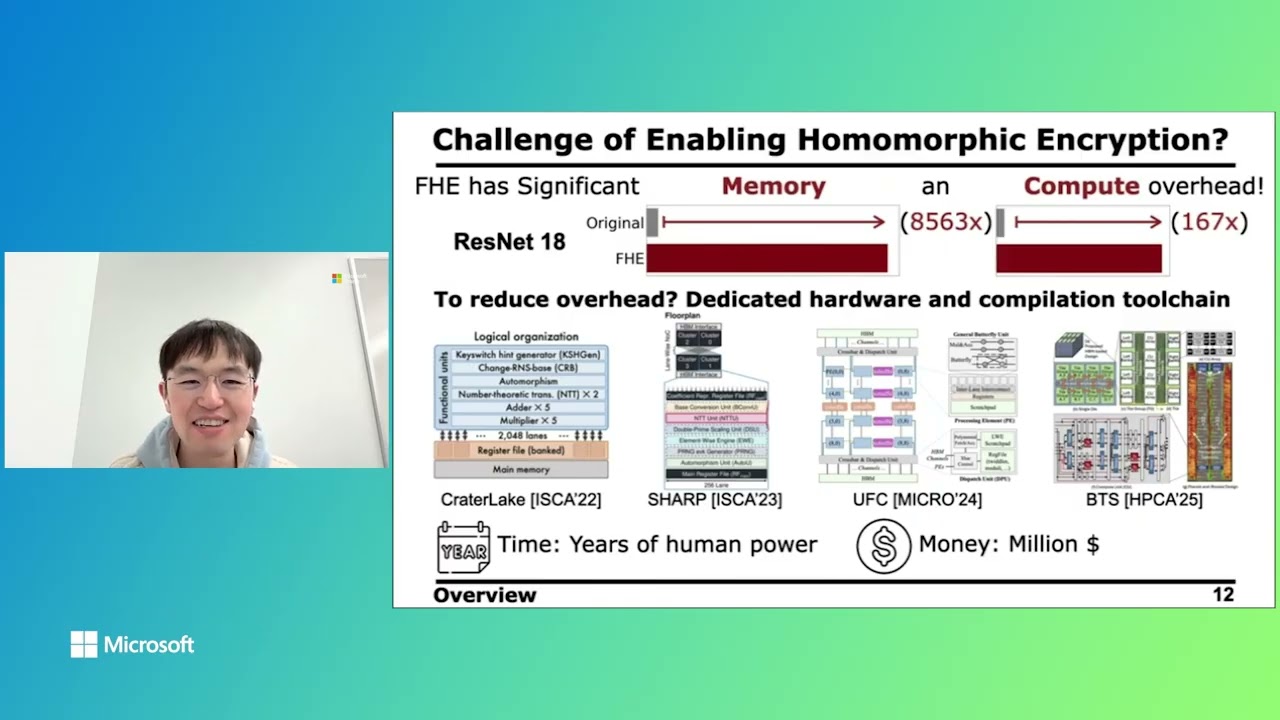
The talk presents CROSS and Morph, two compiler frameworks that enable existing AI accelerators, like Google's TPUs, to efficiently execute cryptographic workloads. CROSS focuses on Homomorphic Encryption (HE) and Morph on Zero-Knowledge Proofs (ZKP), demonstrating how to transform high-precision modular arithmetic into low-precision matrix operations that TPUs excel at, thereby achieving state-of-the-art performance and energy efficiency without any hardware modifications.

Efficient Distributed Orthonormal Optimizers for Large-Scale Training

Efficient Distributed Orthonormal Optimizers for Large-Scale Training

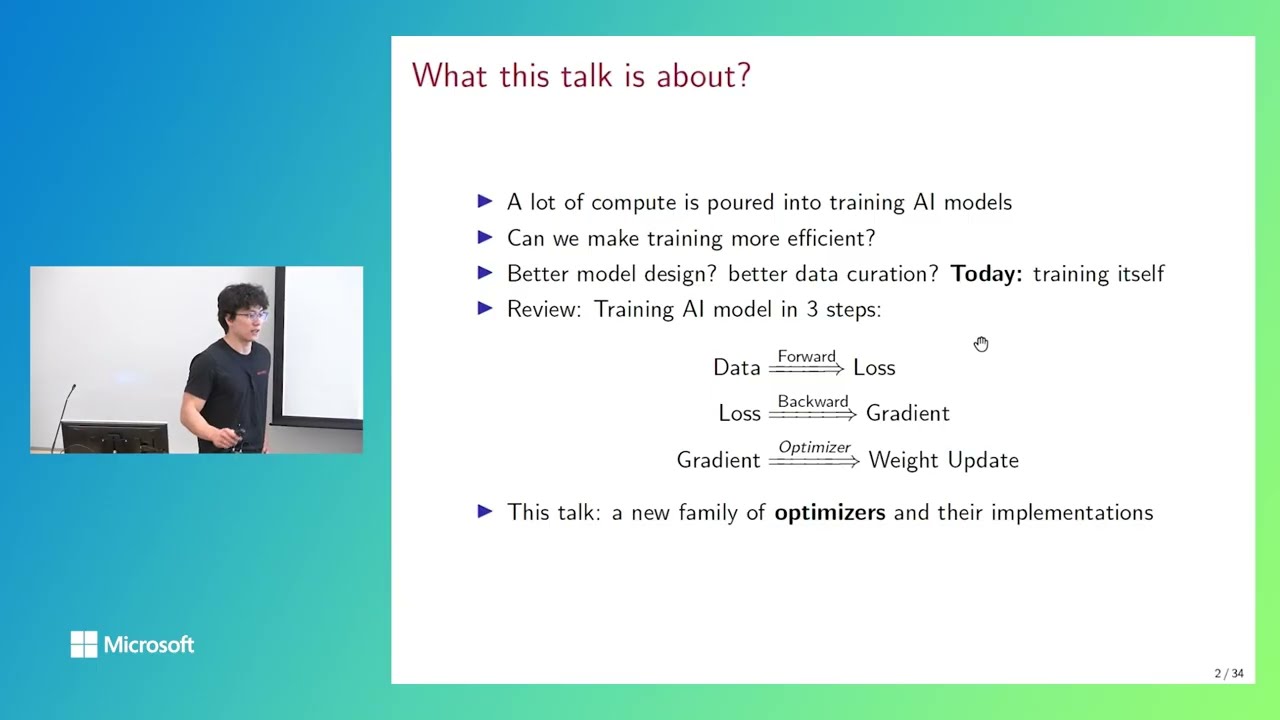
Kwangjun Ahn from Microsoft Research provides a technical overview of orthonormal optimizers (like Muon and Dion2), a new class of algorithms for large-scale AI model training that are emerging as powerful successors to AdamW. The talk covers their theoretical foundations, empirical benefits, distributed implementation strategies, and practical guidelines for integration into modern training pipelines.