Embeddings

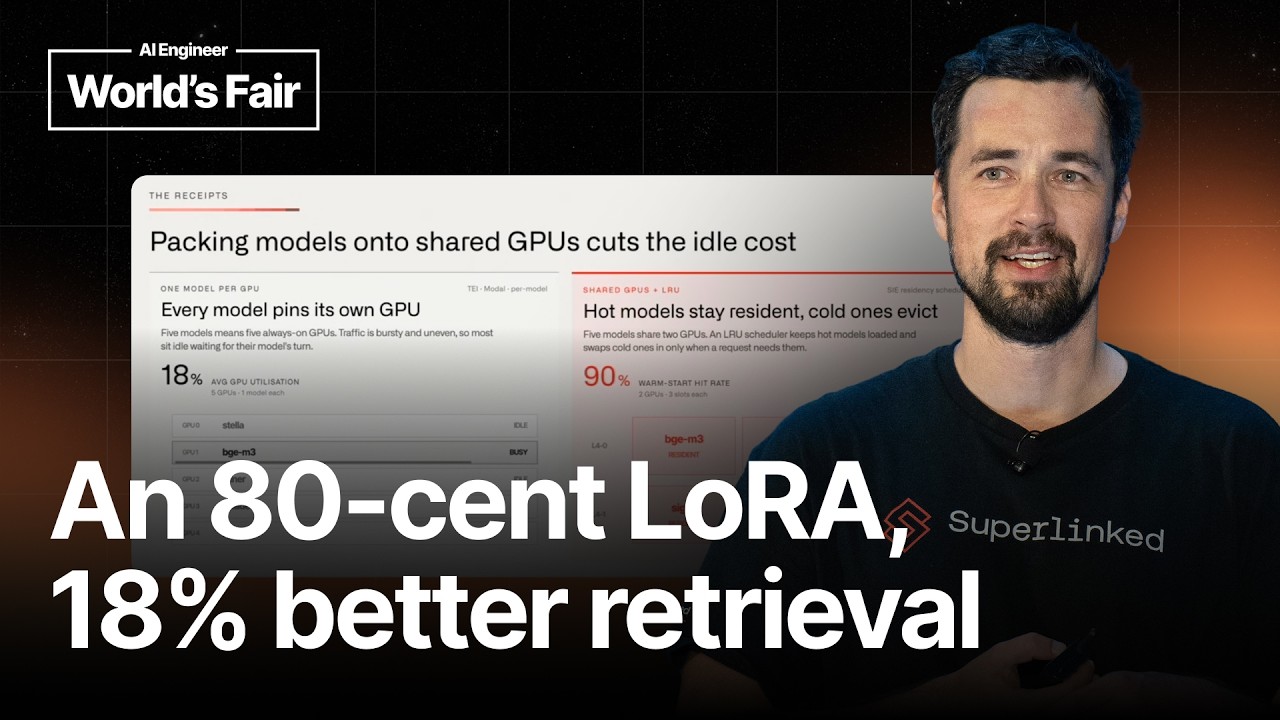
Large clusters for small models — Daniel Svonava, Superlinked

Large clusters for small models — Daniel Svonava, Superlinked

Daniel Svonava argues that small open-source models, when specialized and properly served, can achieve frontier performance for specific tasks, offering significant cost savings and latency improvements over large, generalized models or managed endpoints. He highlights challenges with existing serving infrastructure for a fleet of diverse small models and introduces Superlinked's open-source solution, which leverages a pull-based, centralized queuing system, a Rust sidecar for runtime abstraction, and an autoresearch loop for automated model tuning, enabling high throughput (e.g., half a million embedding tokens/sec on one GPU) and efficient deployment of specialized models and LoRAs.
The Search Engine for the Agentic Web — Will Bryk, Exa

The Search Engine for the Agentic Web — Will Bryk, Exa

Exa's CEO, William Bryk, discusses the impending AI search boom, predicting machines will soon outpace human searches dramatically. He explains Exa's evolution from a consumer search engine to an API for AI agents, driven by the realization that LLMs need external, 'perfect' retrieval to overcome the limitations of traditional search and combat societal misinformation. Exa leverages neural networks, embeddings, and customized features to provide fast, accurate, and cost-efficient information, with plans for a private data marketplace, aiming to deliver 'a year of research in a second' for AI agents and foster a deeply informed society.

Essential Skills for Becoming an AI Engineer: RAG, AI Agents, & More

Essential Skills for Becoming an AI Engineer: RAG, AI Agents, & More

Cedric Clyburn outlines the essential skills for AI engineering, distinguishing it from ML research. He details a three-tier skill stack covering foundational programming (Python, Git, APIs), AI-specific techniques (embeddings, RAG, AI agents), and deployment strategies (containerization, observability). The discussion emphasizes judgment over code generation and highlights key use cases like RAG systems and agent-based solutions.

Why Most AI Agents Fail Horribly

Why Most AI Agents Fail Horribly

Maarten Grootendorst discusses the foundational understanding developers need for modern AI tools, emphasizing core LLM concepts like tokens, embeddings, and attention. He provides a pragmatic view on AI agents, distinguishing hype from practical applications like coding assistants, and explores the role of memory, guardrails, and the growing importance of open-weight models for control and efficiency in AI infrastructure.

AI & Data Science Periodic Tables: How They Work Together

AI & Data Science Periodic Tables: How They Work Together

Aaron Baughman and Martin Keen present a unified framework using "periodic tables" to integrate AI and Data Science. They illustrate how elements like pipelines, embeddings, and RAG combine to build real-world AI applications, using a detailed document Q&A system example. The discussion emphasizes the critical interdependence of data science in grounding AI models and ensuring continuous improvement through an innovative feedback loop.

What Are Large Database Models? AI for SQL Data

What Are Large Database Models? AI for SQL Data

Martin Keen introduces Large Database Models (LDMs), a new AI paradigm that brings advanced analytical capabilities directly into SQL and relational databases. This allows for semantic queries on the 99% of enterprise data traditionally locked away, enabling faster, more secure insights without costly data movement.