Distributed systems

The New Primitives: Building AI Native Software — Kwindla Kramer, Daily

The New Primitives: Building AI Native Software — Kwindla Kramer, Daily

Kwindla Hultman Kramer argues that current AI agents are akin to 1995 web pages – a foundational primitive, not the ultimate destination. Drawing a historical parallel, he predicts the emergence of "AI native software" that will build upon and surpass agents, much like web applications evolved from simple web pages. He illustrates this through computing history, highlighting transformative shifts like VisiCalc's impact on accounting and the vision of Apple's Knowledge Navigator, and concludes by showcasing a game, Gradient Bang, that demonstrates the core primitives of this future AI native software.
MCP Tasks (async): Why Aren't Any Agents Supporting Them? — Cornelia Davis, Temporal

MCP Tasks (async): Why Aren't Any Agents Supporting Them? — Cornelia Davis, Temporal

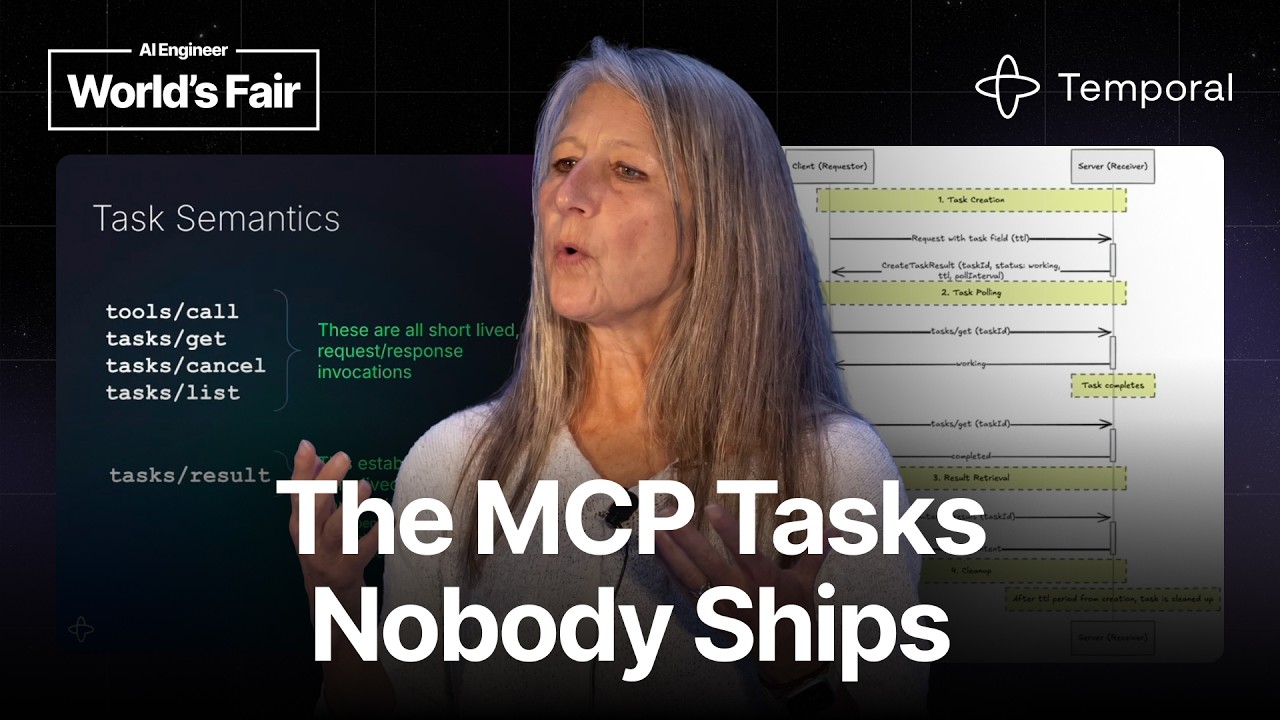
Cornelia Davis explains why the MCP tasks specification, designed for durable, long-running, and interactive operations, hasn't seen widespread adoption. She details V1's architectural flaws, particularly concerning scalability and stateful human-in-the-loop interactions, and introduces V2's shift to a stateless core, client-initiated updates, and a clearer path for client-side durability, while outlining future work on scaling and adoption.

Jeff Dean: The 1% Rule for Building in AI

Jeff Dean: The 1% Rule for Building in AI

Jeff Dean discusses the evolution of AI, drawing parallels between Google's past breakthroughs (like fitting search in RAM and the origin of TPUs) and current challenges. He emphasizes that AI is becoming an energy problem, driving the need for specialized inference hardware. Dean highlights 'context engineering' and multi-agent systems as crucial for long-running, complex AI tasks, and offers advice for startups on finding niches where they can outperform larger entities by focusing on specific domains, data, and models. He stresses the importance of clear specifications for agents and 'taste' in problem selection, encouraging founders to question fundamental assumptions and automate the scientific method to build 'AI that builds AI.'

Developer Productivity at a Developer Productivity Startup • Robert-Jan "RJ" Huijsman • GOTO 2025

Developer Productivity at a Developer Productivity Startup • Robert-Jan "RJ" Huijsman • GOTO 2025

Robert-Jan Huijsman, Founding Engineer at Reboot.dev, outlines a pragmatic approach to developer productivity by tackling friction and non-determinism in both human collaboration and software development. He shares Reboot.dev's strategies, including async workstreams, full-stack typing, unit testing with AI, and foundational engineering principles like retries, durable execution, and strong consistency, to build reliable and efficient systems.

Your Agent Didn't Fail. Your Harness Did. — Vinoth Govindarajan, OpenAI

Your Agent Didn't Fail. Your Harness Did. — Vinoth Govindarajan, OpenAI

Vinoth Govindarajan's talk addresses critical 'harness failures' in AI agents, arguing these, rather than model errors, are the root cause of most production incidents. He introduces the core contract: 'A model proposes, the harness commits, and a receipt proves it,' and outlines five key boundaries (state ownership, ordering, deadlines, authority, user-visible proof) that lead to failures like silent success and incomplete reality. The talk culminates in a practical 'run receipt audit' with five questions to diagnose and ensure reliable agent behavior.

Serving 2 Million Models Without Melting: Scaling the Hugging Face Hub — Arek Borucki, Hugging Face

Serving 2 Million Models Without Melting: Scaling the Hugging Face Hub — Arek Borucki, Hugging Face

Arek Borucki details how Hugging Face scales its infrastructure to serve millions of models and users, focusing on the evolution of search architecture using MongoDB Atlas and Apache Lucene, robust database scaling with a seven-node cluster and sharding, and dynamic frontend autoscaling with Kubernetes and KEDA to ensure an instant, seamless user experience.