Cursor

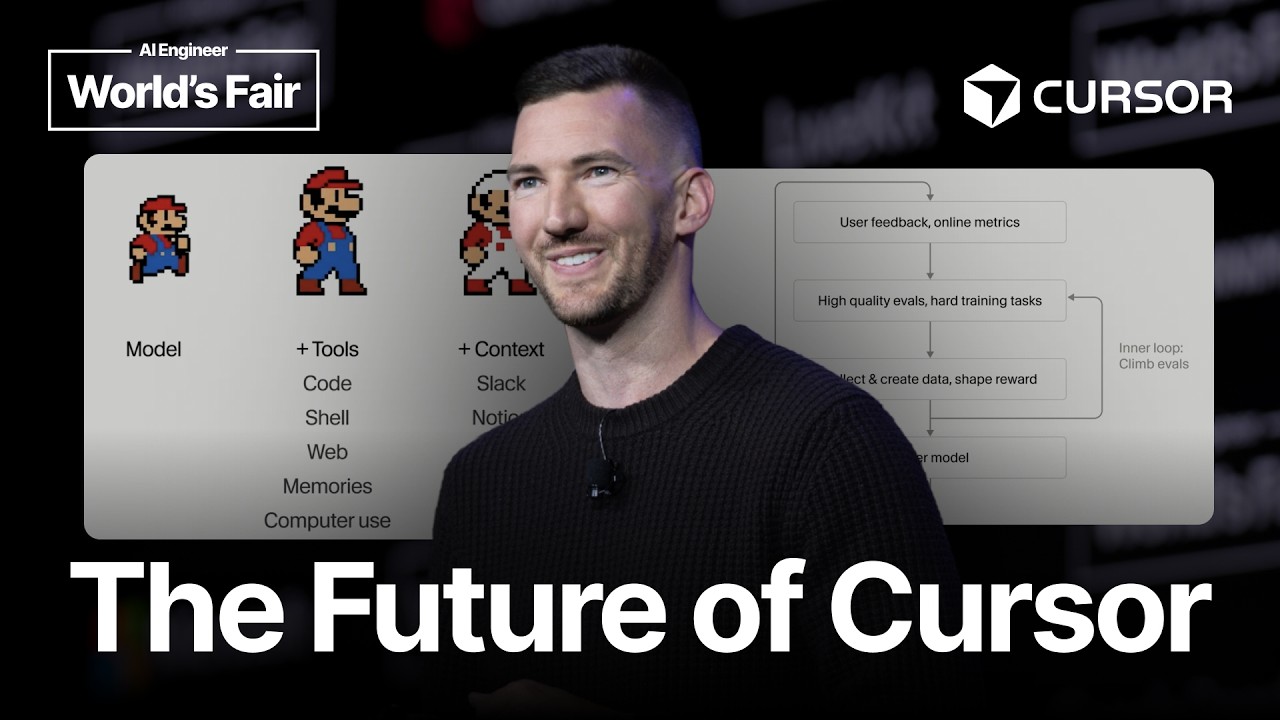
Recursive Model Improvement — Lee Robinson, Cursor, SpaceXAI

Recursive Model Improvement — Lee Robinson, Cursor, SpaceXAI

Lee Robinson of Cursor outlines a comprehensive strategy for recursive AI model improvement, centered on a two-loop training framework. He details how Cursor enhances both user-feedback-driven outer loops and high-quality evaluation inner loops, introducing novel methods like textual feedback and addressing reward hacking. The discussion extends to scaling compute infrastructure through partnerships with SpaceX, Colossus, and Terafab, and leveraging agent-based automation to streamline research and foster a future where models continuously train and improve themselves.
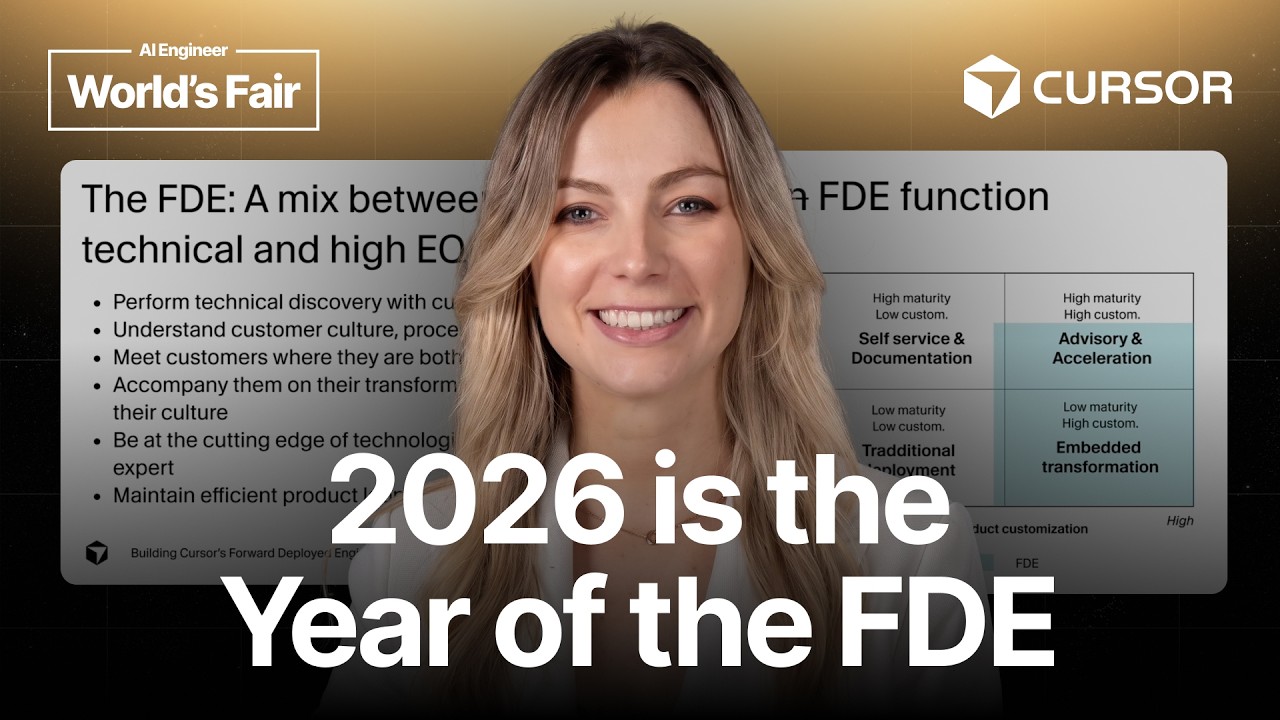
Forward Deployed Engineering at Cursor — Pauline Brunet

Forward Deployed Engineering at Cursor — Pauline Brunet

Pauline Brunet, VP of Forward Deployed Engineering at Cursor, details how FDE drives AI adoption in enterprises. She distinguishes FDE from traditional services, outlines the 'magical unicorn' FDE profile, shares Cursor's project-based co-development approach, and offers best practices for team structure, customer engagement, and measuring ROI.

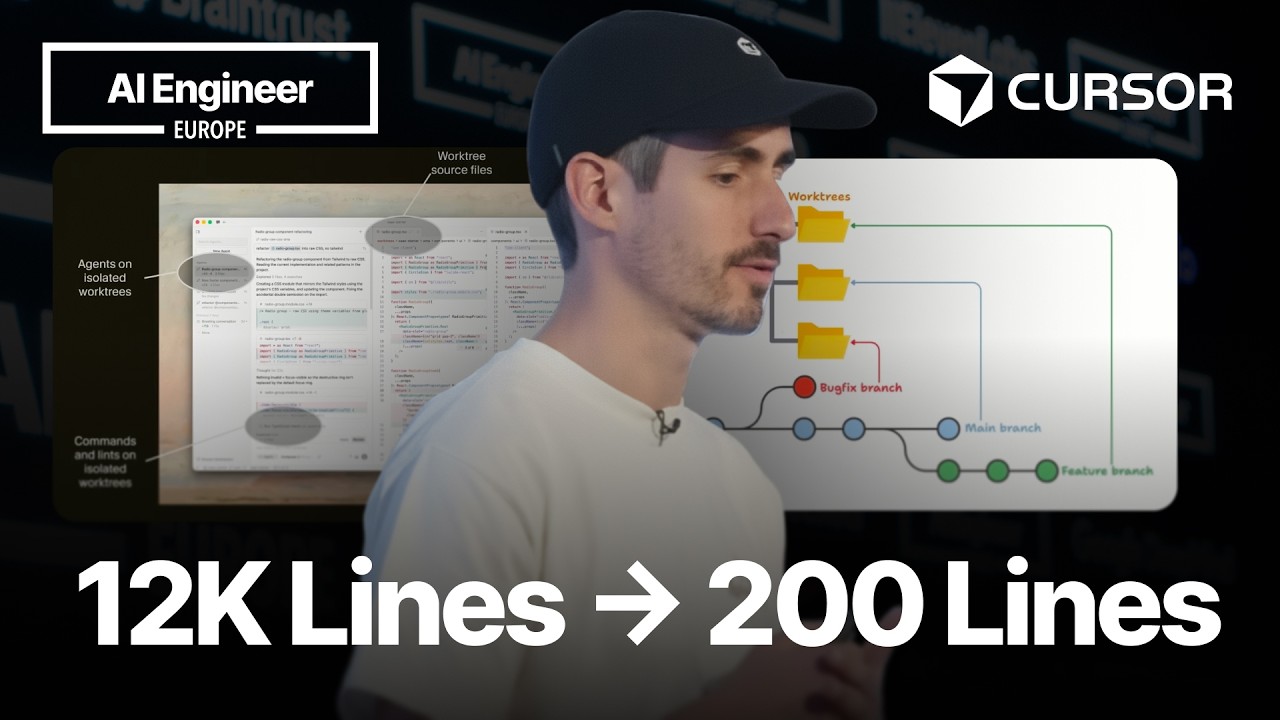
Replacing 12K LoC with a 200 LoC Skill — David Gomes, Cursor

Replacing 12K LoC with a 200 LoC Skill — David Gomes, Cursor

David Gomes from Cursor explains their transition from a complex, 15,000-line Git WorkTrees feature to a lightweight, flexible solution built on Markdown prompts. He details how 'Skills' and 'Sub-agents' recreated parallel coding workflows, and discusses the trade-offs, failure modes, and lessons learned from shifting product logic from hard code to natural language instructions.

Building your own software factory — Eric Zakariasson, Cursor

Building your own software factory — Eric Zakariasson, Cursor

Eric Zakariasson from Cursor explains the shift from single-agent pair programming to managing a multi-agent "software factory". He outlines the practical steps required, from establishing a well-structured codebase with guardrails to adopting a managerial mindset that focuses on automation, asynchronous work, and scaling agent fleets to increase software development throughput and consistency.

Enter the Matrix • Conor Hoekstra • YOW! 2025

Enter the Matrix • Conor Hoekstra • YOW! 2025

Conor Hoekstra demonstrates how to achieve exponential productivity by combining AI-assisted development, array programming, and high-performance computing. Using a financial dashboard app built entirely with AI (Vibe Coding), he showcases a custom array-based DSL with a dual backend (interpreted BQN and compiled NVIDIA Parrot for GPUs), urging developers to fully embrace modern tools and elevate their expectations of what is possible.

The Future of Search: Agents, RAG, and Why Retrieval Still Matters — Simon Eskildsen, Turbopuffer

The Future of Search: Agents, RAG, and Why Retrieval Still Matters — Simon Eskildsen, Turbopuffer

Simon Hørup Eskildsen, founder of turbopuffer, shares his journey from scaling Shopify's infrastructure to creating a new search engine for the AI era. He discusses how a prohibitively expensive experiment at Readwise inspired him to build a cost-effective vector search solution based on object storage and NVMe. Eskildsen breaks down turbopuffer's architecture, its role in cutting costs for companies like Cursor and Notion, his philosophy on building a 'P99' engineering team, and how agentic workloads are changing the future of retrieval.