Code review

Inside the Team That Killed Mandatory Code Review — Quinn Slack, AMP

Inside the Team That Killed Mandatory Code Review — Quinn Slack, AMP

Quinn from AMP discusses a paradigm shift towards cloud-native AI agents and remote development, advocating for the end of local development and traditional code review. He details how AMP's 'Orbs' enable parallel, secure, and remote execution, and how agents are transforming internal tools ('jellyware'), diminishing the role of GitHub and traditional CI/CD, and fostering a lean, high-trust company structure.
How AI Is Changing Code Reviews & Software Development

How AI Is Changing Code Reviews & Software Development

This video explores the evolution of code reviews, tracing their history from manual Fagan inspections and pair programming to modern CI/CD automation. It highlights how AI is now transforming code review from a focus on implementation details to a validation of intent, business outcomes, and requirement fulfillment, emphasizing a collaborative model between AI for broad analysis and humans for context and judgment.

How to build an AI-Native Health Company — Dan Feng, Maven Clinic

How to build an AI-Native Health Company — Dan Feng, Maven Clinic

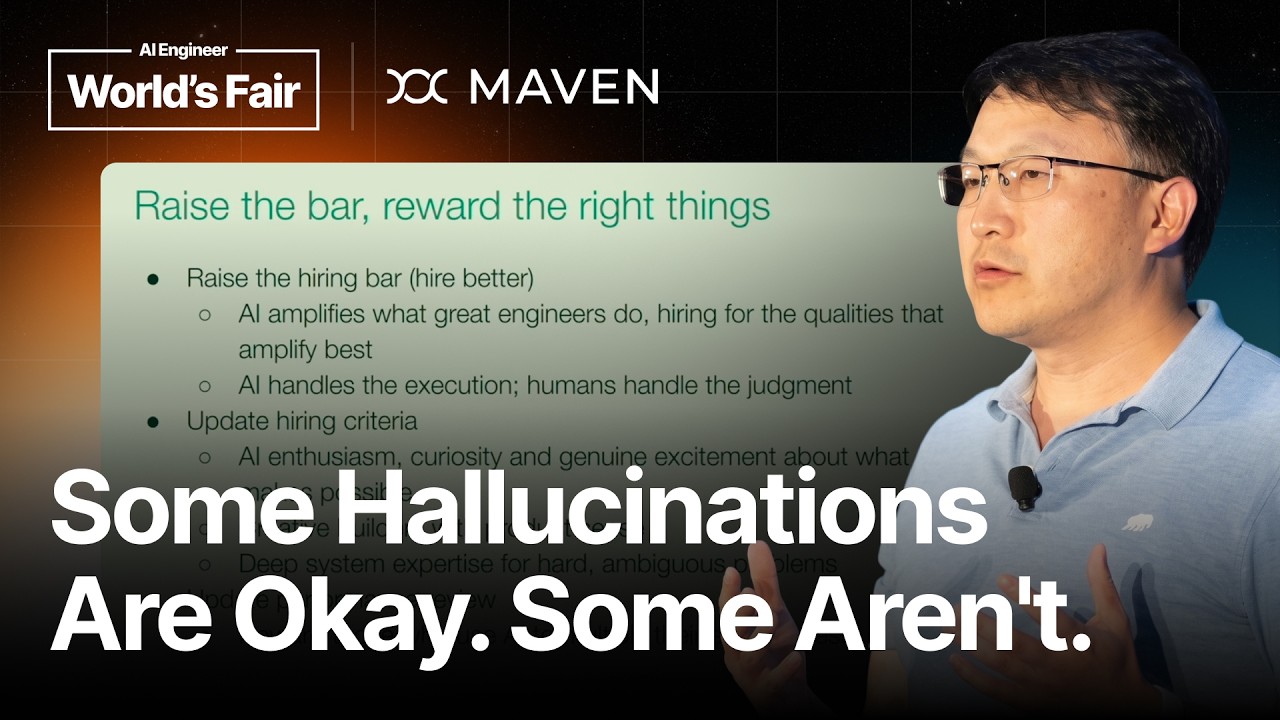
Dan Feng outlines Maven Clinic's transformation into an AI-native company, driven by the realization that "building is cheap and arguing is expensive" in the AI era. This shift has reshaped planning to short, iterative sprints, revolutionized software development with AI coding tools, forced adaptive changes in code review processes, and necessitated a nuanced, multi-layered approach to ensuring reliability in generative AI systems.

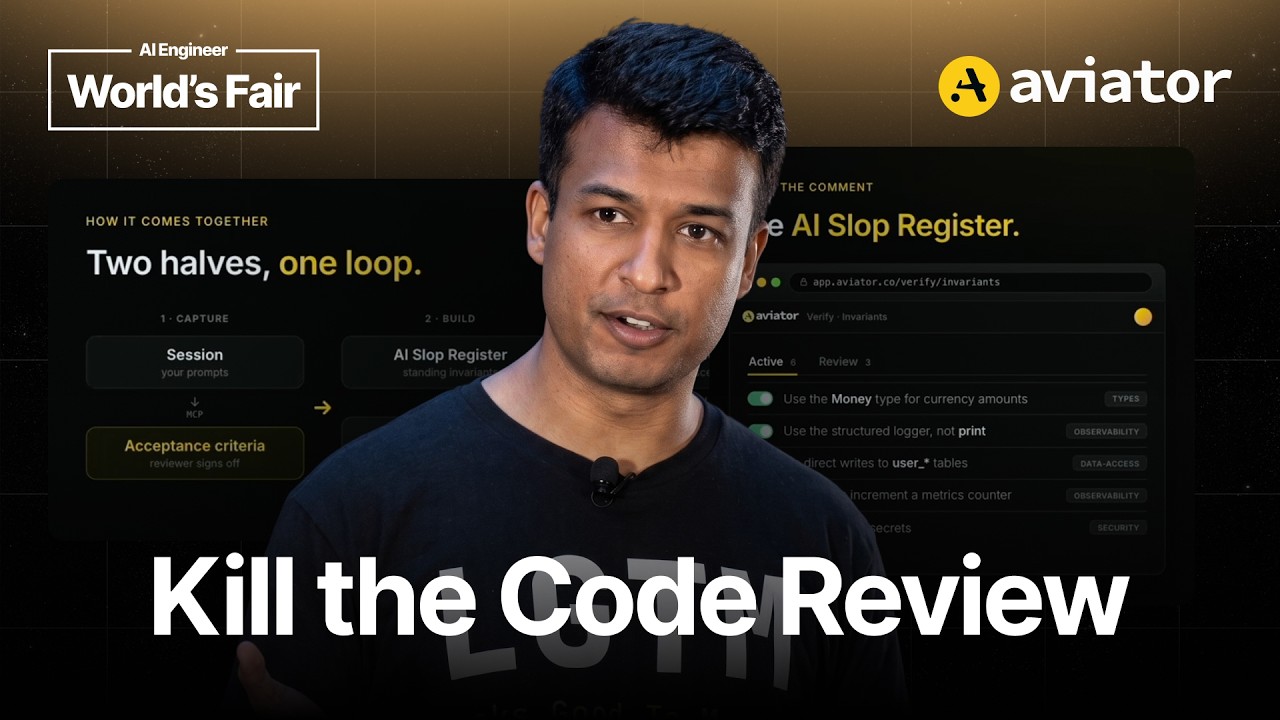
How to Kill the Code Review — Ankit Jain, Aviator

How to Kill the Code Review — Ankit Jain, Aviator

Ankit Jain argues that traditional line-by-line code review is defunct, with AI reviewing code that humans no longer read. He asserts that code review's vital, often overlooked, purpose is 'alignment'—knowledge sharing, mentorship, and architectural feedback—which current AI-driven workflows fail to capture. His proposal involves capturing user-AI interaction prompts as acceptance criteria, generating test plans with an 'AI Slop Registry' (codified recurring review comments), and verifying changes against live previews. The new review surface becomes the 'intent and evidence' rather than the code diff, preserving collaboration and ensuring semantic accuracy.

Why a Nation Can't Outsource Its Frontier AI - Alistair Pullen (Cosine AI)

Why a Nation Can't Outsource Its Frontier AI - Alistair Pullen (Cosine AI)

Alistair Pullen, CEO of Cosine, discusses the UK's sovereign AI initiative, born from US export controls. He outlines Cosine's unique economic model, competing with "millions" against "billions" by licensing models instead of hosting inference. Pullen delves into why open models lag frontier systems, emphasizing active parameters and post-training data. He explains Cosine's innovative approach to "slop" through process-based RL and credit attribution, advocating for runtime proof in code review. The conversation covers their hierarchical "Swarm" sub-agent system, the challenges of memory, and advanced synthetic data generation, concluding on the geopolitical impact of export controls as an unexpected catalyst for UK AI.

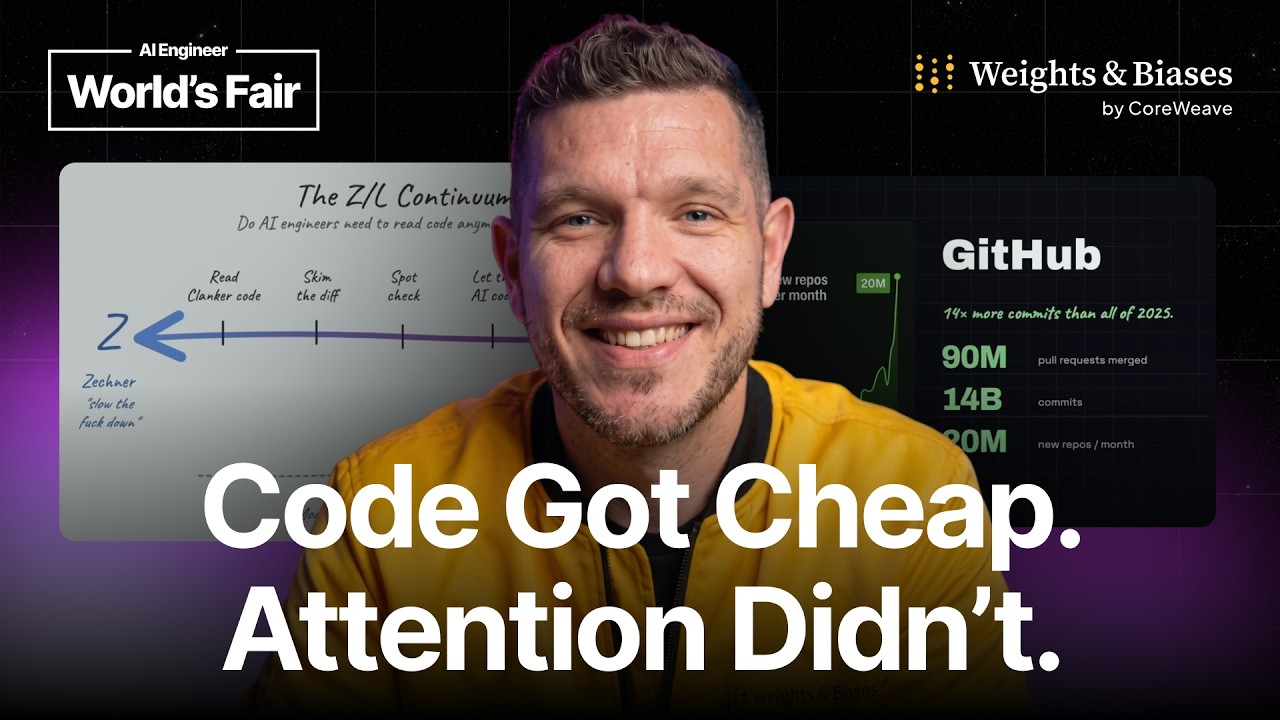
Should AI Engineers Still Read Code in 2026? The Z/L Continuum — Alex Volkov, ThursdAI

Should AI Engineers Still Read Code in 2026? The Z/L Continuum — Alex Volkov, ThursdAI

Alex Volkov introduces the "Z/L Continuum," a framework for navigating the tension between rapid AI-generated code production and the critical need for human review. He argues that the key lies in understanding that the continuum applies to tasks, not individuals, and presents a pragmatic routing table for verifying changes based on their criticality, highlighting the shift towards engineering systems that build and verify code, rather than meticulously inspecting every line. The talk also touches on emerging capabilities like Fable and "loops" and the importance of flexibility and human judgment in the evolving AI engineering landscape.