Ai engineering

How to Build AI-First Organizations — with Jacob Miller and Jeremy Mumford

How to Build AI-First Organizations — with Jacob Miller and Jeremy Mumford

Jacob Miller and Jeremy Mumford, authors of 'Architected Intelligence', discuss the enduring principles for building successful AI products and organizations. They cover why velocity is the only durable moat, why hallucinations are a data curation issue, and the proper progression from skills to workflows to agents, emphasizing a shift from focusing on models to focusing on process and speed.

Harnesses in AI: A Deep Dive — Tejas Kumar, IBM

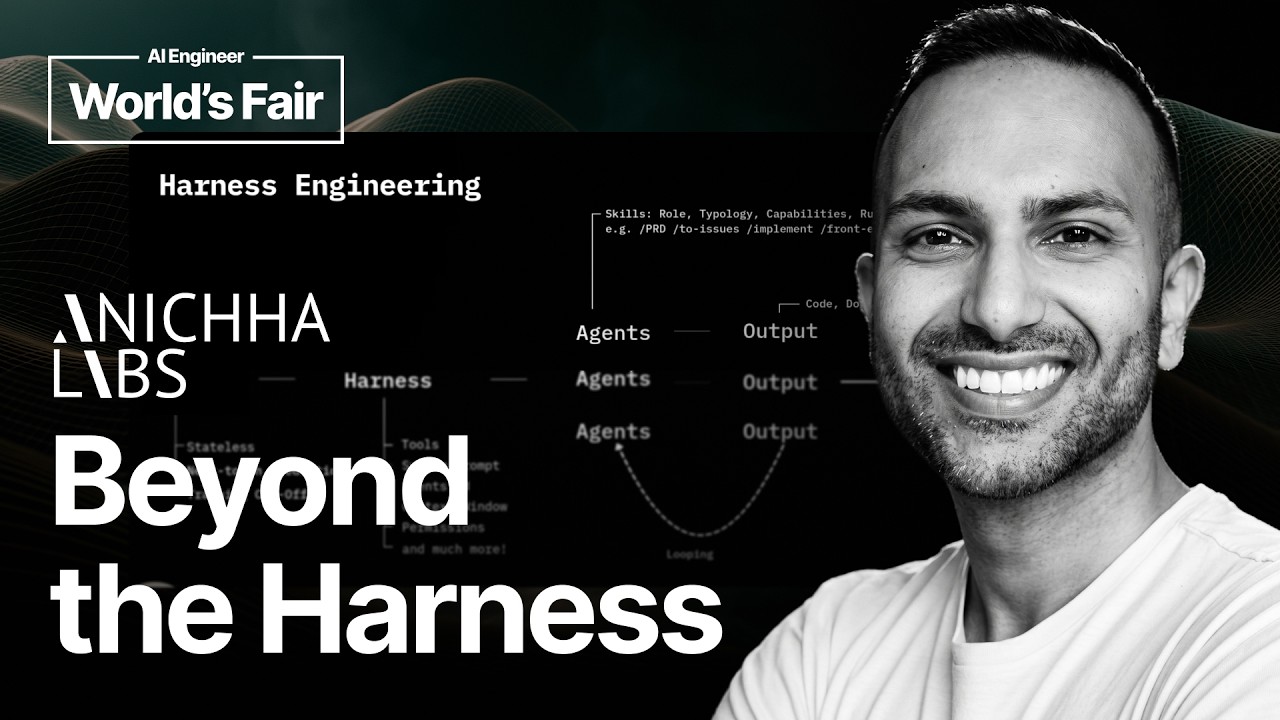
Harnesses in AI: A Deep Dive — Tejas Kumar, IBM

A deep dive into AI harnesses, explaining how to build a programmatic environment around an LLM agent to ensure reliability without prompt engineering. The talk demonstrates building a harness for a browser agent to reliably log in and upvote a post on Hacker News using GPT-3.5 Turbo.

Fighting AI with AI — Lawrence Jones, Incident

Fighting AI with AI — Lawrence Jones, Incident

Lawrence Jones from Incident.io explains why their team needed AI to debug their complex AI SRE product. He details three powerful patterns: a CLI for agents to manage large evaluation files, serializing debug UIs into downloadable file systems for agent-based tracing, and multi-agent pipelines for fleet-scale failure analysis.

⚡️ Matt Pocock - Why Engineering Fundamentals matter MORE now

⚡️ Matt Pocock - Why Engineering Fundamentals matter MORE now

Matt Pocock of AI Hero discusses the critical role of classic software engineering principles in the new era of AI development. He explores how concepts like Domain-Driven Design (DDD), deep modules, and intentional architecture are essential for building maintainable systems with AI, and shares his unique teaching philosophy for the rapidly evolving field of AI Engineering.

Full Workshop: Build Your Own Deep Research Agents - Louis-François Bouchard, Paul Iusztin, Samridhi

Full Workshop: Build Your Own Deep Research Agents - Louis-François Bouchard, Paul Iusztin, Samridhi

This hands-on workshop details the construction of a sophisticated, dual-part AI system for producing high-quality technical content. It begins with an MCP-powered deep research agent that autonomously plans, searches the web, and analyzes sources like YouTube to synthesize a grounded research artifact. The second part is a constrained, deterministic writing workflow that transforms this research into polished, non-sloppy content using an innovative "Evaluator-Optimizer" pattern for iterative refinement. The session emphasizes crucial AI engineering principles, such as choosing between agentic and workflow-based architectures, and concludes with a deep dive into implementing practical observability and evaluation pipelines to ensure the system is both measurable and improvable.

The New Application Layer - Malte Ubl, CTO Vercel

The New Application Layer - Malte Ubl, CTO Vercel

Malte Ubl, CTO of Vercel, posits that AI engineering is the successor to web development, arguing that AI agents will expand, not shrink, the software market. He explores practical agent archetypes being built today and discusses the profound shift required in infrastructure and security as agents become both the builders and primary users of software, concluding that the true innovation and value will lie in the application layer built by AI engineers, independent of the commoditizing foundational models.