Posts

AI Tech Stack | The Founders and Builders Architecting Product Market Fit | Creator's Cut | 2026 |4K

AI Tech Stack | The Founders and Builders Architecting Product Market Fit | Creator's Cut | 2026 |4K

This panel discussion explores the evolving AI tech stack and its impact on product-market fit, ethical governance, and business transformation. Experts from Humana, Catenate, In-Telecom, and Spacer AI explain how AI-powered prompts are replacing static dashboards, detail multi-model API strategies for cost efficiency, and delve into the critical role of human-in-the-loop oversight for autonomous agents to ensure data security and responsible AI deployment. They emphasize that true value lies in domain expertise and solving real-world pain points, not just building 'shiny toys'.


The Search Engine for the Agentic Web — Will Bryk, Exa

The Search Engine for the Agentic Web — Will Bryk, Exa

Exa's CEO, William Bryk, discusses the impending AI search boom, predicting machines will soon outpace human searches dramatically. He explains Exa's evolution from a consumer search engine to an API for AI agents, driven by the realization that LLMs need external, 'perfect' retrieval to overcome the limitations of traditional search and combat societal misinformation. Exa leverages neural networks, embeddings, and customized features to provide fast, accurate, and cost-efficient information, with plans for a private data marketplace, aiming to deliver 'a year of research in a second' for AI agents and foster a deeply informed society.

The unreasonable effectiveness of BM25 for agentic search — Jo Kristian Bergum, Hornet.dev

The unreasonable effectiveness of BM25 for agentic search — Jo Kristian Bergum, Hornet.dev

Jo Kristian Bergum argues that the 30-year-old lexical search function BM25 is making a powerful comeback, not because it has changed, but because LLM agents are fundamentally different and more capable users. He highlights how these agents, with their general knowledge and ability to formulate complex queries, leverage BM25's strengths. Using the Browsecom+ benchmark, he demonstrates that reasoning isn't the bottleneck for LLMs, but effective retrieval and query formulation are. He advocates for a "file system workspace" approach, allowing models to use their existing coding and bash skills to interact with retrieved documents, signaling a shift in how search systems are designed and evaluated for agentic applications.

The vulnpocalypse might not be so bad after all

The vulnpocalypse might not be so bad after all

This podcast episode explores the evolving cybersecurity landscape, debating the impact of AI on vulnerability management, examining rogue AI agents' unexpected behaviors, underscoring the persistent effectiveness of old-school social engineering, and advocating for a redefinition of cyber resilience in the face of converging AI and quantum threats in the financial sector.

How Physical AI Learns Across Language, Video and Action — Ming-Yu Liu

How Physical AI Learns Across Language, Video and Action — Ming-Yu Liu

Ming-Yu Liu from NVIDIA details Cosmos 3, a novel omnimodal world model capable of video description, generation, and robot action synthesis. He elaborates on its architecture, which integrates a vision language model with a bidirectional diffusion generator. Liu defines world models as a collection of tools comprising forward dynamics, inverse dynamics, and policy, trained synergistically. The discussion covers learning robot skills from human video, the crucial role of neural simulators like Cosmos Dreams for policy verification and accelerating development in robotics, and the importance of safety for future humanoid robots. The episode concludes by outlining the Super, Nano, and Edge model sizes and NVIDIA's commitment to open-sourcing Cosmos's code, models, and data.

Realtime Voice Agents with Frontier Intelligence — Bohan Li, EliseAI

Realtime Voice Agents with Frontier Intelligence — Bohan Li, EliseAI

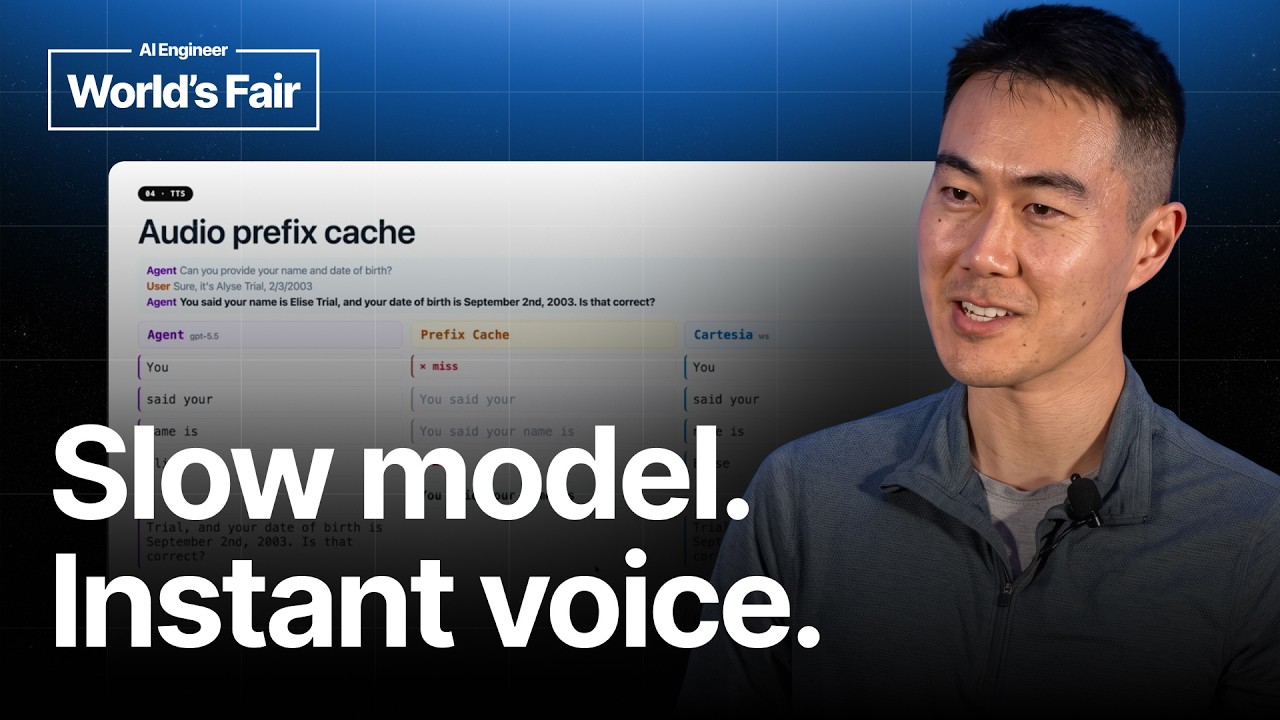
Bohan Li of EliseAI unveils a sophisticated architecture for real-time voice agents that merges high intelligence with low latency, akin to a self-driving car's perception, planning, and control systems. Key innovations include a speculative transcriber combining fast streaming with accurate contextual correction, background agents for offloading LLM tool calls and enabling eager generation, and a clever prefix cache for speech synthesis that seamlessly blends pre-cached audio with dynamically generated speech to mask underlying processing delays.