Posts

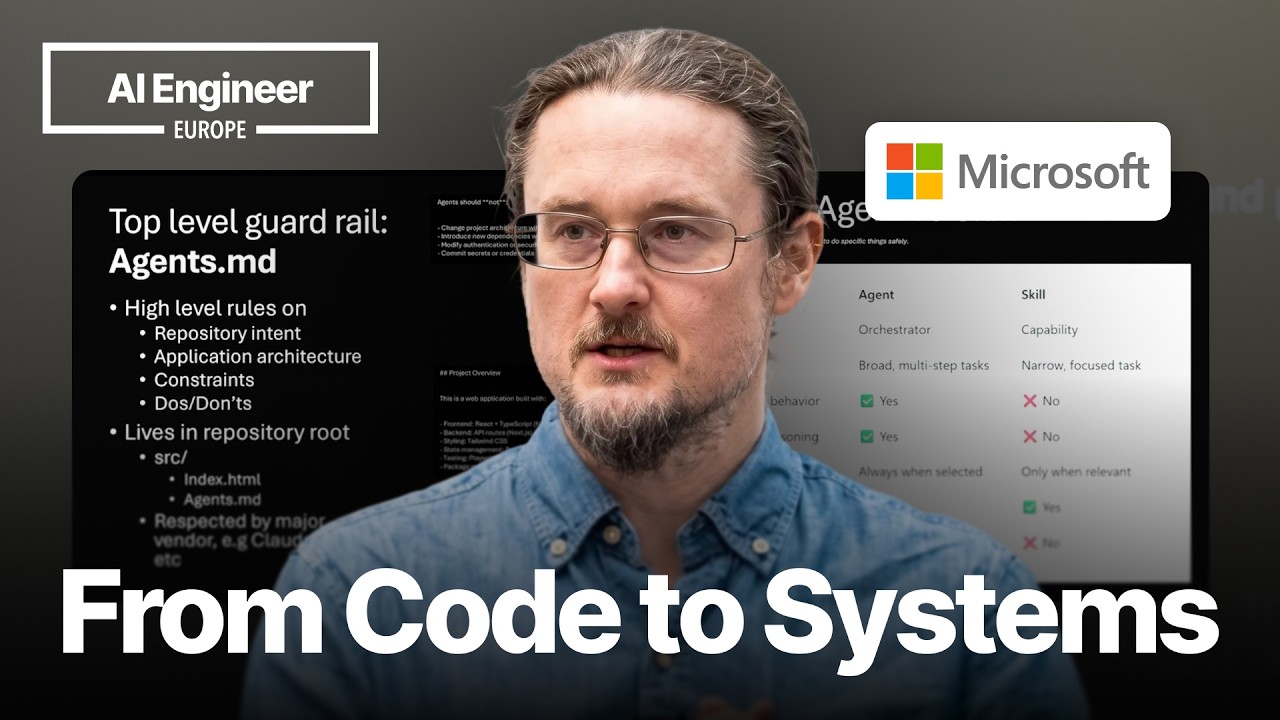
From Writing Code to Designing Systems: How the Developer Role is Changing — Chris Noring, Microsoft

From Writing Code to Designing Systems: How the Developer Role is Changing — Chris Noring, Microsoft

This talk introduces a paradigm shift in software development, moving developers from pure code producers to system designers and agent orchestrators. It details a new workflow leveraging GitHub Copilot CLI, custom Copilot agents, and explicit guardrails like `agents.md` and skills. The focus is on how to decompose complex problems, delegate implementation to AI, and encode architectural standards and constraints directly, enabling higher consistency, quality, and accelerated delivery through a "human-in-the-loop" delegation model.

Podcast Crossover: AIE, AGI, frontier lab strategy with ​ ⁨@matthew_berman⁩  and @swyxtv

Podcast Crossover: AIE, AGI, frontier lab strategy with ​ ⁨@matthew_berman⁩ and @swyxtv

Matt, the organizer of the AI.engineer conference, shares insights into its origin, the challenges of early adoption, and its current value as a neutral ground for AI labs. He delves into AI hardware trends, discussing specialized chips like Etched, and gives a nuanced take on Anthropic's Fable, addressing performance concerns and compute limitations. The conversation then explores OpenAI's rumored equity offer to the US government, discussing implications for regulation and societal involvement. Matt shares his perspective on AI existential risk and alignment, emphasizing the need for pragmatic engineering solutions. Finally, he outlines the limitations of current LLMs, the critical need for data efficiency, and offers strategic advice for "Agent Labs" navigating the "model capability overhang" versus multi-model agnosticism.

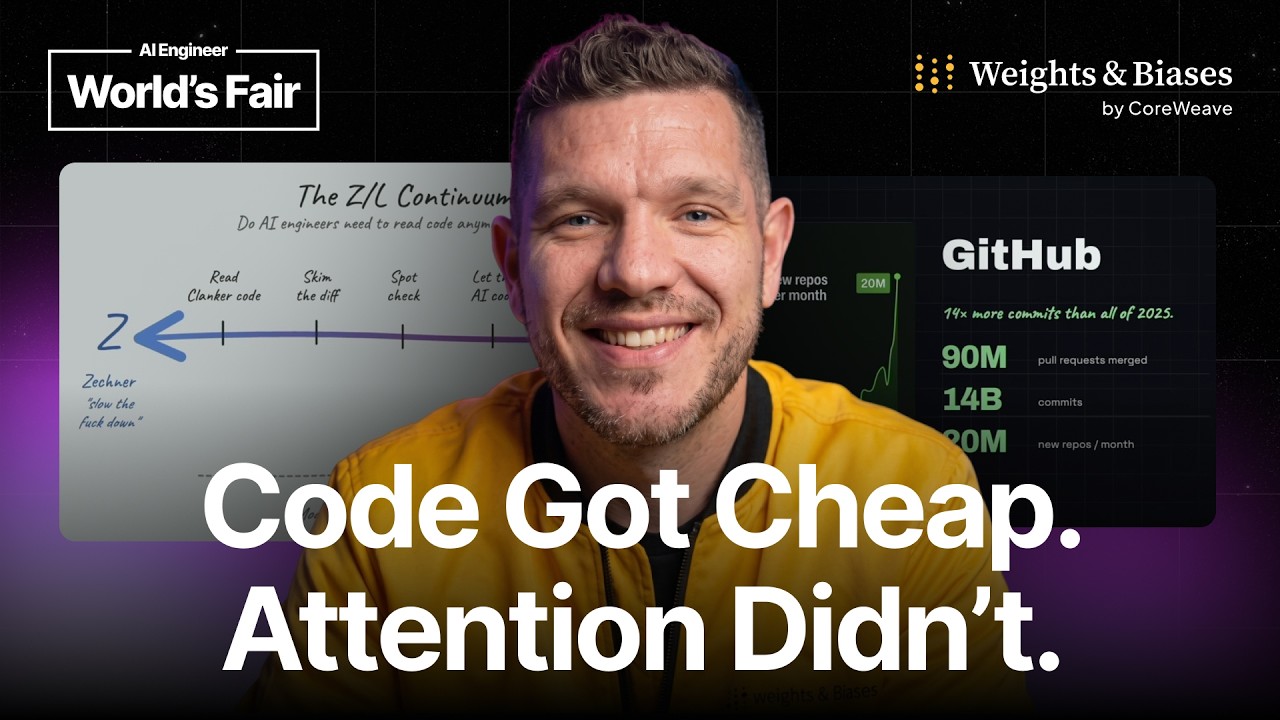
Should AI Engineers Still Read Code in 2026? The Z/L Continuum — Alex Volkov, ThursdAI

Should AI Engineers Still Read Code in 2026? The Z/L Continuum — Alex Volkov, ThursdAI

Alex Volkov introduces the "Z/L Continuum," a framework for navigating the tension between rapid AI-generated code production and the critical need for human review. He argues that the key lies in understanding that the continuum applies to tasks, not individuals, and presents a pragmatic routing table for verifying changes based on their criticality, highlighting the shift towards engineering systems that build and verify code, rather than meticulously inspecting every line. The talk also touches on emerging capabilities like Fable and "loops" and the importance of flexibility and human judgment in the evolving AI engineering landscape.

General relativity from first principles – Adam Brown

General relativity from first principles – Adam Brown

Adam Brown elucidates Einstein's General Relativity, tracing its origins from the equivalence principle and curved spacetime to the mind-bending physics of black holes. He covers the striking observational evidence for black holes and the historical confirmation of GR, concluding with a speculative discussion on how AI could accelerate scientific discovery as 'superhuman explainers'.

Understanding the inner thoughts of AI

Understanding the inner thoughts of AI

Neel Nanda, head of Google DeepMind's language model interpretability team, discusses the critical field of interpretability, likening it to the "neuroscience of AI." He explains why understanding the internal workings of "grown, not designed" neural networks is crucial for AI safety and scientific discovery. The episode explores cutting-edge techniques like Chain of Thought monitoring, mechanistic interpretability (steering and probing), and Sparse Autoencoders, highlighting their strengths and limitations in debugging, detecting deception, and uncovering hidden model objectives. Nanda emphasizes interpretability's role in building safe, aligned, and trustworthy AI as we approach AGI, acknowledging its pragmatic necessity despite inherent limits to full understanding.

Reddit cracks down on AI slop & the future of AI compute

Reddit cracks down on AI slop & the future of AI compute

This episode explores Reddit's aggressive AI spam combat strategy, revealing AI's dual role in fighting malicious AI. It then dissects Anthropic's Economic Index, highlighting how Claude integrates into daily life despite significant user selection bias. The discussion also covers Orin's $33M raise for a GPU compute marketplace, debating the fungibility of compute and the technical hurdles. Finally, Anthropic's chip ambitions are analyzed as an economic strategy to optimize models, reduce NVIDIA dependency, and manage rising token costs, with comparisons to existing hardware ecosystems and NVIDIA's market position.