Posts

Agents Need Feature Flags - Sachin Gupta

Agents Need Feature Flags - Sachin Gupta

AI teams are deploying advanced agent systems without the fundamental safety mechanisms (feature flags, canaries, kill switches) that web teams adopted over a decade ago. This oversight leads to critical incidents like data deletion and financial loss. This talk introduces six agent-specific feature flag types—for prompts, tools, models, memory, autonomy, and sub-agents—and outlines a practical playbook for secure AI deployment, emphasizing the critical role of a pre-wired kill switch to manage the high blast radius of AI agents.
Your Agents Need a Save Button - Hamza Tahir, ZenML

Your Agents Need a Save Button - Hamza Tahir, ZenML

Most AI agents lack a "save button" for persistent state, making debugging and optimization challenging. This talk introduces the concept of a durable runtime with checkpointing, allowing developers to replay agent executions, perform "what-if" analyses (e.g., swapping models, mocking tools), and conduct cohort-based evaluations using production data. The open-source tool Kitaru is demonstrated as a solution to build, debug, and improve agents at scale by capturing full execution state, not just traces.

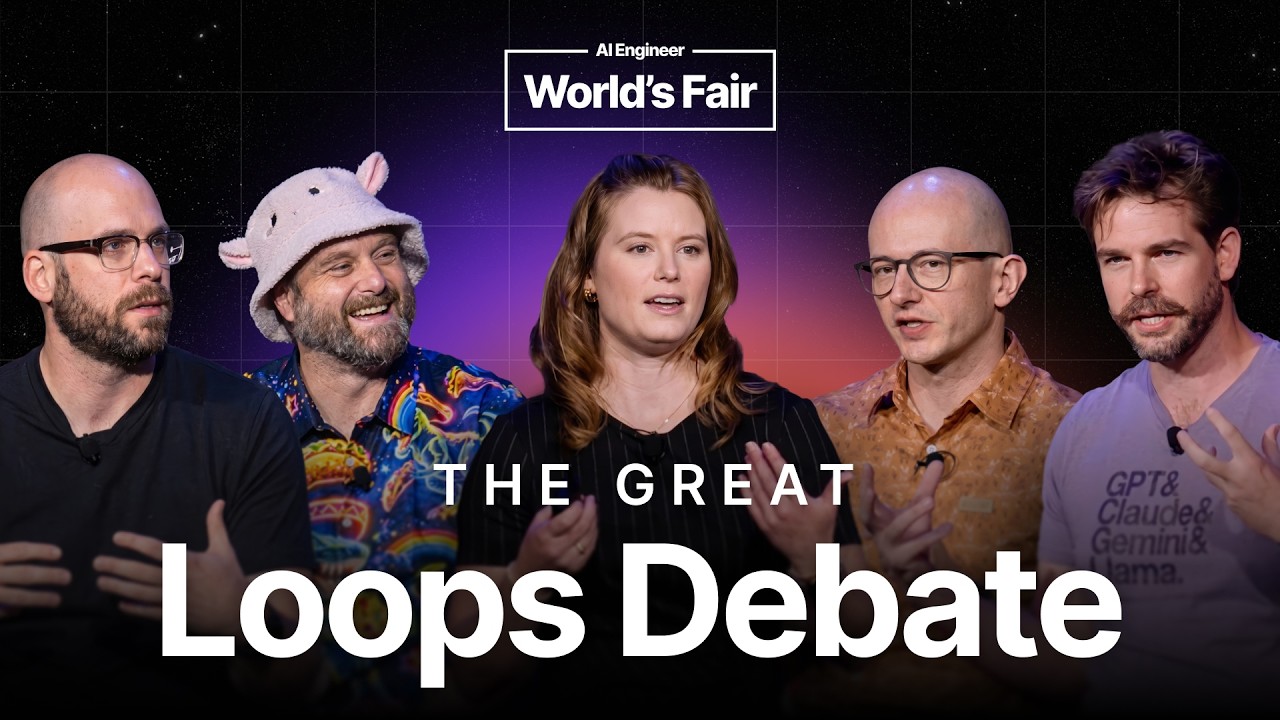
The Great Loops Debate — Dex Horthy, Geoff Huntley, Ian Livingstone, Greg Pstrucha, @insecure-agents

The Great Loops Debate — Dex Horthy, Geoff Huntley, Ian Livingstone, Greg Pstrucha, @insecure-agents

An Oxford-style debate exploring the gap between the hype and practical reality of "loops" in AI/ML development. Experts discuss their history, optimal anatomy, future role in software factories, and challenges like security, economic viability, and the imperative for strong engineering discipline.

On AI and Knowledge — Pablo Castro, Distinguished Engineer & CVP for AI Knowledge, Microsoft

On AI and Knowledge — Pablo Castro, Distinguished Engineer & CVP for AI Knowledge, Microsoft

Pablo Castro explores the three pillars of AI knowledge—intrinsic, extrinsic, and learned—explaining how models leverage parametric memory, agents integrate with enterprise data through sophisticated RAG systems like Foundry IQ, and how continuous learning loops, facilitated by tools like the Agent Optimizer, enable self-improving agents, driving the next wave of AI applications.

Research to Reality with Google DeepMind — Benoit Schillings, Google DeepMind, VP of Technology

Research to Reality with Google DeepMind — Benoit Schillings, Google DeepMind, VP of Technology

Benoit Schillings, VP of Technology at Google DeepMind, explores the evolution of AI's role in software development, highlighting the transition from human-limited coding to an AI frontier where syntax generation is solved. He delves into the power of self-play for model training, the shifting economics of software engineering, and the imperative for active guardrails. Schillings also discusses the need for inductive architecture, advanced model planning, multimodal reasoning (as seen in Gemini), and the potential for AI to drive scientific breakthroughs in fields like chemistry and biology by uncovering patterns imperceptible to human bias.

AI Can't Learn The Way Humans Do - This Could Fix That

AI Can't Learn The Way Humans Do - This Could Fix That

This discussion explores world models as a promising path to solving sample efficiency in AI and achieving AGI. It contrasts deterministic control (Newtonian physics) with stochastic environments (RL), explaining the challenges posed by large action spaces in Go, self-driving, and robotics. The episode delves into how synthetic data, video diffusion models, and latent space architectures like JEPA are making world models practical, while also highlighting remaining open problems in physics modeling, real-time adaptation, and rich sensory integration.