Posts

Fable 5 as Advisor: Anthropic's Two-Model Pattern for Smarter, Cheaper Agents (Ep. 1010)

Fable 5 as Advisor: Anthropic's Two-Model Pattern for Smarter, Cheaper Agents (Ep. 1010)

The episode explores Anthropic's "advisor strategy," a novel AI agent pattern that combines a fast, cheap "executor" model with a frontier-class "advisor" model. This allows for mid-task consultation within a single API call, resolving the tension between cost and capability. Benchmarks show simultaneous improvements in quality and cost reduction, demonstrating that AI progress is shifting towards intelligent model composition rather than just larger models.
Thinking Machines Lab drops Inkling & Meta’s Muse Spark 1.1

Thinking Machines Lab drops Inkling & Meta’s Muse Spark 1.1

This episode covers Thinking Machines' Inkling, an open-source, customizable model prioritizing architecture over benchmarks; Meta's Muse Spark 1.1, positioned for agent orchestration and enterprise use; OpenAI's GPT-5.6 Sol's 8% score on ARC-AGI-3, reigniting AGI debates; and Anthropic's "J-space" paper, exploring internal model reasoning and its implications for AI safety and interpretability.

Closing Keynote: Garry Tan, Y Combinator

Closing Keynote: Garry Tan, Y Combinator

Garry Tan, President of Y Combinator, details how AI-native companies are achieving unprecedented productivity and scale with lean teams. He introduces the concept of "wiring the work" by treating AI as a workforce where organizational components are encoded into markdown "skill files." Tan explains how "company brains" act as a library and librarian, managing institutional knowledge to overcome human memory limits. He emphasizes the discipline of "skillifying" every task to ensure continuous learning and calls on founders to build these new AI-native infrastructures to "boil the ocean"—tackling previously insurmountable problems.

Imagination Engineering — Eve Bouffard, Head of Design, Y Combinator

Imagination Engineering — Eve Bouffard, Head of Design, Y Combinator

Eve Bouffard of Y Combinator introduces "Imagination Engineering," arguing that powerful AI shifts the human challenge from execution to ideation. She showcases personal experiments like an AI-generated website from her public thoughts, a tool visualizing historical geniuses, and custom productivity aids. Bouffard highlights AI's role as a "rocket ship for the mind," enabling rapid learning and software creation on demand.

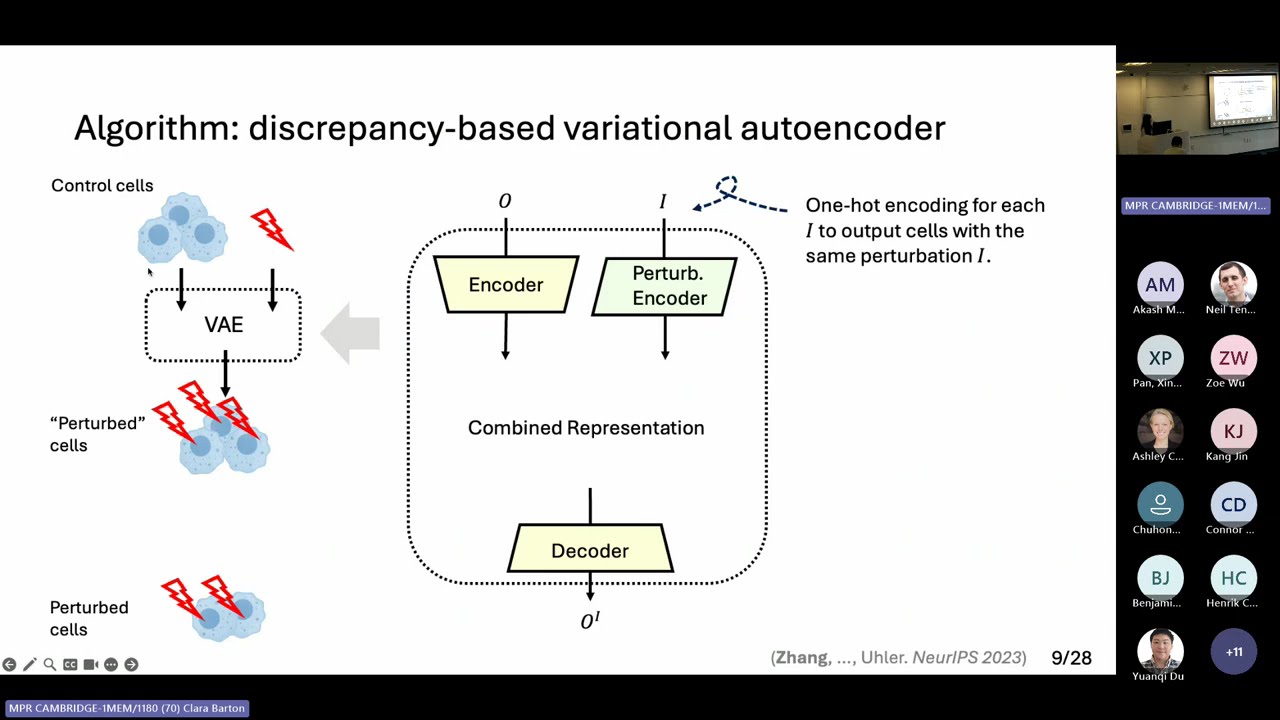
Learning Genetic Perturbation Effects at Single-Cell Resolution for Virtual Cells

Learning Genetic Perturbation Effects at Single-Cell Resolution for Virtual Cells

Jiaqi Zhang's talk focuses on advancing causal discovery and perturbational modeling for gene networks, crucial for therapeutic insights. She introduces theoretical guarantees for learning latent causal variables and presents MORPH, a VAE-based framework that predicts the effects of novel and combinatorial gene perturbations by integrating diverse prior biological knowledge and using distributional loss for training. The model has demonstrated success in guiding experimental design, including identifying novel T-cell regulators for cancer immunotherapy, highlighting its potential to accelerate biological discovery and drug development.

Level Up: Choosing The Technical Leadership Path • Patrick Kua • GOTO 2025

Level Up: Choosing The Technical Leadership Path • Patrick Kua • GOTO 2025

Patrick Kua explores the essence of technical leadership, emphasizing its critical role in overcoming organizational misalignment and accidental complexity, drawing from real-world examples. He introduces a "Trident Model" for career growth, differentiating technical leadership from individual contribution and management. The talk highlights compelling reasons for engineers to embrace leadership, such as shaping team environments, influencing product direction, and solving complex "people-system" problems. Finally, Kua provides a practical five-step recipe for aspiring leaders to start demonstrating impact through ownership, sponsorship, and delivering tangible value.