Posts

Expanding Flows for Fast and Flexible Generation Beyond the Fixed Canvas

Expanding Flows for Fast and Flexible Generation Beyond the Fixed Canvas

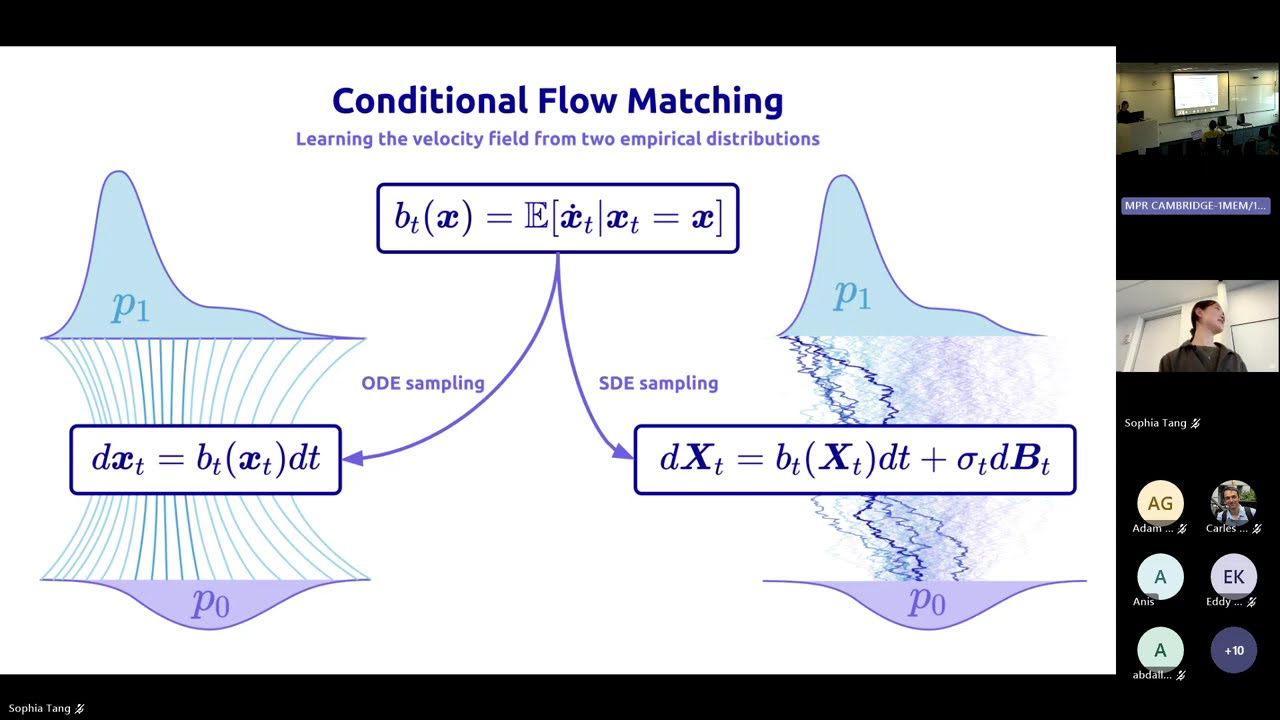
This talk introduces Expanding Generative Flows (EFlows) and Expanding Flow Maps (EFMs), a novel framework for flow-based generative models that overcome the limitation of fixed-canvas generation. It proposes decomposing the generative process into an 'expand' operation (to increase dimensionality with new coordinates/tokens) and a 'transport' map, allowing for fast and flexible generation of variable-sized outputs across both continuous and discrete state spaces. The framework leverages local time clocks, piece-wise deterministic Markov processes, and specific training objectives for consistency, demonstrated through applications in conformer generation, molecular graph generation, and language modeling.
Open Models: Kimi K3, Qwen 3.8, Xi's WAIC Speech, Distillation, The Open-Closed Gap, and What's Next

Open Models: Kimi K3, Qwen 3.8, Xi's WAIC Speech, Distillation, The Open-Closed Gap, and What's Next

Nathan Lambert and Florian Brand discuss the accelerating open model landscape, focusing on the surge in Chinese models like Kimi K3 and GLM 5.2. They explore the reasons behind China's progress, the evolving US ecosystem, the cybersecurity implications of open-source bans, and debunk common misconceptions about distillation, particularly challenging Ben Thompson's recent claims. The episode concludes with predictions and a frontier model tier list.

GPT-Red: Can AI read teams stop prompt injections?

GPT-Red: Can AI read teams stop prompt injections?

This podcast explores AI's impact on cybersecurity, discussing OpenAI's GPT-Red for automated red-teaming against prompt injections, the open-source ScamBuster that uses AI to bait scammers for threat intelligence, and Bruce Schneier's insights on the widening gap between skill and ability in the AI era and its ethical implications for the field.

Better Agent Auth — Bereket Habtemeskel & Paola Estefania, Better Auth

Better Agent Auth — Bereket Habtemeskel & Paola Estefania, Better Auth

The Agent Auth protocol introduces a novel approach to securing AI agents by treating them as distinct principals with their own identities, moving away from sharing user credentials. It defines a system for agent discovery, fine-grained capability-based authorization, and comprehensive traceability, enabling users to grant specific authority to agents and revoke it granularly. This paradigm shift offers enhanced security, accountability, and control over autonomous operations.

2026 State of AI Engineering — Barr Yaron, Amplify Partners

2026 State of AI Engineering — Barr Yaron, Amplify Partners

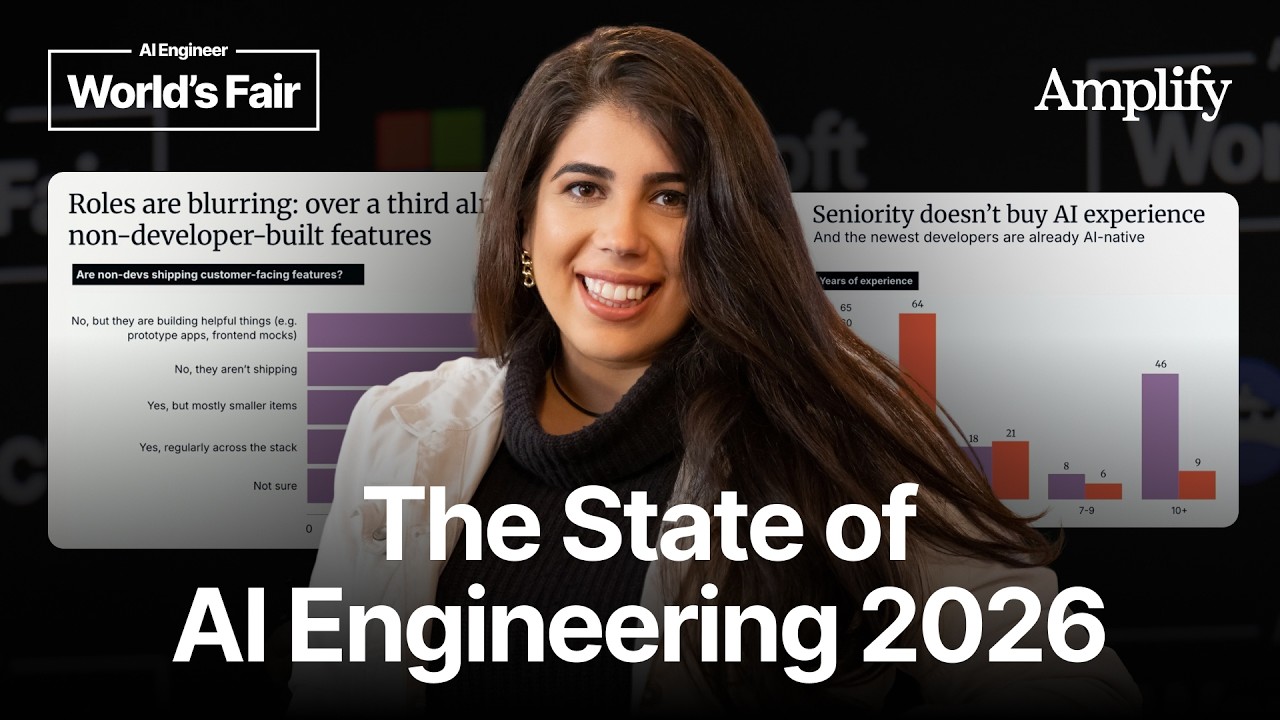
Barr Yaron's 2026 AI engineering survey reveals key trends: audio and image generation are rapidly gaining traction, while cost is now a primary engineering constraint. Agents are evolving to take actions within systems, but control mechanisms remain primitive. Evaluation (eval) is still the top infrastructure challenge. AI positively impacts job satisfaction and experimentation but also raises concerns about technical skill erosion and non-developers shipping code, fundamentally changing engineering culture. Predictions include a likely AGI declaration within five years and a shift away from Transformers as state-of-the-art.

Why Physical AI Is the Next Frontier | The a16z Show

Why Physical AI Is the Next Frontier | The a16z Show

Applied Intuition discusses the emergence of physical AI, its mission to put intelligence on a billion machines, and its latest platform, Dana, designed to democratize autonomous system development. The conversation covers the vast scope of physical AI beyond automotive, the unique challenges of real-world deployment (safety, data, hardware), the current state and future of self-driving cars and trucks, and the transformative potential of humanoids and world models. They also touch upon the geopolitical landscape of AI and the global ambitions of Applied Intuition.