Posts

Chelsea Finn: Building Robots That Can Do Anything

Chelsea Finn: Building Robots That Can Do Anything

Developing general-purpose robots requires a shift from specialized, single-task systems to broad foundation models. This is achieved through a combination of large-scale, diverse, real-world data collection and a specific training methodology: pre-training on all available data and then fine-tuning on a curated, high-quality subset of demonstrations. This recipe, combined with architectural innovations to preserve the capabilities of Vision-Language Model (VLM) backbones, enables robots to perform complex, long-horizon tasks, generalize to unseen environments, and respond to open-ended human instructions.
907: Neuroscience, AI and the Limitations of LLMs — with Dr. Zohar Bronfman

907: Neuroscience, AI and the Limitations of LLMs — with Dr. Zohar Bronfman

Zohar Bronfman discusses why current LLMs are not on a path to AGI, contrasting their combinatorial creativity with the transformational, domain-general intelligence of humans. He argues that predictive models, not generative ones, deliver the most business value and explains how his platform, Pecan AI, automates the critical data preparation bottleneck to democratize predictive analytics for all businesses.

OpenAI Just Released ChatGPT Agent, Its Most Powerful Agent Yet

OpenAI Just Released ChatGPT Agent, Its Most Powerful Agent Yet

The OpenAI team details the creation of a new, powerful AI agent in ChatGPT, achieved by unifying the Deep Research and Operator models. They cover its unified architecture with shared state across tools, the reinforcement learning techniques used for training, and the critical safety measures required for an agent that can take real-world actions.

The Future of Software Development - Vibe Coding, Prompt Engineering & AI Assistants

The Future of Software Development - Vibe Coding, Prompt Engineering & AI Assistants

A discussion on the state of technical infrastructure, focusing on how AI and Large Language Models represent a new, fourth foundational pillar alongside compute, network, and storage. The talk covers how AI is disrupting software itself, the investment landscape, and the future of the developer profession.

Intern talk: Distilling Self-Supervised-Learning-Based Speech Quality Assessment into Compact Models

Intern talk: Distilling Self-Supervised-Learning-Based Speech Quality Assessment into Compact Models

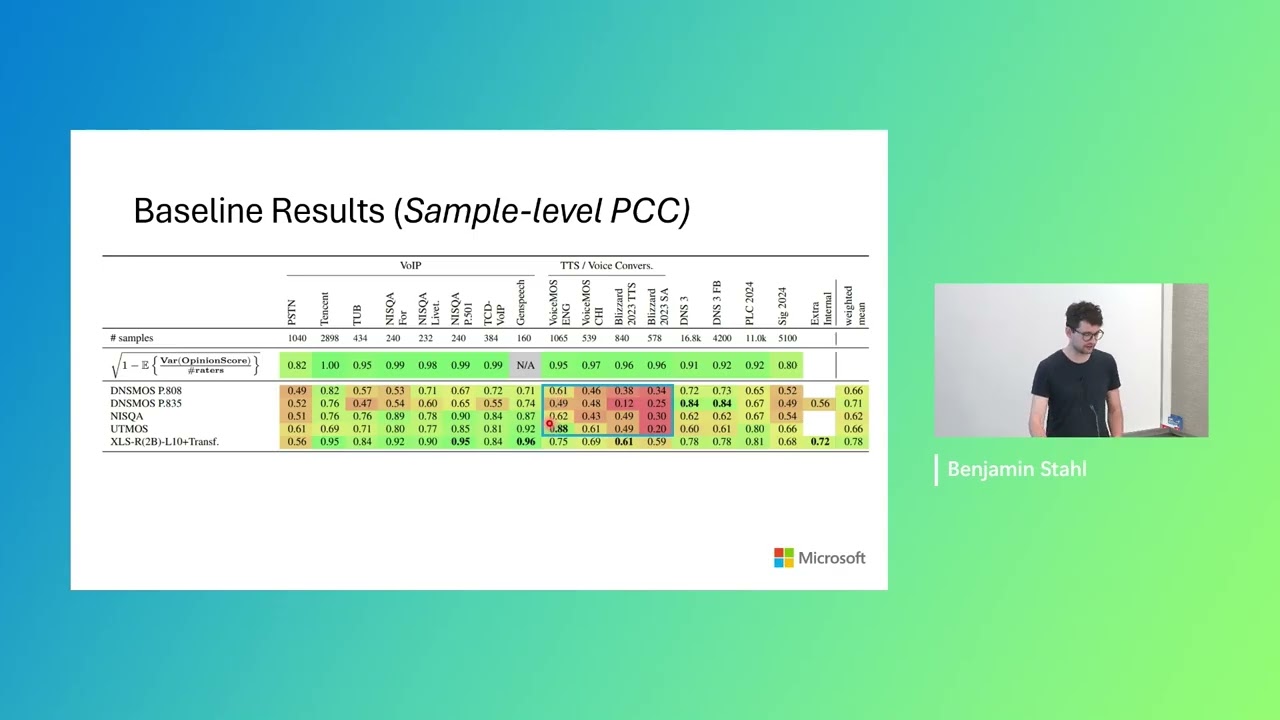
This research explores the distillation and pruning of large, self-supervised speech quality assessment models into compact and efficient versions. Starting with the high-performing but large XLSR-SQA model, the work details a process of knowledge distillation using a teacher-student framework with a diverse, on-the-fly generated dataset. The resulting compact models successfully close over half the performance gap to the teacher, making them suitable for on-device and production applications where model size is a critical constraint.

Anthropic co-founder: AGI predictions, leaving OpenAI, what keeps him up at night | Ben Mann

Anthropic co-founder: AGI predictions, leaving OpenAI, what keeps him up at night | Ben Mann

Ben Mann, co-founder of Anthropic, discusses the accelerating progress in AI, forecasting superintelligence by 2028. He details Anthropic's safety-first mission, the "Economic Turing Test" for AGI, the mechanisms of Constitutional AI, and why focusing on alignment created Claude's unique personality.