Posts

Platforms for Humans and Machines: Engineering for the Age of Agents — Juan Herreros Elorza

Platforms for Humans and Machines: Engineering for the Age of Agents — Juan Herreros Elorza

This talk by Juan Herreros Elorza explores how to design internal developer platforms for a future where AI coding agents are first-class users. It argues that the same best practices that make platforms accessible to humans—self-service interfaces, well-defined APIs, local-first workflows, and rich observability—are now critical prerequisites for agents to autonomously build, debug, and ship software. The session provides concrete principles for platform design, discusses how to manage AI-assisted contributions, and emphasizes the need to measure the impact of these changes on developer productivity and system reliability.

Your Insecure MCP Server Won't Survive Production — Tun Shwe, Lenses

Your Insecure MCP Server Won't Survive Production — Tun Shwe, Lenses

Lenses.io experts Tun Shwe and Jeremy Frenay discuss the significant security and design hurdles in transitioning Model Context Protocol (MCP) servers from local development to enterprise production. They introduce five core principles for secure agentic design, including shrinking the attack surface and constraining inputs, and detail the necessity of remote MCP servers with robust authentication. The talk provides an in-depth comparison of OAuth 2.1's Dynamic Client Registration (DCR) and the more secure Client ID Metadata Document (CIMD) approaches for managing agent identities, offering a roadmap for building enterprise-grade agentic AI systems with MCP.

Agentic Engineering & PINNs: AI for Simulation Engineers - James Shaw | Podcast #172

Agentic Engineering & PINNs: AI for Simulation Engineers - James Shaw | Podcast #172

James Shaw, a mechanical engineer and Ansys channel partner, delves into the current and future impact of agentic AI and physics-informed neural networks (PINs) on simulation workflows. He explores how AI is revolutionizing aspects from tech support and model setup to the solver itself, particularly in CFD. The discussion also covers the implications for the engineering job market, the 'senior-junior inversion crisis', and the continued irreplaceability of skilled engineers due to the inherent physicality of the world, emphasizing the need for robust, trustworthy data to train AI.

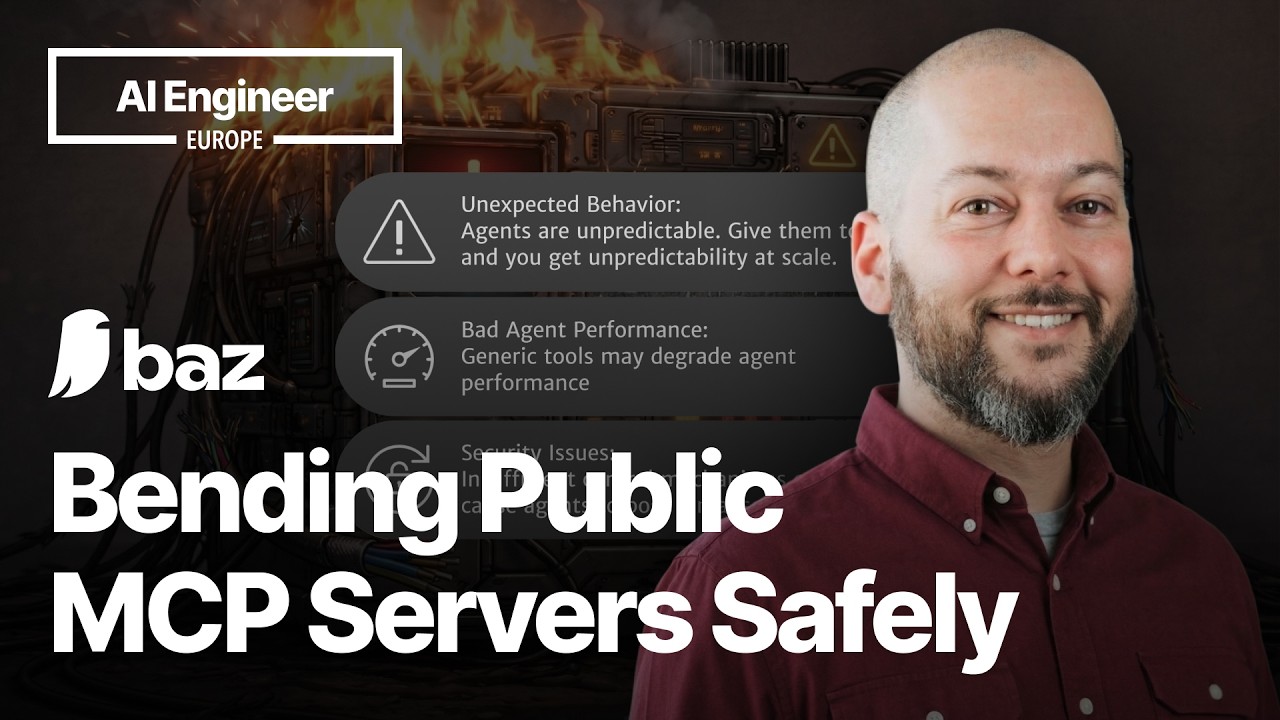
Bending a Public MCP Server Without Breaking It — Nimrod Hauser, Baz

Bending a Public MCP Server Without Breaking It — Nimrod Hauser, Baz

Learn practical strategies to adapt third-party MCP server tools for production AI applications. This talk covers five key practices: curating tools, enhancing descriptions, implementing deterministic guardrails, composing new tools from existing ones, and leveraging tools as simple functions, all demonstrated through a real-world "Spec Reviewer" example.

Extreme Harness Engineering for the 1B token/day Dark Factory — Ryan Lopopolo, OpenAI Frontier

Extreme Harness Engineering for the 1B token/day Dark Factory — Ryan Lopopolo, OpenAI Frontier

Ryan Lopopolo of OpenAI's Frontier team discusses "Harness Engineering," a new paradigm where AI agents manage the entire software development lifecycle. He details an experiment building a 1M LOC product with zero human-written code, shifting the engineer's role from coding to designing systems and context for agents. The conversation covers the Symphony orchestration framework, the concept of "agent-legible" software, and the future of AI-driven development.

AI Won't Take Your Job—It Will Make You the CEO | The a16z Show

AI Won't Take Your Job—It Will Make You the CEO | The a16z Show

Balaji Srinivasan discusses the paradoxical nature of AI, which lowers creation costs while simultaneously raising verification costs. He argues this tension pushes society toward a "trusted tribe" model, similar to the Chinese internet, where AI excels within high-trust groups but struggles between them. The conversation covers why physical tasks are easier to automate than digital ones, how AI makes everyone a CEO rather than obsolete, and why crypto, particularly Zcash, serves as a necessary counterbalance for inter-tribe transactions in an AI-driven world.