From PhD Side Project to $500M ARR: Will Falcon’s PyTorch Lightning Story
Will Falcon, CEO of Lightning AI, discusses the company's merger with Voltage Park to create a full-stack AI neo-cloud. He delves into the capabilities of Lightning AI Studio, a comprehensive platform for AI development, and recounts the origin story of PyTorch Lightning, from a personal research tool to a world-leading open-source framework.
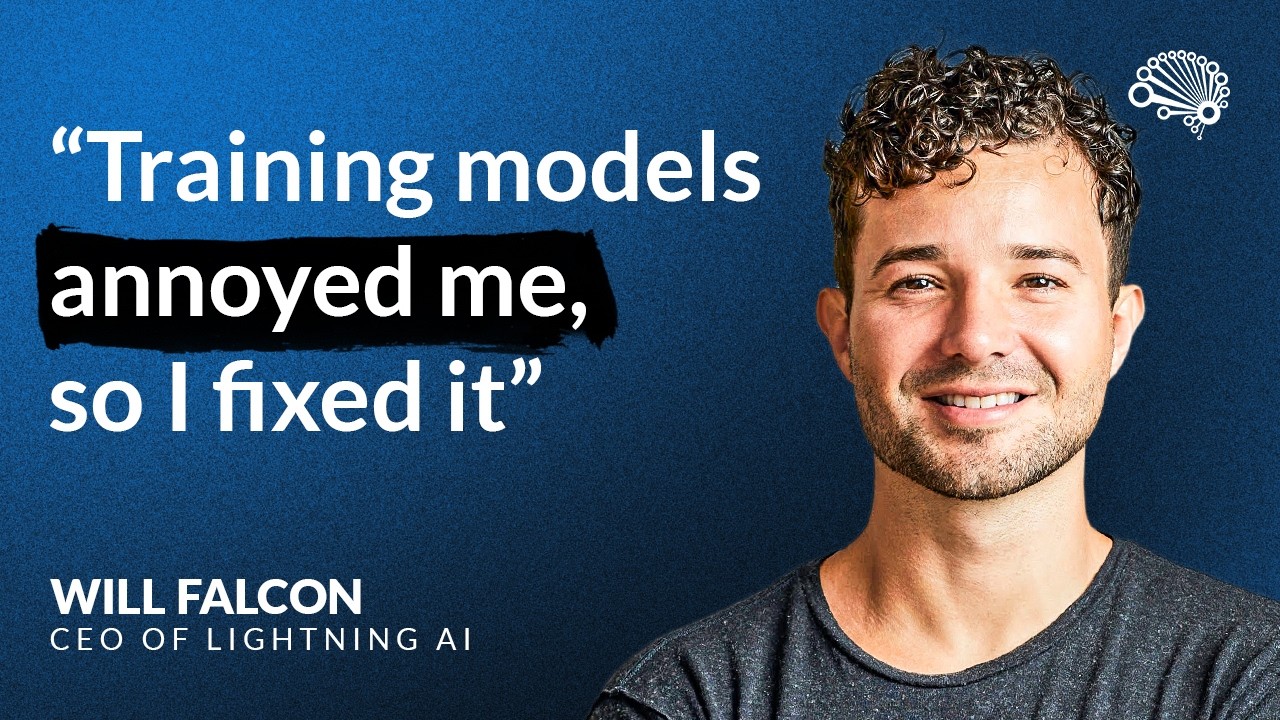
Lightning AI has merged with Voltage Park, creating what is described as the “full-stack AI neo-cloud for enterprises and frontier labs.” This strategic move combines Lightning AI’s comprehensive software ecosystem with Voltage Park’s robust hardware infrastructure, including over 35,000 GPUs. The result is a vertically integrated platform analogous to Apple’s combination of macOS and Mac hardware, designed to provide a seamless and powerful environment for the entire AI development lifecycle.
The Rise of the AI Neo-Cloud
A “neo-cloud” is a new category of cloud provider built from the ground up with a GPU-first architecture. Unlike traditional clouds like AWS, which were originally designed for CPU-based applications and later retrofitted for AI, neo-clouds are optimized for the high-performance demands of training and deploying large-scale models. They work directly with hardware providers like NVIDIA to implement technologies such as InfiniBand and vast storage solutions, offering superior performance for AI workloads.
The merger addresses a key bottleneck in the AI industry: the scarcity and high cost of compute. By integrating Voltage Park’s hardware, Lightning AI can offer its users and enterprise clients more accessible and cost-effective compute, claiming to cut AI costs by up to 70%. This integration also mitigates the fragile economics often associated with smaller, over-leveraged neo-clouds by building on a foundation of strong enterprise customer relationships, significant revenue, and a lack of debt.
Lightning AI Studio: An Integrated Development Environment
Lightning AI Studio is the core software offering, providing a persistent, collaborative, cloud-based development environment. It is designed to replace the fragmented, multi-tool workflow that many AI teams currently use.
Key features of the Studio include:
- Flexibility: Users can work within a web-based VS Code-like interface, or connect their preferred local IDEs (like VS Code or Cursor) and terminals to the remote cloud environment.
- Collaboration: The platform functions like a Google Doc for code, allowing teams to work together in a shared, secure, and auditable environment. This is particularly crucial for enterprises concerned about sensitive data on local machines.
- Full-Stack Capabilities: The Studio integrates all necessary tools for the AI lifecycle, including experiment management, model hubs, training infrastructure, and inference deployment.
- Vibe Coding: An AI coding assistant is built into the platform to help bridge the talent gap. It assists data scientists and non-AI developers in performing complex tasks like fine-tuning models or setting up inference endpoints, effectively handling the MLOps component for them.
- Multi-Cloud and On-Prem: The platform maintains its “bring your own cloud” (BYOC) flexibility, allowing users to connect to any cloud provider or run entirely on-premises for maximum security.
The Origin of PyTorch Lightning
The foundation of the Lightning AI ecosystem is the open-source framework PyTorch Lightning. Its creation stems from Will Falcon’s own experiences as a researcher, first as an undergrad at Columbia and later as a PhD student at NYU and a researcher at Facebook AI Research (FAIR).
- Early Days: The precursor to PyTorch Lightning was a personal research library built on Theano in 2015. The goal was to accelerate research by abstracting away repetitive engineering code, allowing for rapid experimentation with different model architectures. This tool was instrumental in a neuroscience project, reducing a model’s training time on neural decoding data from 21 days to just one hour by enabling multi-GPU training.
- Open-Sourcing at NYU/FAIR: During his PhD at NYU, advised by AI pioneers Yann LeCun and Kyunghyun Cho, Falcon was encouraged to open-source the project. At FAIR, surrounded by the core PyTorch team and other leading researchers, the library was refined and infused with specialized knowledge about large-scale distributed training.
- Core Philosophy: PyTorch Lightning was designed to let researchers focus on the science and math of their models, not the engineering boilerplate. It organizes PyTorch code into a structured format, handling details like multi-GPU training, 16-bit precision, and TPU execution, which were previously complex and error-prone to implement manually.
Today, PyTorch Lightning has been downloaded nearly 400 million times and is the backbone for training large language models at major organizations, including NVIDIA (Nemo), AWS, and LinkedIn. For users who need more granular control, the ecosystem also includes Lightning Fabric, a more “hackable” and less-managed library, and Lit-Serve for building production-grade inference servers.