The Transcript Looked Fine. The Call Wasn't. — Debugging Voice Agents, Arize
Fuad Ali from Arize AI explains why voice agents are uniquely challenging to debug, as critical issues like latency, interruptions, and tone are invisible in text logs. He presents a solution combining unified audio, transcript, and trace views with OpenInference semantic conventions and audio-native evaluations. The talk culminates in a vision for self-healing voice agents through automated observation, evaluation, and improvement cycles, demonstrating how to achieve robust, continuously improving AI voice systems.
The Invisible Challenges of Voice Agents: Beyond Text Logs
Fuad Ali, a Senior Product Manager at Arize AI, addresses the critical and often overlooked challenges in debugging voice agents, a rapidly expanding but inherently fragile domain within AI. He contends that traditional text-based logs are woefully inadequate for identifying nuanced failures unique to voice interactions, advocating for a holistic observability approach.
Why Voice Agents are Uniquely Difficult to Debug
Despite the explosive growth and adoption of voice agents (evidenced by recent developments like GPT real-time and Vercel integrations), they present a complex set of failure modes invisible to standard text logs. These include:
- Latency: Unacceptable delays in agent response.
- Turn-taking issues: Agents interrupting users or experiencing dead air.
- Transcription drift/errors: Mishearing user input.
- Tone and sentiment: Inability to detect user frustration or emotion from audio.
- Barge-in events: When a user speaks while the agent is still speaking.
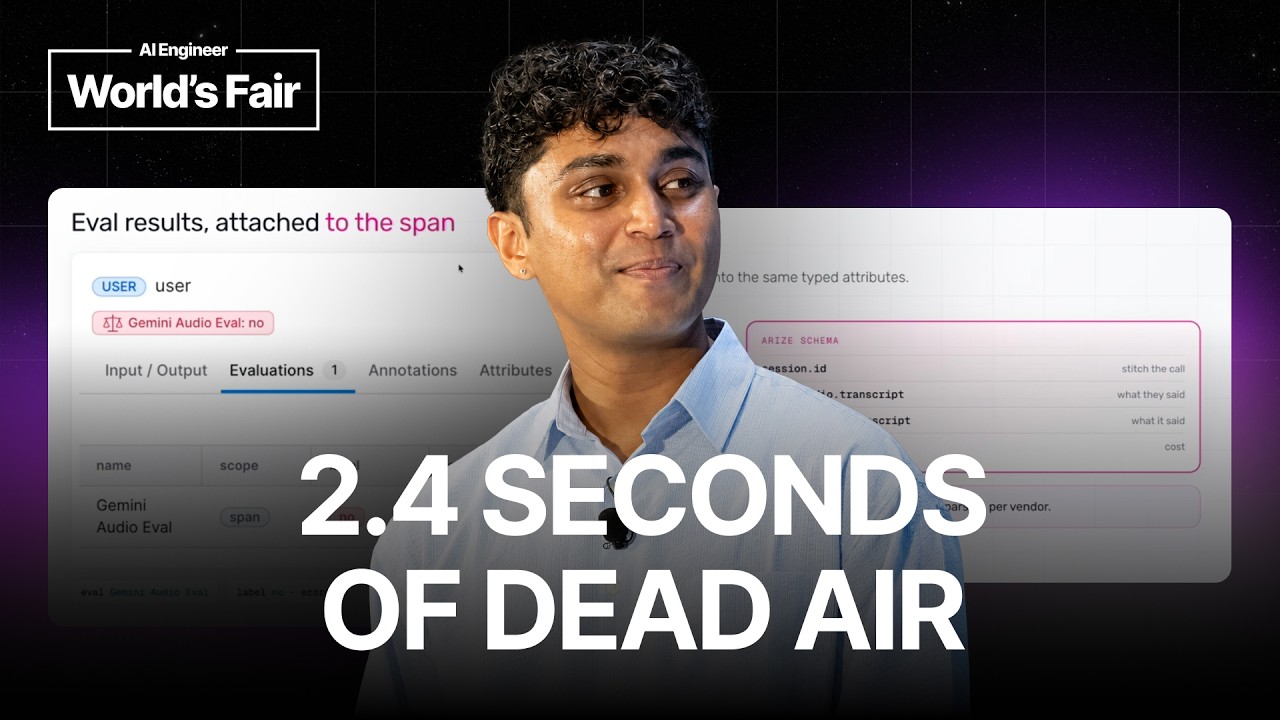
Ali illustrates this with a compelling example of a customer service call for a refund. While the text log initially suggested the agent had self-corrected (user requested refund for order “14”, agent processed for “40”, user corrected “No, 14”, agent confirmed refund), the actual audio revealed severe issues:
- 2.4 seconds of dead air before the agent’s initial response.
- The agent talking over the caller in the correction phase.
- The agent ultimately processing the refund for the wrong order (40 instead of 14), a critical error.
- A flat, robotic tone further exacerbated the poor user experience.
These audio-specific problems would have been completely missed had only the LLM output or transcript been reviewed.
Arize AI’s Solution: Holistic Observability and OpenInference
To overcome these limitations, Arize AI proposes a comprehensive approach centered around a unified session view and standardized tracing:
1. See Beyond the Transcript: Unified Session View
The core principle is to integrate audio, transcript, and trace data into a single, cohesive session view. This allows developers to:
- Observe multi-turn conversations in their entirety.
- Play live audio inline with the trace, providing immediate context.
- Analyze critical metrics such as time-to-first-audio, interruption events, and sentiment.
This approach aims to bring the same rigor and debugging capabilities applied to complex coding agents to the voice domain.
2. Trace Everything with OpenInference Semantic Conventions
Arize AI leverages OpenInference, an open-source, OTel-compliant set of semantic conventions for Generative AI. They have extended these conventions to support real-time audio, enabling:
- Standardized Tracing: It maps web socket events and other real-time audio interactions into an easily understandable and queryable format.
- Provider Agnostic: This allows for consistent tracing across various foundational models and providers (e.g., OpenAI, Google Gemini Live), enabling a “one queryable schema” approach. This eliminates the need for bespoke parsing for each vendor.
- Comprehensive Data Capture: The instrumenter captures the entire session lifecycle, audio input, transcript, conversation items, output, response lifecycle, and token counts.
This standardization is crucial for efficient debugging across potentially billions of traces, especially when quickly identifying issues or swapping in new models.
3. Replay the Whole Conversation
The platform utilizes a session ID to stitch together every turn and web socket event into a complete timeline. This allows users to:
- Play the full audio conversation directly within the UI, without external tools.
- Identify precise moments of interruption, agent pauses, and who spoke when.
- Correlate audio events with tool calls, showing exactly when an agent invoked an external function (e.g., weather API) inline with the conversation, which is vital for debugging tool-related failures.
Audio-Native Evaluations (Evals)
Beyond traditional text-based evaluations, Ali emphasizes the necessity of audio-specific evals:
- Tonality and Sentiment Analysis: Classifying user emotion (positive, neutral, negative, frustrated) directly from audio, which is impossible with text alone.
- Latency SLAs: Monitoring and flagging breaches of time-to-first-audio service level agreements.
- Interruptions and Inaccuracy: Detecting barge-ins, transcription drift, and mishearings.
- Task Success: Evaluating if the agent successfully completed the user’s request, even when accounting for audio-specific challenges.
These evals are designed to run directly against the audio using specialized audio models, rather than just LLMs as judges on transcripts. Arize simplifies their creation through “skills” (e.g., “Hey Claude, create an audio eval for me for sentiment analysis using GPT audio and catch frustrated user tone”). These evals are attached directly to spans, enabling powerful querying and filtering across the data.
The Observe, Evaluate, Improve Loop: Towards Self-Healing Voice Agents
Ali concludes by advocating for a continuous improvement loop: Observe, Evaluate, and Improve. This iterative process is supported by advanced capabilities for self-healing:
- Agent Experiments: Arize introduces “agent experiments” as an automated feedback mechanism. Imagine an SRE agent (not a human engineer) that:
- Automatically analyzes failed traces.
- Hypothesizes potential fixes (e.g., truncating tool results to prevent context overload).
- Deploys the hypothesized fix in a development environment.
- Replays the original failed traces against this fixed endpoint.
- Generates a detailed report card validating the fix (e.g., proving latency reduction).
- Creates a pull request (PR) for human review, effectively automating the entire debugging-to-fix cycle.
This vision allows for rapid iteration and continuous improvement, bringing self-healing software capabilities to voice agents. The speaker strongly urges adoption of the OpenInference Instrumenter and utilizing platforms like Arize to ensure voice agents are developed with the same rigor and observability as other critical software systems.