Terence Tao – Kepler, Newton, and the true nature of mathematical discovery
Terence Tao uses the story of Kepler's discovery of planetary motion as an analogy for AI's role in science. He argues that AI excels at broad, high-temperature idea generation but requires a robust verification process to be useful. The bottleneck in science is shifting from hypothesis generation to verification and curation, a challenge current scientific structures are not equipped to handle. Tao foresees a future of human-AI collaboration where humans provide deep insights and AI explores the vast breadth of possibilities, ultimately making scientific papers richer but not necessarily deeper.
The history of scientific discovery, particularly Johannes Kepler’s formulation of the laws of planetary motion, offers a powerful analogy for the potential and pitfalls of using AI in modern research. Kepler’s journey was not a linear path to a single eureka moment but a decades-long process of generating and testing numerous hypotheses, many of which were incorrect.
Kepler as a “High-Temperature LLM”
Kepler can be viewed as an early “high-temperature LLM”—a prolific idea generator. He initially proposed a beautiful but flawed theory that the orbits of the six known planets were determined by the five Platonic solids nested within each other. This was a creative, aesthetically driven hypothesis.
However, the crucial element that turned his creative exploration into scientific progress was a rigorous verification loop provided by Tycho Brahe’s astronomical data. Brahe’s observations were an order of magnitude more precise than any previous dataset, and this precision was essential. When Kepler tested his Platonic solid model against the data, it failed, being off by about 10%.
This forced Kepler to abandon his elegant theory and spend years analyzing the data itself, eventually leading him to his three empirical laws:
- Orbits are ellipses, not circles.
- A line segment joining a planet and the Sun sweeps out equal areas during equal intervals of time.
- The square of the orbital period is proportional to the cube of the semi-major axis of its orbit.
These laws were discovered empirically, driven by data, not derived from a first-principles theory. It took Isaac Newton a century later to provide the underlying theoretical explanation with his law of universal gravitation. This story highlights that idea generation, even when producing “random astrology” and incorrect theories, can lead to profound discoveries as long as it is coupled with a robust mechanism for verification.
The New Scientific Bottleneck: From Idea Generation to Verification
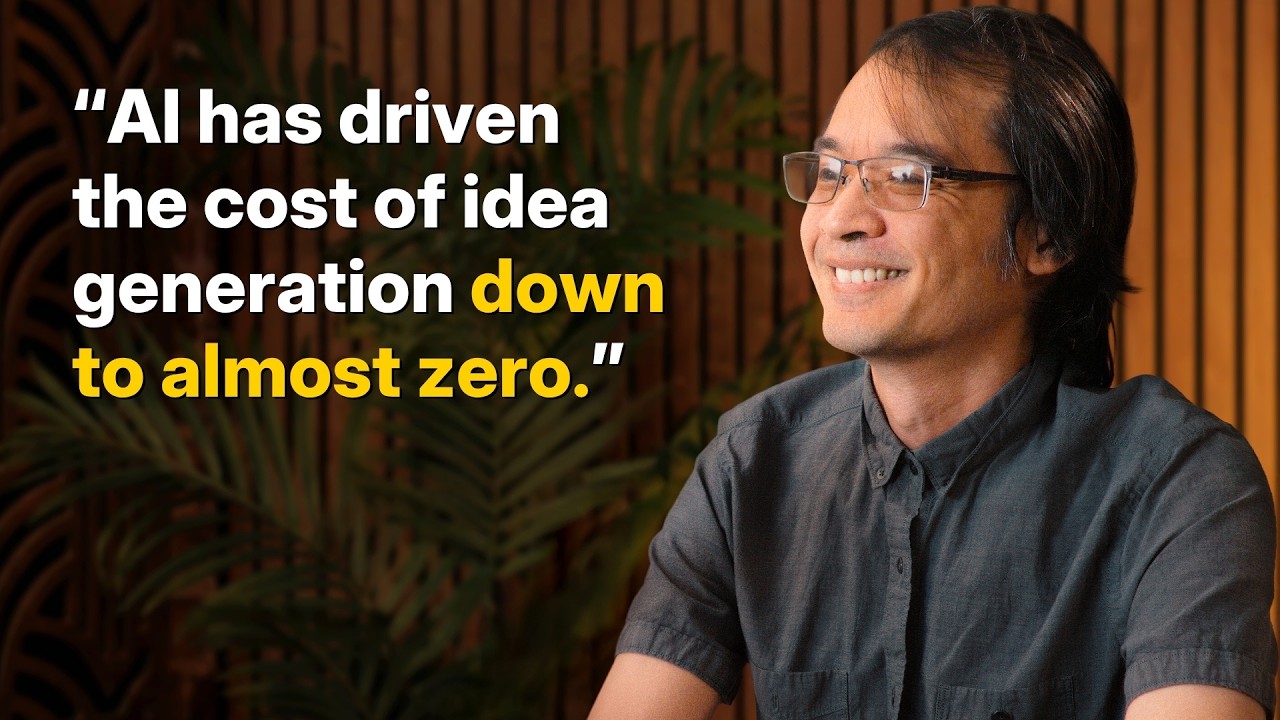
Historically, the most celebrated part of science has been idea generation. However, AI has driven the cost of generating hypotheses down to nearly zero. We are now inundated with potential theories, creating a new bottleneck: verification, validation, and curation.
Our current scientific infrastructure, such as peer review, was designed for a world of scarce ideas and is already being overwhelmed by AI-generated submissions. The challenge is no longer a lack of ideas but an inability to sift through the “slop” to find the signals that represent genuine progress.
This is complicated by the nature of scientific progress itself. A new, ultimately correct theory can initially be less accurate than an established, incorrect one. For example, Copernicus’s heliocentric model with perfect circular orbits was less predictive than the highly-tweaked, millennium-old Ptolemaic geocentric model. It survived this “epistemic hell” not because of its immediate accuracy, but because of a mixture of judgment and heuristics that are difficult to codify. Evaluating which flawed theories represent progress and which are dead ends is a nuanced, subjective process that we don’t know how to automate or scale.
AI for Mathematics: Breadth over Depth
Recent progress in AI for mathematics illustrates its current capabilities and limitations. AI models have successfully solved around 50 of the unsolved Erdős problems, which is a remarkable achievement. However, this progress has plateaued after the “low-hanging fruit” was picked.
These successes share a common pattern:
- The problems solved were typically obscure, with little existing literature.
- The solutions involved combining existing, sometimes obscure, techniques in novel ways.
This demonstrates that AI excels at breadth. It can systematically try every known technique on a vast array of problems, something no human can do. However, it struggles with depth—the process of making cumulative, partial progress on a single, difficult problem. Current models are like “jumping machines” that can clear low walls in a single leap but cannot establish a foothold on a higher cliff and build from there. They lack the ability to learn and adapt their strategy within a single problem-solving session.
This leads to a future of human-AI complementarity:
- AI will map out new fields, handle auxiliary tasks (literature search, coding, numerical simulation), and solve problems that yield to broad applications of known methods.
- Humans will focus on the deep, difficult problems that require new concepts, intuition, and the cumulative building of understanding.
As a result, AI makes research papers “richer and broader, but not necessarily deeper.”
Understanding, Formalism, and the Future
A key question is whether we can gain human understanding from a complex, AI-generated proof (e.g., in a formal language like Lean). The outlook is optimistic. A formal proof, even if initially incomprehensible, is a structured artifact that can be analyzed. A new profession of mathematicians may emerge, dedicated to “post-processing” these proofs—using other AIs to refactor them, performing ablation studies to find the key lemmas, and extracting the core human-understandable insights.
Looking forward, a major challenge is the lack of a formal language for scientific strategy. While Lean formalizes proofs, we have no way to formalize the process of forming plausible conjectures, building narrative arguments, and assessing the promise of a research direction. This is the semi-formal, intuitive language scientists use to communicate, and capturing it is a prerequisite for AIs to contribute to the strategic layer of science.
For now, the human element, particularly serendipity, remains crucial. Over-optimizing research and eliminating inefficient, random explorations—like browsing a physical journal or having a chance conversation in a hallway—could inadvertently inhibit the very kind of discovery it aims to accelerate.