She Raised $64M to Build an AI Math Prodigy | Carina Hong, CEO of Axiom
Carina Hong, Founder & CEO of Axiom, discusses building a self-improving AI reasoning engine that combines generation and verification. Starting with formal mathematics, Axiom's system has achieved superhuman results on the notoriously difficult Putnam Exam by leveraging formal languages like Lean to overcome the probabilistic and unverifiable nature of standard LLMs. Hong explores how this technology can solve major bottlenecks in hardware and software verification, code migration, and database consistency, and what it means for the future of mathematical research.
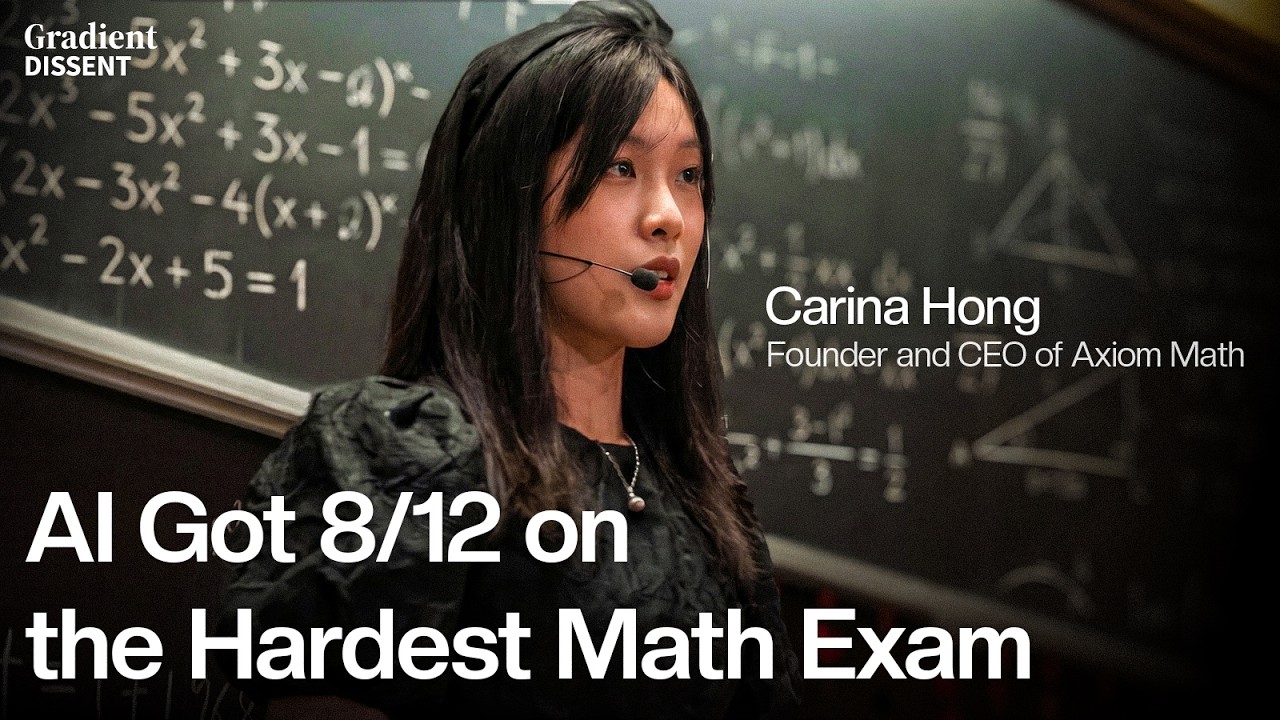
Axiom’s mission is to build a self-improving reasoning engine that uniquely combines generation and verification, an often-overlooked component in the current AI landscape. The company starts with an “AI mathematician” as a testing ground for this self-improvement loop, using formal languages like Lean to ground its natural language capabilities.
The Architecture of a Reasoning Engine
Axiom’s system is built on three core components that interact with each other:
- Prover: A system that can prove theorems.
- Conjecturer: A system that proposes interesting and novel conjectures.
- Knowledge Base: A database of what has already been proven, which both the prover and conjecturer can reference.
Tying these components together is auto-formalization, the process of converting natural language mathematics into a formal language. This is a core technology for Axiom, viewed as being as challenging and important as theorem proving itself.
Superhuman Performance on the Putnam Exam
Axiom’s prover has demonstrated remarkable capabilities on the Putnam Mathematical Competition, an infamously difficult exam for undergraduates where the median score is often zero.
- Axiom’s system solved 8 out of 12 problems within the official time limit, a score that would place it in the top five (Putnam Fellow). A ninth problem was solved shortly after.
- This performance significantly surpasses that of Axiom’s founder, Carina Hong, who scored 4 out of 12.
- This success showcases the power of combining deterministic, formal tools with probabilistic systems. Formal systems cannot “hand-wave” through difficult steps, forcing a level of rigor that informal LLMs lack. For instance, the AI prover might spend significant effort generating detailed code to rigorously prove convergence or limits, something a human might take for granted.
AI vs. Human Problem-Solving
While LLMs can seem impressive on some math problems, they often fail on seemingly simpler brain teasers because they lack true reasoning and verification. They generate solutions statistically without a guarantee of soundness.
- Formal Verification’s Role: Axiom’s use of formal languages like Lean ensures that a proof is sound. Unlike a natural language proof from an LLM, which can have subtle flaws that are hard to spot, a Lean proof is machine-verifiable.
- Interpretability: While the AI may generate proofs that are structured differently from human proofs, they are ultimately interpretable. The formal code of each step can be inspected and converted back to natural language, a significantly easier task than the initial formalization. The AI may find solutions that are convergent with what a human would find, acting like a collaborator with a different style, akin to the discovery of a self-taught genius like Ramanujan.
Applications Beyond Pure Mathematics
The core technology of generation paired with verification has profound implications for high-stakes commercial applications where correctness is critical. Formal verification is a major bottleneck in many industries, often consuming years of effort.
- Hardware and Software Verification: In chip design, verification teams can be three to four times larger than design teams, with verification cycles taking years. AI-powered formal verification can dramatically reduce this time and lower the expertise required. AWS, for example, took five years to manually formalize just one component of its hypervisor.
- Code Migration and Equivalence: When upgrading legacy systems, it’s crucial to ensure the new code is perfectly equivalent to the old code. Formal methods can prove this equivalence, preventing regressions in critical business functions.
- Database Consistency: Formal verification can be used to prove the consistency of database protocols, such as solving the Byzantine Generals Problem, ensuring reliability even in the presence of bad actors.
- Spec-Driven Development: The approach mirrors spec-driven models like Kiro from AWS, where a formal specification can be used to generate verified code (e.g., in a language like Rust), unifying implementation and verification into a single process.
The Future of Mathematics with AI
AI will not replace mathematicians but will change the nature of their work by allowing them to operate at a higher level of abstraction.
- Mathematicians can focus on developing high-level intuition and guiding the overall direction of research.
- The AI will act as a “diligent grad student,” handling the laborious and technical work of checking every lemma and formalizing proofs.
- AI will also play a crucial role in mathematical discovery, constructing interesting examples and counterexamples to guide the formation of new conjectures. This creates a powerful feedback loop: a mathematician’s intuition leads to a conjecture, the AI proves it, and the process generates new patterns and conjectures to explore.