Max Hodak: What Really Kills Deep Tech Startups?
Max Hodak, CEO of Science, reveals that deep tech startup success, exemplified by their retinal implant, is fundamentally driven by robust internal infrastructure. He argues that meticulous design of processes like purchasing, hiring, and unique 'EigenReviews' dictate a company's iterative speed. Hodak emphasizes the irreplaceable founder's judgment, action-driven information generation, and the critical role of custom operating systems, including AI-native tools, in achieving impactful outcomes in complex, capital-intensive fields like biotech.
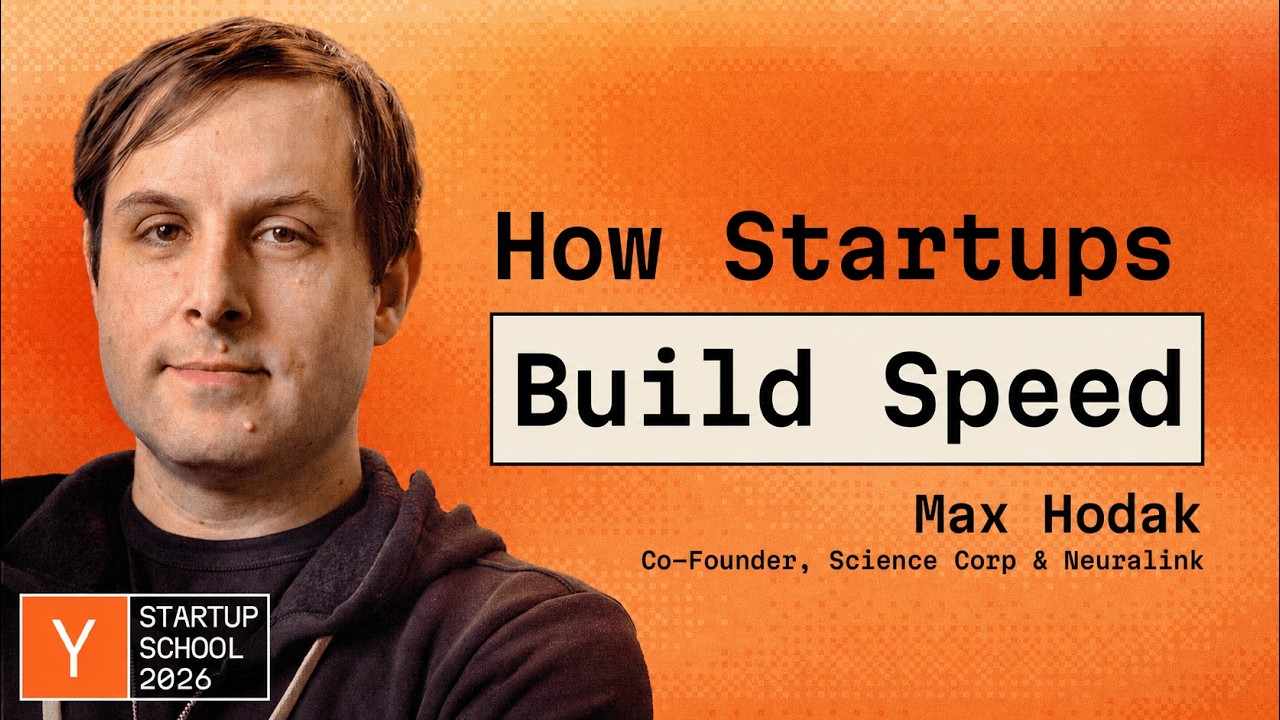
Max Hodak, CEO of Science, presented a compelling case for the critical role of robust internal infrastructure in the success of deep tech startups, arguing that “amateurs talk strategy, professionals talk logistics.” While Science’s groundbreaking retinal prosthesis (a chip implanted under the retina to restore vision, already enabling a patient to read a 300-page novel) exemplifies technological innovation, Hodak stressed that the ability to scale and iterate rapidly is determined by foundational, often overlooked, internal systems.
The Indispensable Role of Infrastructure
Hodak contends that unlike pure software startups, deep tech companies constantly acquire “many, many thousands of things” and hire extensively. The “rate of iteration separates success from failure,” and this speed is directly a function of well-designed infrastructure. He posits that deep tech companies more often fail due to an inability to manage human organizations and their operational systems rather than due to technical feasibility issues.
Streamlining Purchasing and Cost Management
A common challenge highlighted is “the 17th employee problem”: how does a growing team efficiently acquire necessary resources? Hodak illustrates the pitfalls of micromanaging purchases (e.g., scrutinizing a $3,000 power supply) versus the significant costs of delaying high-paid employees. He argues that spending review must occur earlier through budgeting, allowing teams to make trade-offs within allocated resources.
Procurement, often seen as an academic’s trivial task, becomes a critical bottleneck in startups, involving complex vendor relationships, certifications, and multi-week lead times. Science addresses this by actively managing procurement metrics. Furthermore, buying in bulk for diverse experiments complicates cost attribution, leading to the perception that “experiments are free.” Hodak reveals that a single wafer iteration, for instance, can cost $40,000, rapidly depleting a startup’s runway if not tracked.
Science’s solution is “Helix,” an extensive internal software platform that centralizes almost all company operations, from purchasing to manufacturing steps. This allows for precise correlation of data, enabling accurate cost attribution, pricing estimates, and transparent understanding of spending and runway, which Hodak argues is crucial for survival.
Building a Rigorous and Scalable Hiring Process
Hiring is another universal challenge that distinguishes successful from failing startups. Hodak notes that the best companies emerge from specific “scenes,” leveraging their network for initial hires. However, scaling requires hiring from the general public, necessitating a “defined process.” Without one, recruiting quickly becomes an overwhelming bottleneck.
Science has developed a four-step hiring process, replacing commercial Applicant Tracking Systems (ATS) with custom software for greater flexibility:
- Company-wide Voting: Upon application, the system pings 7-8 current employees (matched by background) for a vote (“Known good,” “Strong yes,” “Yes,” “No,” “Strong no”). This distributes the initial review load, prevents bottlenecks, and averages judgment.
- Phone Screen: Conducted by a company-wide pool, this screen assesses three core qualities:
- Judgment: Ability to make good decisions in complex, vague situations.
- Horsepower: Fundamental technical competence and learning ability.
- Agency: Effectiveness in shaping the world to their will.
- Homework: Half of phone-screened candidates proceed to take-home assignments. Ideally, these are AI-resistant, have a high ceiling, and are numerically scorable, allowing for quick evaluation of exceptional ability.
- Full Interview: The final stage, designed for a high conversion rate (at least 25%) to ensure efficient use of time.
Hodak asserts this four-step sequence is the minimum necessary for a comprehensive hiring decision.
Rethinking Performance Reviews with “EigenReviews”
Traditional annual 360-degree reviews are deemed disruptive, infrequent, and often only confirm existing, unaddressed issues. Hodak advocates for “synthetic gradients” to provide continuous feedback.
Science’s “EigenReviews” system addresses this: every 4-6 weeks, employees are prompted via Helix with a single question: “Knowing how this person turned out, would you vote again today for their hire?” The system then constructs a feedback graph, weighting votes higher from employees themselves rated highly (analogous to Google’s PageRank). This distributed, continuous system (with about a month’s lag) offers superior insight into company performance and talent, while utilizing techniques like Markov chain Monte Carlo dropout to detect potential voting cliques.
The Founder’s Non-Delegable Judgment and the Power of Action
A crucial lesson for founders is the inability to delegate judgment. As CEO, decisions must resonate with one’s own conviction, even in isolation, as success demands “differentiatedly good” judgment. This becomes particularly acute years into a company’s journey when high-stakes decisions offer no external advice.
Furthermore, Hodak emphasizes that “action produces information.” It’s difficult to get truly stuck; the action space is always larger than it appears. Taking action, even seemingly disruptive ones (e.g., removing a well-liked but ill-fitting employee), injects “entropy” that unblocks progress and creates new information. The company’s “operating system”—its processes for purchasing, accounting, recruiting, and more—fundamentally dictates its reach and impact.
Q&A Insights
- Industry vs. Academia: When a field matures, industry often outpaces academia in resources and speed. For aspiring deep tech founders, working at a high-performing company to learn “organizational skills” and “empirically excellent judgment” is often more valuable than a PhD, though context varies.
- Exceptional Ability: Evidenced by winning “legible competitive games” (e.g., chess grandmaster, Formula SAE competitions) or concrete achievements distinguishing individuals from their peers.
- AI and Engineering Hiring: Science doesn’t use LeetCode; instead, they focus on evaluating “thinking” (e.g., design questions, problem decomposition) rather than raw coding ability, acknowledging AI’s role as a coding multiplier.
- Lessons from Neuralink: Working with Elon Musk provided invaluable “reinforcement learning” for developing sound judgment in high-stakes situations, highlighting that startup success lacks a generic algorithm or shortcuts.
- BCIs and Consciousness: Hodak believes BCIs can definitively address consciousness, seeing it as a practical, not philosophical, problem, solvable by fully mapping and driving neural activity.
- Contributing to BCIs: Given its interdisciplinary nature, a broad understanding of the problem space, coupled with a specific “hard skill” (e.g., software, electronics, materials science), is crucial. Science values smaller, integrated teams that can hold more of the problem in their heads.
- AI’s Impact in Scientific Research: AI acts as a multiplier, not a replacement. Its biggest impacts at Science are in coding, streamlining complex regulatory compliance (by quickly finding standards and generating evidence tables), and generally making companies “AI-native” by centralizing data for agents.
- Custom Infrastructure: Hodak champions building bespoke internal software (like Helix) over commercial solutions. While initially contrarian, this “harness fit” approach allows for unique processes (e.g., their voting-based ATS) and greater efficiency, especially with modern “vibe coding” capabilities.
- BCIs as Longevity/Healthcare: Near-term BCIs are primarily a longevity and healthcare story, offering “effect sizes” (e.g., deep brain stimulation for Parkinson’s, cochlear implants) that traditional medicine struggles to achieve. By dealing directly with the brain, they bypass difficult biology problems, yielding reliable engineering gradients and profound patient impact.
- Funding Strategy: Founders should determine the cost of the next value inflection experiment, then raise twice that amount, pushing for profitability sooner to ensure long-term sustainability and attract diverse investors.
- Hardest BCI Challenges: Key engineering hurdles include managing power and thermal constraints on implants and developing advanced “packaging” (conformal coatings) that protect devices from the body’s aggressive environment without causing harm.
- Biotech for Founders: Remains capital-intensive and a long commitment (a decade). However, its impact on patients and the world, driven by a desire for “power to heal the sick” rather than just money, is unparalleled.
- Wrong Popular Belief: The very act of investing in bespoke internal systems like Helix is contrarian to common startup advice, but Hodak believes it’s essential for achieving true differentiation and control.