Rebuilding the Computer for the AI Age: Unconventional AI's Naveen Rao
Naveen Rao, CEO of Unconventional AI, argues that the 80-year-old digital computing paradigm is hitting a fundamental energy wall. He proposes a new approach to AI hardware, inspired by neuroscience, that replaces matrix math with nonlinear dynamics, leveraging the time domain for computation to approach the thermodynamic limits of efficiency.
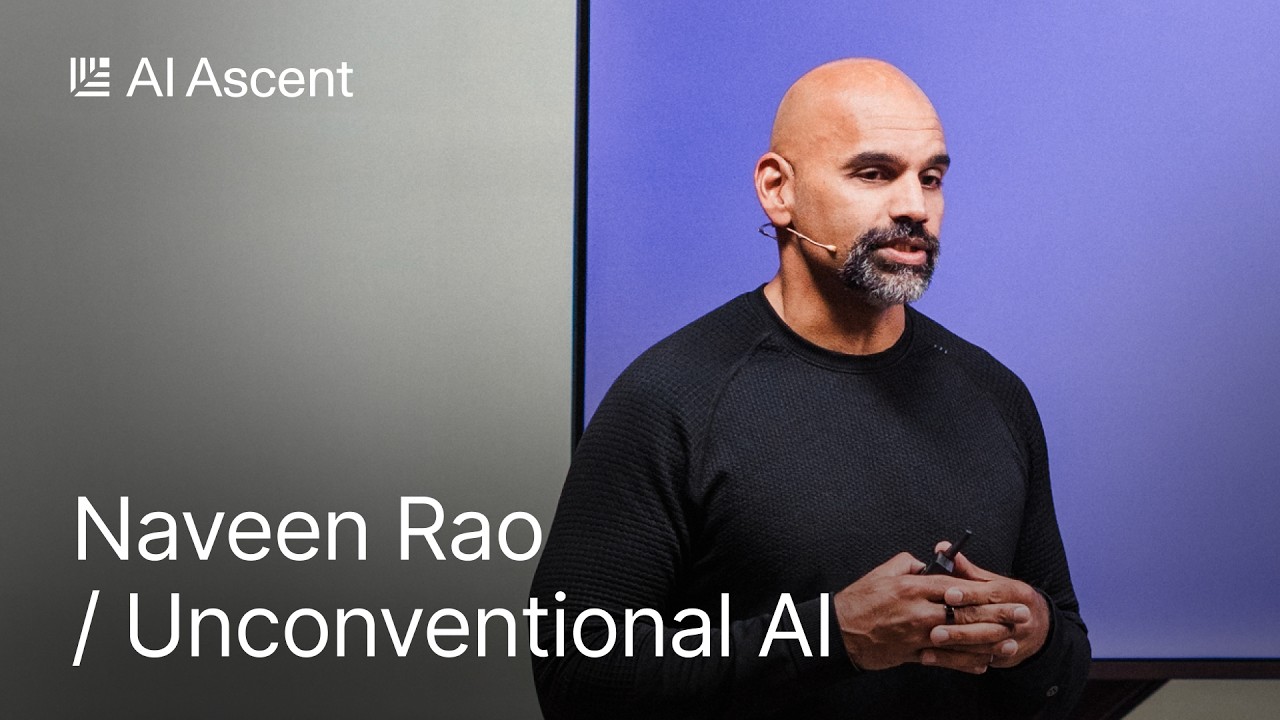
Naveen Rao, CEO of Unconventional AI, posits that the foundational principles of digital computing, established 80 years ago, are no longer suitable for the era of intelligence. The current trajectory of scaling AI is unsustainable and will soon collide with a fundamental physical limitation: the world’s energy supply.
The Approaching Energy Wall
The core issue is the staggering inefficiency of our current computing substrate. The entire human population, all 8 billion people, operates on a collective brainpower of just 160 gigawatts (at ~20 watts per brain). In contrast, AI training and inference already consume many gigawatts, and within the next two to four years, we will reach a point where there is simply no more available energy to dedicate to AI. While we can build more power plants, the inefficiency of the underlying computation model remains the bottleneck.
A computer performing inference, including the energy to build and run the model, can consume megawatts or even a gigawatt of power, whereas a human accomplishes more complex tasks on just 20 watts. This highlights a massive discrepancy in energy efficiency that cannot be overcome by incremental improvements.
The Thermodynamic Limit of Intelligence
There is a thermodynamic limit to intelligence per watt, a concept derived from the Landauer principle, which dictates the minimum possible energy required for a computation.
- The Limit: This represents the absolute asymptote of computational efficiency.
- Biology: Nature, through 4 billion years of evolution, has produced systems (like the brain) that are remarkably efficient, operating close to this limit—perhaps within two orders of magnitude.
- Current Technology: Today’s GPUs and conventional hardware sit roughly three orders of magnitude below biology’s efficiency.
The goal is to bridge this vast gap by rethinking computation from first principles, rather than continuing to build upon an outdated, 80-year-old digital abstraction.
A New Paradigm: Nonlinear Dynamics
The proposed solution is to move away from the von Neumann architecture and its reliance on matrix math. The brain does not use floating-point numbers or matrix multiplications; it uses nonlinear dynamics, where computation is embedded in the time-varying interactions between neurons.
Key principles of this new approach include:
- Computation in Time: Instead of the traditional von Neumann cycle of fetching data from memory, operating on it, and writing it back—a process that burns most of the energy—this new model uses the physics of the system itself to compute. An initial state is set, and the system is allowed to evolve naturally over time. The state is implicit, and the computation occurs along the time axis.
- Coupled Oscillators: The hardware can be conceptualized as a fabric of coupled electronic oscillators. The “program” or “model” is encoded in the trainable couplings between these oscillators. By adjusting these connections, the system can be trained to follow specific trajectories through its state space, effectively performing computations.
- Non-Von Neumann Architecture: This method completely merges state and computation. There is no longer a separation between memory and the processing unit, eliminating the primary source of energy waste in current systems.
Prototype and Demonstration
Unconventional AI has already developed a working prototype, designing and taping out a chip in just six months—a feat made possible by using AI in the design process.
A demo showcased a generative model running on a simulation of this dynamical system. After being trained on images of animals (e.g., cats, horses), the system could generate recognizable images. Starting from a random state, an error is backpropagated at t=1 to nudge the system toward a specific class (like “horse”). From that point on, the system evolves on its own, not only converging on horse-like images but also smoothly morphing between different representations it has learned, demonstrating that it has organized its state space in a meaningful way. This proves the system is trainable and can be connected to solve practical AI problems.