Cognitive Exhaust Fumes, or: Read-Only AI Is Underrated — Šimon Podhajský, Head of AI, Waypoint
A deep dive into a "read-only" personal AI system that analyzes your digital footprint—or "cognitive exhaust fumes"—from sources like email, notes, and browsing history. The author argues that this observer approach provides more profound insights and is inherently safer than action-oriented AI agents, by preventing data contamination and mitigating the high-stakes risks of write-access errors.
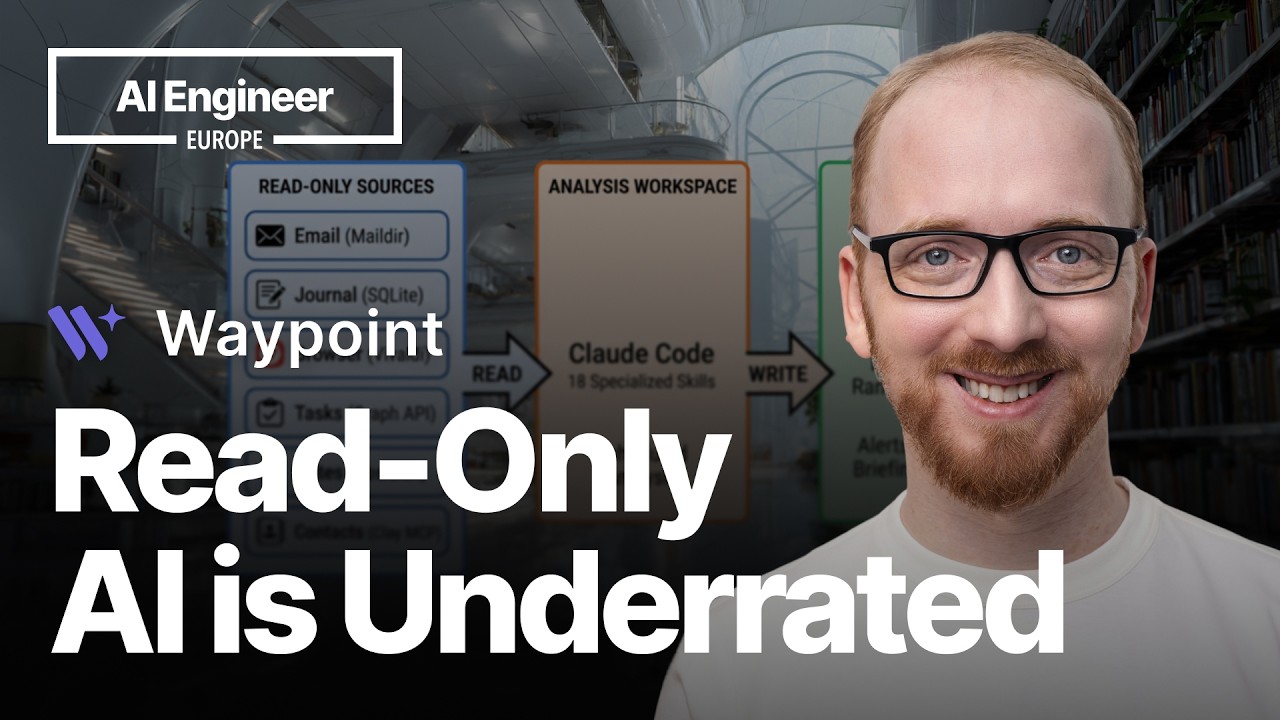
The prevailing trend in personal AI is the development of agents that can act on a user’s behalf. However, this approach carries significant risks. An alternative is a read-only personal AI system, designed to analyze your digital activity without the ability to modify any data sources. This system acts as an “observer” rather than an “agent.”
The Concept of “Cognitive Exhaust Fumes”
The digital byproducts of our cognitive processes—such as browser history, emails, journal entries, and task lists—are termed “cognitive exhaust fumes.” Individually, these data points might seem like waste, but when analyzed collectively, they can diagnose the state of our cognitive “engine.” The real value lies in the cross-source signal, which reveals patterns that no single application can see. For example, your email client doesn’t know what’s in your journal, and your task manager is unaware of your browsing habits. This cross-source analysis can highlight:
- Intention-Action Gaps: Discrepancies between what you plan to do and what you actually do.
- Attention Drift: Where your focus is unintentionally shifting.
- Relationship Decay: Neglected connections in your personal or professional network.
System Architecture: Fulan
The presented system, named Fulan, operates on a simple three-zone architecture:
- Sources: Six data sources (e.g., email, journal, tasks, CRM, browser sessions, notes) are accessed with read-only permissions. The AI never writes back to these sources.
- Workspace: This is where the analysis happens. Scripts query the sources and use an LLM (like Claude) to synthesize insights.
- Outputs: The generated analysis, such as a weekly reflection, is saved to a separate location (e.g., an Obsidian vault, Notion, or text files), keeping the original data sources pristine.
Practical Applications
Two primary use cases demonstrate the system’s power:
- Weekly Reflection: Inspired by David Allen’s Getting Things Done (GTD), the system generates a structured Markdown document reflecting on the week’s activities. It synthesizes themes, identifies tensions, reviews commitments, and highlights notable moments, offering a deep reflection on your thinking patterns rather than a simple productivity report.
- Cross-Source Queries: By combining data from multiple sources, the system can answer complex questions. For example, by querying recent reading history (from browser data) and a personal CRM, the AI can suggest people in your network to discuss specific topics with. This insight is generated without sending any messages or scheduling meetings, leaving the final action to the user.
The Philosophy: Why Read-Only?
The read-only constraint is an intentional design choice, not a limitation. The core arguments for this approach are:
- Risk Asymmetry: A read-only error has zero downside—you can simply ignore the output. A write error, however, can have unbounded negative consequences, potentially damaging your career, relationships, or reputation.
- Avoiding Cognitive Pollution: Once an AI starts writing to your data sources (e.g., drafting emails), the “cognitive exhaust” becomes contaminated. You can no longer distinguish between your own patterns and those of the human-AI hybrid, making genuine self-reflection impossible.
- Reclaiming Agency: A read-only system provides insights and suggestions, but the decision to act remains with you. It supports your agency rather than attempting to automate it away.
- Observers vs. Agents: An “observer” AI provides high-value reflective insights (e.g., realizing you’ve avoided a key project for weeks), whereas an “agent” typically saves a few seconds on a low-value task. They are different product categories serving different needs.
Security Considerations
While safer, a read-only system is not without risks:
- Mosaic Effect: Combining many small, seemingly innocuous pieces of data can create a detailed and sensitive profile, making the system a high-value target.
- Lethal Triquetra: While the system avoids direct write access, it can still interact with the external world (e.g., via shell access or API calls to services like Anthropic), which introduces a potential vector for data exfiltration. The most significant risk lies in sending a large corpus of personal data to a third-party API.
The key is not to claim the system is perfectly secure, but to have examined the security posture and consciously accepted the remaining risks.