The Nuclear Renaissance - Radiant | a16z American Dynamism
Radiant is revolutionizing nuclear power with factory-built, portable Kidos microreactors designed for rapid deployment and simplified operation. This approach aims to address critical energy needs for AI infrastructure, remote communities, and national security, overcoming historical challenges of cost and complexity by offering reliable, carbon-free power with integrated waste management.
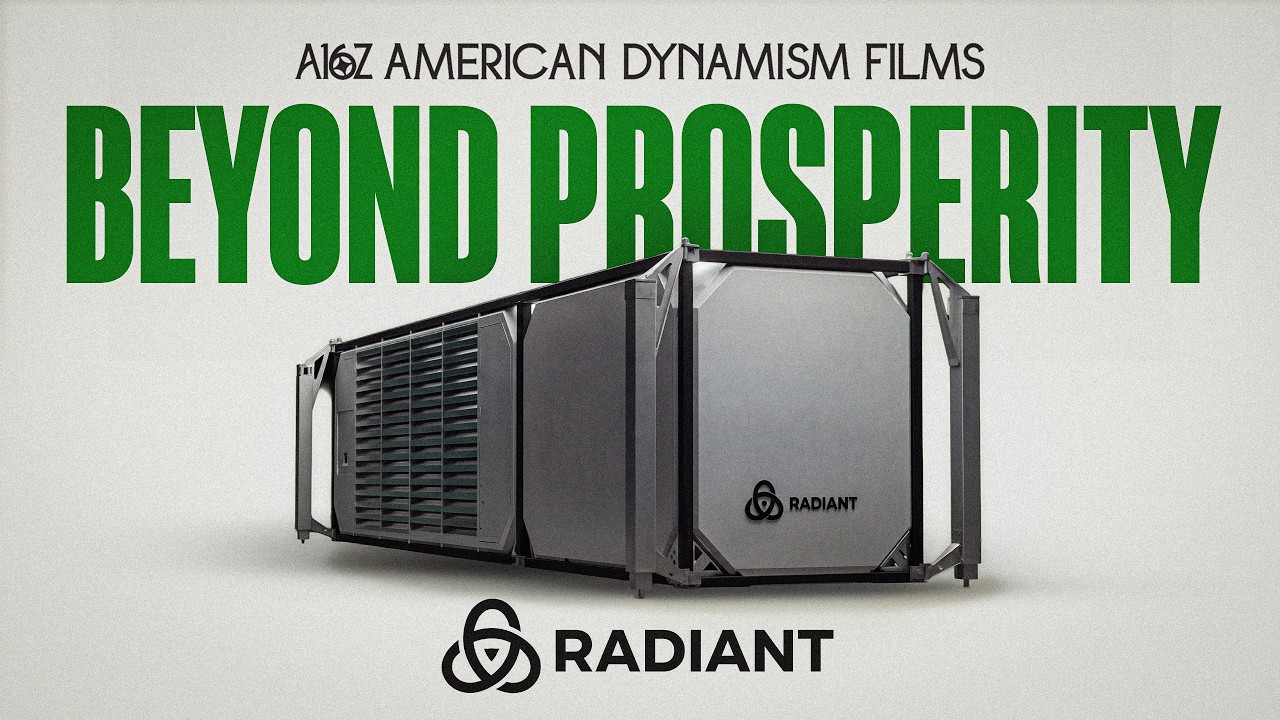
The core thesis of Radiant centers on advancing human prosperity by democratizing access to affordable and reliable power, positing that “power is the source and it is civilization itself.” Historically, the United States’ ability to innovate in nuclear power diminished due to a disconnect from customer needs and over-regulation, which rendered it “too expensive.” This led to a period where, despite early successes like the 52 reactors built at Idaho National Laboratory (INL) within 21 years (ending in 1977), no advanced reactors have been deployed since. Misinformation from environmental groups also contributed to public apprehension and regulatory tightening.
The existing US energy grid, largely constructed in the 1960s and 70s, is increasingly inadequate for modern demands, evidenced by nearly half of Americans experiencing power outages annually. To foster innovation and prosperity, a significant surplus of energy beyond baseline needs is crucial. Furthermore, achieving energy independence is a vital national security imperative, insulating the nation from geopolitical vulnerabilities linked to foreign energy reliance. Nuclear power, Radiant argues, is uniquely positioned to provide this critical energy security.
Radiant’s inception stems from an ex-SpaceX engineer’s work on the Mars challenge, where the necessity for multiplanetary life underscored the indispensable role of nuclear power for extraterrestrial energy generation. Recognizing a gap in the market for such solutions, the founder was compelled to establish Radiant to meet these burgeoning energy demands.
Radiant’s Kidos Microreactor: A Paradigm Shift
Radiant’s flagship innovation, the Kidos microreactor, represents a fundamental shift from traditional, decade-long nuclear construction projects to a “factory-built product.” Its design and operational model offer several transformative advantages:
- Portability and Deployment Flexibility: Kidos reactors are designed for mobility, capable of being transported by land, air, and sea. Their above-ground, movable design allows deployment precisely where customers require power, eliminating the need for permanent, extensive onsite infrastructure.
- Integrated Waste Management: Radiant addresses a major historical friction point by managing the entire fuel cycle. After use, reactors are returned to Radiant’s factory in Oak Ridge, Tennessee, for refueling. This approach absolves customers of the burden of managing “radiological sites forever,” handling “all of the parts of the nuclear industry that customers didn’t want.”
- Superior Performance and Scalability: Comparable in size to a diesel generator, a Kidos reactor provides power for five years on a single fueling, significantly outperforming diesel units that require refueling every eight hours, while delivering “many, many times more power.” Multiple Kidos units can be “daisy-chained” to meet larger energy demands, capable of powering a small city or a very large data center.
- Customer-Centric Simplicity: Radiant aims to streamline the nuclear power experience to be as user-friendly as an iPhone. The company meticulously controls all costs within its factory, transferring “zero uncertainty” to the customer regarding construction, interconnection, or onsite activities. The operational promise is straightforward: “make a reactor. It shows up, it plugs in, you get power.”
This factory-built model eliminates the uncertainties and high costs associated with traditional onsite construction, enabling predictable pricing and efficient mass production. The 1-megawatt scale of Kidos is pivotal for its transportability and the return of spent fuel, offering “no nuclear strings attached” and guaranteeing “clean power.” This inherent portability is also critical for national security, facilitating the rapid deployment of advanced technologies like AI or drones in remote, off-grid locations by providing “the grid with you in a box.”
Testing, Partnerships, and Future Vision
Radiant is making significant strides toward deployment, targeting 2026 for testing a commercial prototype at Idaho National Laboratory’s historic dome. This facility, originally built in the 1950s for an experimental breeder reactor, has been repurposed for this crucial test, for which Radiant was competitively selected by INL. The Kidos system is engineered to operate at over 700°C for 150 continuous hours during testing, validating its robust performance. This partnership with INL, coupled with supportive presidential executive orders, has accelerated Radiant’s progress.
Radiant aspires to be the first company to commercially deploy a new microreactor, underscoring that safety is foundational for both commercial viability and its broader mission. The current period is seen as a “full-on renaissance” for nuclear power, with Radiant demonstrating the courage to take calculated risks and prove that nuclear solutions can be deployed rapidly and safely. The ultimate vision extends to a future where reactors are mass-produced—perhaps “one nuclear reactor per week”—enabling ubiquitous power generation for space exploration, sub-oceanic cities, or extreme environments like Mount Everest. Radiant’s audacious goal is to “change society’s relationship to energy” through “ridiculous” but transformative innovations, ultimately empowering civilization to achieve multiplanetary existence.