Abstraction & Idealization: AI's Plato Problem [Mazviita Chirimuuta]
Professor Mazviita Chirimuuta discusses the philosophical underpinnings of neuroscience, challenging the brain-as-computer metaphor. She introduces 'haptic realism'—a view of knowledge as interactive and constructed—and argues for the inseparability of embodiment, finitude, and true understanding in both humans and AI.
The Problem of Abstraction in Science
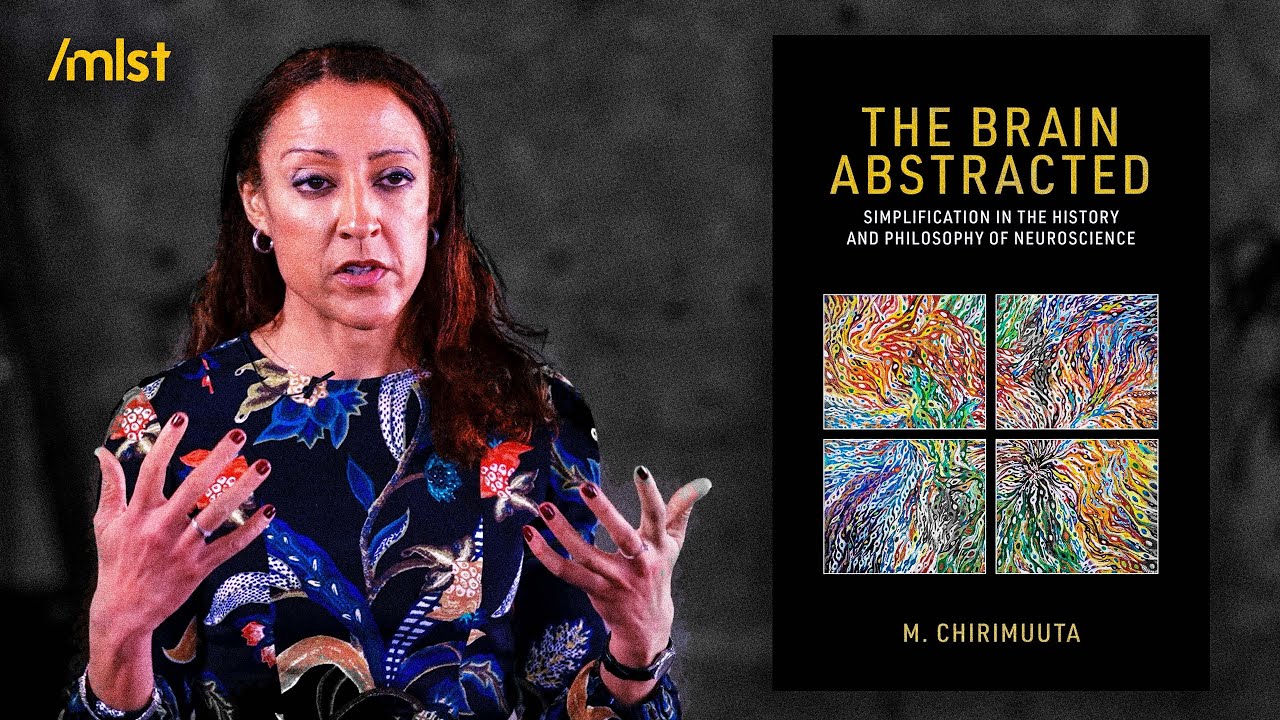
Scientific inquiry fundamentally relies on simplification to make the world legible, but this process involves critical choices about what details to ignore. In her book, The Brain Abstracted, Mazviita Chirimuuta explores the distinction between two key types of simplification:
- Abstraction: The process of ignoring details known to exist in a concrete system. For example, ignoring friction in a basic physics problem.
- Idealization: Attributing properties to a system that are known to be false, often to make mathematical modeling more tractable, such as assuming infinite populations in genetics.
Chirimuuta contrasts two views on abstraction. The first is a Platonic or “lofty” view, common among some AI researchers, which posits that a neat, mathematical, and decomposable reality underlies our messy world of appearances. This “kaleidoscope effect” suggests that science is a process of discovering these fundamental, pre-existing patterns.
The alternative, more “down-to-earth” view, which Chirimuuta favors, is that abstraction is a necessary tool for finite knowers. We simplify not because reality is simple, but because our cognitive capacities are limited. We pretend things are simpler than they are to gain analytical traction. From this perspective, when scientists distinguish “signal” from “noise,” it is a decision based on their current goals and interests. What is considered noise for one investigation could be a crucial signal for another, or for the system’s functioning in the natural world.
A Cautionary Tale: The Reflex Theory
The history of neuroscience provides a powerful example of how oversimplification can lead a field astray. The reflex theory, dominant in the late 19th and early 20th centuries, proposed that all brain functions were essentially complex versions of simple sensory-motor reflex arcs.
Even its proponents, like the influential physiologist Charles Sherrington, admitted that the “simple reflex” was a pure idealization that likely didn’t exist in nature. Yet, this simplified model was embraced as the key to unlocking the complexities of the nervous system. The theory ultimately failed because it was too simplistic to account for the vast amount of experimental data, and it was eventually superseded by the computational theory of mind, which offered a new, powerful set of idealizations.
The Brain-as-Computer Metaphor
The idea that the brain is a kind of computer is a powerful and productive metaphor, but Chirimuuta warns against its “ontologization”—the leap from saying the brain can be modeled as a computer to declaring that the brain is a computer. This move gives researchers license to ignore the messy, complex biological realities of the nervous system, such as biochemistry, the role of the vasculature, and interactions with the immune system.
The core challenge to the computational theory of mind is its lack of specificity. If computation is merely a matter of mapping physical dynamics to a computational formalism, then any physical system—a rock, a sofa, the weather—can be described as implementing a computation. What, then, makes the brain special?
Furthermore, drawing on John Searle, Chirimuuta argues that computation itself, as a mathematical formalism, lacks causal powers. Causal power resides in concrete, physical systems. The computational theory of mind attempts to explain a concrete physical phenomenon (cognition) with a non-causal, abstract formalism (computation), creating an explanatory gap.
Haptic Realism: Knowledge Through Interaction
As an alternative to traditional scientific realism and empiricism, Chirimuuta proposes haptic realism. This view emphasizes that knowledge is not passively received but actively constructed through interaction with the world.
“The contrast here is with an ideal of knowledge which is based on this idea that we can know things in a disengaged way… John Dewey called it the spectator theory of knowledge.”
Instead of a visual metaphor for knowledge (passively observing from a distance), haptic realism uses the metaphor of touch. To know something is to engage with it, manipulate it, and inevitably change it in the process. Scientific knowledge is always the product of this interactivity between human agents (with their goals and frameworks) and the world, which “pushes back.”
This leads to a more pluralistic view of science. Nature is “protean”—like the mythological shape-shifter Proteus, it is inexhaustibly complex. It can be “pinned down” to yield true answers, but there is no single, final theory that will capture its essence once and for all. Different paths of inquiry can yield different, equally valid, forms of knowledge.
Embodiment, Agency, and Understanding
Applying these ideas to AI, Chirimuuta is skeptical that a disembodied system like a Large Language Model (LLM) can achieve understanding in the way humans do. Human cognition is not a set of discrete, detachable modules. Our linguistic abilities are deeply entangled with our sensory-motor engagement with the world, our embodiment, and the fundamental challenges of biological existence.
“The idea that you could just sort of detach off a language faculty, have it replicated in an LLM that doesn’t have the other bits of our cognition and it doesn’t have embodiment… and that it could have understanding in the same way that we do. I find that implausible.”
Agency is another key factor, characterized by responsiveness to distal causes—events far removed in time and space. While a simple physical system’s behavior is determined by proximal forces, a cognitive agent’s actions are shaped by memories, future goals, and abstract concepts.
The biological implementation of the brain is not a trivial detail that can be abstracted away. The incredible energy efficiency of the brain, compared to the vast resources required by artificial neural networks, suggests that its “messy” biological substrate is fundamentally intertwined with its function.
Heidegger, Technology, and Human Finitude
Drawing on the philosopher Martin Heidegger, Chirimuuta suggests that the modern technological project, including the quest for strong AI, can be seen as the culmination of a metaphysical tradition that seeks to transcend human finitude. It reflects an aspiration to escape the limitations of our embodied, situated existence and leap into a “spiritual world of pure information.”
This is mirrored in how we talk about technology. We use metaphors like “the cloud” that present it as immaterial, weightless, and disconnected from the real-world constraints of energy consumption, resource extraction, and physical infrastructure.
This increasing mediation of our lives through technology is running a massive, uncontrolled experiment, particularly on children. By reducing the amount of direct, face-to-face social interaction, we may be fundamentally altering how the next generation develops, with unknown consequences for their ability to lead happy, fulfilling lives.