How AI Agents Pay: Checkout in ChatGPT and Google AI Mode — Sam Parsons, PayPal
Sam Parsons from PayPal Enterprise Payments explores three distinct ways merchants can accept payments initiated by AI agents: Instant Checkout in ChatGPT (Agentic Commerce Protocol), Google AI Mode (Universal Commerce Protocol), and a custom MCP app with an external checkout page. He details the technical flows, emphasizing tokenization for secure transactions and outlining the trade-offs between in-agent experiences and full merchant control.
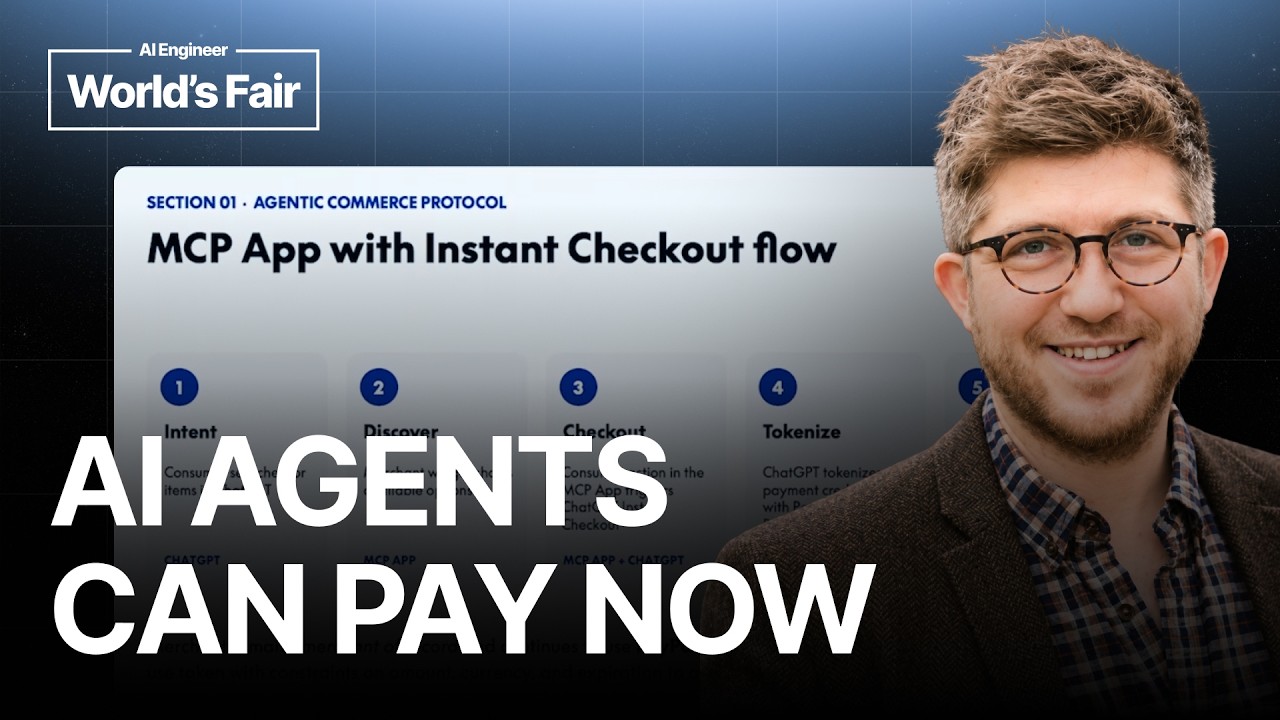
Sam Parsons, Senior Staff Software Engineer at PayPal Enterprise Payments (formerly Braintree), discusses the evolving landscape of agentic commerce, where AI agents initiate purchases. PayPal’s goal is to build bridges for merchants to accept payments from diverse platforms, an area rapidly expanding.
Three Paths to Agentic Payments
Parsons outlines three primary integration paths for merchants to enable payments via AI agents:
- Instant Checkout in ChatGPT (Agentic Commerce Protocol - ACP): Leverages OpenAI’s Agentic Commerce Protocol.
- Google AI Mode (Universal Commerce Protocol - UCP): Utilizes Google’s Universal Commerce Protocol, often in conjunction with Google Pay.
- MCP App with External Checkout: Provides merchants with maximum control over the checkout experience.
Both the Agentic Commerce Protocol (ACP) and Universal Commerce Protocol (UCP) are noted to be very similar in their specifications, reflecting the early but converging nature of this domain.
Instant Checkout in ChatGPT (ACP)
This path allows for direct in-chat purchases within ChatGPT, powered by an MCP app built by the merchant.
The MCP App and Merchant Control
An MCP app is described as an MCP server with embedded UI (HTML, JavaScript) that can be rendered inside various agents like ChatGPT or Claude (where it’s called a connector). This gives merchants control over the user experience within the agent, dictating the look, feel, and presented purchase options.
The Checkout Flow
- User Intent & Discovery: A user expresses a desire to buy something in ChatGPT. The merchant’s MCP app presents relevant products or services, fully controlling this discovery UI.
- Initiating Checkout: Once the user selects an item, the MCP app triggers a checkout using the Agentic Commerce Protocol, signaling ChatGPT to begin the payment process.
- Tokenization: The user provides payment credentials (e.g., credit card). This data is tokenized by PayPal Enterprise Payments systems. Parsons emphasizes that tokenization is crucial: “where the user exchanges a real payment credential that’s transactable, say your credit card number and instead they exchange that for a token that can then be passed around without increasing PCI scope and you know dangerous things happening.” This token is then returned to ChatGPT, which is safe to pass around.
- Merchant Processing: The merchant receives this token and processes it like any other PayPal Enterprise Payments token. Settlements, refunds, chargebacks, and compliance remain consistent.
Demo Example: Hotel Booking
A demo showcased booking a hotel in ChatGPT. The initial selection UI was merchant-controlled. Upon proceeding to checkout, ChatGPT’s native instant checkout experience appeared for card entry. This demonstrated how the actual payment credential input is handled by the host agent (ChatGPT) and tokenized by PayPal, keeping sensitive data out of the merchant’s and agent’s direct PCI scope.
Integration Points
- MCP App Widget: Merchants integrate a JavaScript code snippet within their MCP app to trigger the checkout experience.
- MCP Server Call: The merchant’s MCP server receives a
complete checkouttool call containing the token, which can then be processed as a typical PayPal Enterprise Payments token.
Constrained Tokens
Payment tokens issued by PayPal are constrained for security:
- Merchant-specific: Usable only by a designated merchant.
- Max amount: A maximum transaction value is enforced.
- Currency: Tied to a specific currency.
- Expiration: Tokens have a limited validity period. Transactions processed via this method are attributed to their source, e.g., “ChatGPT transaction,” within PayPal’s systems.
Google AI Mode (UCP)
This path offers a different integration model for merchants leveraging Google AI Mode with the Universal Commerce Protocol.
Simplified Merchant Integration
A key distinction here is that merchants do not build an MCP app or custom UI. Instead, their integration primarily involves providing endpoints and product information.
The Checkout Flow
- User Shopping: User interacts in Google AI Mode.
- Session Creation: The agent creates a session with the merchant using UCP.
- Tokenization with Google Pay: When the user initiates checkout, Google Pay tokenizes the payment details via PayPal Enterprise Payments.
- Merchant Receives Token: The token is returned to the merchant.
- Charge Processing: The merchant uses this token to process the transaction, with standard PayPal procedures for settlement, refunds, etc., applying.
Integration Points
Merchants primarily configure:
- A
well-known JSONfile for UCP, specifying PayPal/Braintree as the payment processor, along with their merchant ID and client key. - An endpoint to receive calls from
UCP checkout sessionthat include the session ID and the payment token from Google Pay.
MCP App with External Checkout
This option provides merchants with the most control, albeit with slightly increased user friction.
Full Merchant Control
Merchants use an MCP app to display product cards and a checkout button. When the user clicks “checkout,” the system triggers a handoff to an external checkout page. This external page, fully controlled by the merchant, can offer a wider range of payment methods and a completely custom UI.
Demo Example: Checkout from Claude
A demonstration showed a user in Claude selecting items via an MCP app. Clicking “checkout” opened an external link to the merchant’s dedicated checkout page. After completing the payment on the external page, the MCP app in Claude automatically updated to reflect the confirmed order, demonstrating communication between the external page and the agent environment.
Trade-offs and Future Developments
While offering full control, this method introduces more friction due to the external page redirection. Parsons mentioned an upcoming feature called elicitation for MCP apps, which aims to enable more seamless external validation, potentially within an iframe, to reduce this friction.
Choosing a Path
The choice among these paths depends on the merchant’s priorities:
- For presence in ChatGPT, the ACP path with an MCP app is suitable.
- For Google AI Mode, the UCP endpoint-based integration is required.
- For maximum UI control and payment method flexibility, an MCP app with an external checkout handoff offers the most options.
PayPal Enterprise Payments is actively building these foundational integrations to support the emerging landscape of agentic commerce.