From Systems of Record to Systems of Context — Omri Bruchim, monday.com
monday.com introduces a paradigm shift from traditional "systems of record" to a "system of context" to overcome the limitations of current AI agents. By developing a "Monday world model" with a unique data architecture, including slow and fast processing engines inspired by neuroscience and lambda architecture, their AI assistant Sidekick gains a deep understanding of user workflows, priorities, and implicit meaning, allowing it to provide truly contextual and proactive assistance.
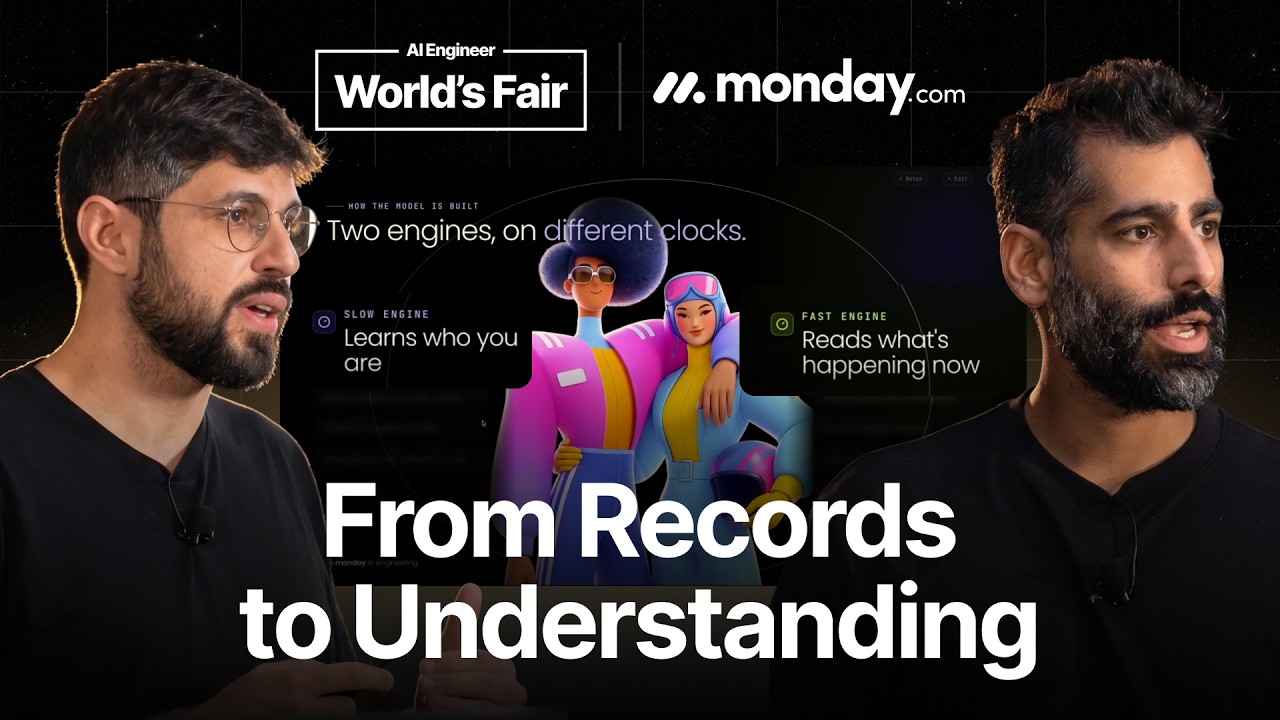
The discussion introduces a fundamental shift from traditional “systems of record” to a “system of context” within software. For decades, software has excelled at recording events—every task, document, message, and status update. However, modern AI agents, despite having access to vast amounts of this data (e.g., boards, tasks, emails, Slack messages), often fail to provide truly intelligent assistance because they lack understanding.
The Problem: Data Without Understanding
The core issue isn’t a lack of data or retrieval capabilities; it’s the absence of semantic understanding. As exemplified by an AI assistant suggesting a user “go to the gym” when asked, “What should I focus on right now?”, current agents struggle to connect disparate pieces of information meaningfully. They present disconnected bullet points dressed as confident paragraphs, failing to grasp the user’s priorities or the underlying implications of their work.
Why Context is Hard
Building a system of context presents three significant challenges:
- The Agent Gap: AI agents are proficient at executing specific tasks when given clear instructions. However, they are “lost find them find the problem”—they cannot discern what problems are most important or what a user should be doing without an inherent understanding of the user’s role, priorities, and workflow.
- Records Lack Meaning: A log or a record only states what happened, not why. The speaker uses a GitHub analogy: a line of code has meaning beyond its syntax. To truly understand it, one might need to trace it through a PR description to a Monday.com board entry that links it to a customer complaint, revealing the full context and intent.
- Building Ahead of Time: Meaning and context cannot be constructed effectively at runtime, when a user poses a question. It’s too late. True understanding requires pre-computation, building context “much before someone asks the question.”
monday.com’s Solution: The Monday World Model
monday.com addresses this by building the “Monday world model,” a system designed to understand why things matter, who the user is, and how to help them. This is not merely a larger prompt or a longer context window; it’s a fundamentally different approach focused on understanding entities and their interconnections.
The Data Model: This model collects thousands of data points (activity logs, status changes, messages, meetings) to construct three core components the agent can reason over:
- User’s Work Structure: This maps key entities, relationships, and dependencies within the user’s work (e.g., how a Slack message links to a task, who is blocking whom).
- Current Snapshot: Live signals provide real-time updates on critical elements (e.g., what’s overdue, what’s suddenly urgent, active collaborators).
- Durable User Profile: Over time, decisions, outcomes, and work patterns are distilled into a persistent profile of the user’s routines and cadences.
Two Engines for Context Generation:
The system employs two distinct engines, inspired by neuroscience’s complementary learning systems (hippocampus and neocortex) and data processing’s lambda architecture:
- Slow Engine: Operates over a long time window (weeks) to mine patterns, understand the user’s persona, routines, collaborators, main goals, and projects. It distills these into a durable profile, which is reinforced over time. This engine learns “who the user is and how they work.”
- Fast Engine: Processes a short, recent window (days) to recompute live signals related to the user’s current state—what’s urgent, what’s overdue, and who they are currently engaged with. This engine focuses on understanding “your day” and updates frequently.
How it Comes Together:
Data from various sources (Monday, Slack, email, calendar) is transformed into structured data, signals, and patterns. Both the slow and fast engines perform pre-computation offline and ahead of time. When a user interacts with Sidekick, a minimal slice of logic is recomputed for the most recent activity, and the pre-computed, comprehensive context is served to the agent. This allows Sidekick to reason effectively and decide when and how to proactively engage.
Benefits and Limitations
This architectural design yields several advantages:
- Resilience: The data model is robust, with isolated sources ensuring graceful degradation rather than outright failure if one data feed is problematic.
- Urgency Understanding: Sidekick can discern the importance of facts, knowing when to notify the user proactively and when to remain silent.
- Compounding Value: The model continuously improves. “Every day the data is captured, the layers fill in and the profile sharpens.” Adding new data sources is efficient and only enhances the model’s understanding.
- Uniqueness: The data model is tailored to each individual user’s unique work patterns.
However, the model acknowledges limitations: it always trails the live world, new users lack sufficient data, and built-in biases can affect signals. The ongoing challenge is distinguishing crucial information from noise.
Ultimately, Sidekick allows monday.com to provide a truly contextual answer to questions like “What should I focus on right now?” by processing “breadcrumbs” (boards, emails, meetings, Slack messages) through its fast and slow engines to build a personal profile and identify immediate action items.