Reddit cracks down on AI slop & the future of AI compute
This episode explores Reddit's aggressive AI spam combat strategy, revealing AI's dual role in fighting malicious AI. It then dissects Anthropic's Economic Index, highlighting how Claude integrates into daily life despite significant user selection bias. The discussion also covers Orin's $33M raise for a GPU compute marketplace, debating the fungibility of compute and the technical hurdles. Finally, Anthropic's chip ambitions are analyzed as an economic strategy to optimize models, reduce NVIDIA dependency, and manage rising token costs, with comparisons to existing hardware ecosystems and NVIDIA's market position.
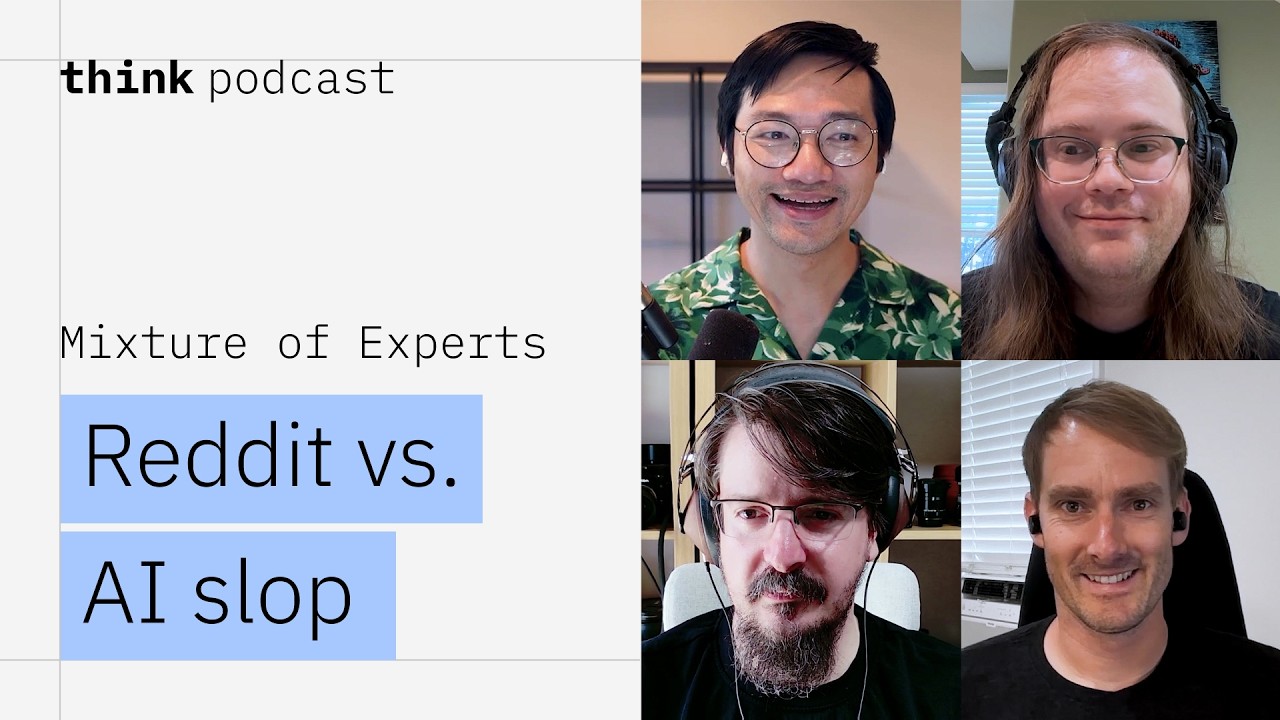
This episode of Mixture of Experts delves into critical developments across the AI landscape, beginning with Reddit’s aggressive strategy to combat AI-generated spam and bots. The discussion highlights that while spam has always existed, generative AI dramatically increases its sophistication and quantity. Ren Whitnah notes this leads to an “Ouroboros of AI,” where AI must combat AI. Mihai Criveti frames this as a “war of proliferation of weaponized AI,” essential for platforms like Reddit to maintain authentic human connection and protect their business model, especially considering their data resale to AI companies. Gabe Goodhart emphasizes Reddit’s effort to build trust by demonstrating AI’s nuanced role—both as a problem and a solution—and introduces their tiered approach to moderation tools (admins with powerful AI, volunteer mods, and human up/downvoting). The conversation concludes on concerns about future online community openness, fearing increased verification requirements as sophisticated bots rise.
Next, the hosts dissect Anthropic’s Economic Index for June 2026, which explores how people use its AI assistant, Claude. Gabe Goodhart challenges the “narrow scope” narrative, asserting AI’s capability breadth, but stresses the adoption breadth as the key. He points out the report’s significant selection bias, as Claude users are generally more technically minded and often paying customers, making it a non-representative sample of the general population. Despite this, Gabe finds it heartening that AI integrates into daily life patterns, aligning with natural human cycles (e.g., professional topics during weekdays, personal/hobby use on weekends). Mihai Criveti, who recently spent over $500 on Fable in a day, notes the prevalent use of AI for homework, which remains the number one use case globally, suggesting future restrictions. Ren Whitnah observes the growing use of AI for personal projects like video game development, highlighting how LLMs excel at common patterns while not diminishing the need for unique creativity. The segment concludes with a call for more unbiased, third-party studies given the inherent selection bias of surveying a specific user base.
The podcast then explores Orin’s $33 million raise to create a liquid marketplace for GPU compute power, aiming to commoditize compute like oil futures. Tim Hwang introduces the concept of a market for buying and selling computing rights. Mihai Criveti compares it to carbon credit markets and foresees its potential, especially with the high cost and scarcity of powerful models (like Fable). He mentions Sam Altman’s prior ideas for crypto tokens for AI spend. Gabe Goodhart draws parallels to oil in terms of extraction and distribution complexity but questions the fungibility of compute, highlighting significant technical challenges: GPU workloads are not equal; large training jobs require complex gang scheduling and high-speed networking, making them hard to commoditize; and inference faces sensitivity and security constraints (geographic, encryption). Ren Whitnah discusses how futures markets can make assets less fungible, potentially raising compute prices and benefiting larger players rather than democratizing access. He also introduces Jevons paradox, suggesting that as cost decreases, overall usage increases, which could lead to unexpected price dynamics or even prioritize reselling compute over training new models.
Finally, the episode examines Anthropic’s chip ambitions and potential Samsung partnership. This move reflects a broader trend of frontier labs building custom hardware to optimize for their models and reduce dependency on NVIDIA. Gabe Goodhart views this primarily as an economic imperative: high demand and limited supply drive companies with leverage to increase proprietary supply. He doesn’t believe it will replace NVIDIA but rather augment supply and is a strategic move for sovereignty and resilience against geopolitical and corporate pressures. Crucially, Gabe suggests these custom, power-efficient chips are a self-preservation mechanism for labs to mitigate the eventual “shoe dropping” of high token costs for consumers. Mihai Criveti agrees, pointing to Google’s TPUs and specialized accelerators (Cerebras, Groq) as precedents for efficiency and tailored use cases. He sees it as a move for Anthropic to diversify its supply chain and gain independence from suppliers like Google, who are also competitors. Ren Whitnah concludes by questioning why NVIDIA doesn’t pursue vertical integration into frontier models. He posits that building models is currently a “loss leader” and NVIDIA’s core business is “selling shovels to gold miners.” Furthermore, model development requires massive data, a significant moat that NVIDIA doesn’t possess, making their strategy of providing infrastructure and tools a smarter play than entering the model-building market directly.