Why LLM Recommenders Will Be AI's Biggest Consumer App — Devansh Tandon, Meta
Devansh Tandon, who leads Meta Recommendations Research, argues that recommendation systems scale like LLMs, that the field is early on that curve, and that LLM recommenders will become one of AI's biggest consumer applications. He walks through four S-curves of recommendation, a three-step recipe built on semantic IDs, and why content feeds can be up to 100x cheaper per hour of engagement than AI chat apps.
Two big arguments
Devansh Tandon, who leads Meta Recommendations Research, opens with two claims. First, recommendation systems scale just like LLMs, and the field is still very early on that scaling curve. Second, the LLM recommender will become one of the biggest consumer applications of AI. He notes that his group trains frontier LLMs and recommenders that power Instagram, Facebook ads, and the wider Meta family of apps. Before Meta he spent a long time at Google on key ML teams, including DeepMind and YouTube. His earlier AI Engineer talk covered semantic IDs and generative retrieval, which have since moved from research into scaled production at YouTube, Meta, Spotify, and DoorDash.
Scaling laws reach recommendation
He starts with the 2020 scaling laws paper, which he calls a landmark. Its core idea is that loss falls predictably on a log-linear curve as model size, data, and training compute grow. That predictability is what set off the race for the AI frontier and what underwrites today’s capex buildout. Tandon’s point is that recommenders followed the same pattern well before the LLM wave. They were among the largest production ML models at big tech companies and still serve billions of daily active users. On the x-axis sit data, compute, and model size. Offline, the y-axis is normalized entropy or AUC gains. In production, it becomes engagement and revenue impact.
He cites HSTU from 2024 and a 2025 follow-up as evidence that these curves show up offline and then translate into product outcomes. From Meta’s earnings reports, he highlights Instagram Reels, which grew watch time 30% year over year. The gains came from simplifying the ranking architecture so it could scale efficiently, doubling the length of user interaction sequences used in training, and increasing the richness of each interaction’s signal.
The flywheel of tokens in, engagement out
Tandon frames the whole business as a flywheel. You train a model, then run inference on it, and the resulting recommendations drive consumer engagement such as daily actives and time spent. That engagement turns into monetization through ads or subscriptions, which pays for the next training run. Every step up a scaling curve is one more loop of this wheel, and he argues that most consumer apps are spinning this same core flywheel.
Four S-curves of recommendation
He describes four paradigms the industry is climbing, often in parallel.
- Traditional recsys covers feature engineering, user and content embeddings, two-tower models, and sparse rankers. Most production systems still sit here. He does not think this curve disappears. Instead, he expects automated research and agents to take over feature engineering and speed up model development.
- LLM-inspired models scale architectures end to end, as in the HSTU and OneRec papers. He believes this is where the leading industry recommenders largely operate today.
- LLM-native systems adapt a base model that already understands language and can reason, with the TIGER and PLUM papers as examples.
- Agentic systems have LLMs orchestrate recommendation in a loop. Agents plan, retrieve, rank, critique, and refine recommendations by calling models again before delivering them. He draws a parallel to coding agents. LLM-native progress is like improving the core model from one generation to the next, while agentic progress is like improving the harness around it, the way Claude Code or Codex improves on the raw model.
He says companies are scaling across all four curves at once, with most recommendation work living in the LLM-inspired stage and trying to graduate to LLM-native.
The three-step recipe
He describes building an LLM recommender as three steps. First, tokenize your content and create a language for your domain. Second, adapt the LLM so it understands both English and that domain language, making it bilingual. Third, prompt the model with user information so it decodes recommendations directly from your content corpus.
He presents this as a five-layer cake. At the bottom are semantic IDs. Above them is a base foundation model, either open-weights or first-party. Pre-training bridges English and recommender tokens. Post-training steers the model toward tasks like predicting engagement or reasoning over recommendations. The top layer is light, surface-specific fine-tuning. The key advantage, in his view, is that most of the compute is shared across product surfaces, so teams don’t have to train a separate model from scratch for every surface.
Semantic IDs as compression
He gives two reasons to tokenize content. The first is a stable representation. A hash ID keeps shifting, so a model can only memorize it, while a semantic ID gives the model something consistent to learn over. The second is compression. A three-minute Instagram Reel is about 10,000 tokens raw, which would fill a context window very quickly. Compressed, it becomes about 10 tokens. In his tennis example, related Reels share a prefix: the first token might represent sports, the next two tennis, and the final token makes each video individual. He notes that many teams are already replacing hash IDs with SIDs in traditional models and seeing good impact.
Pre-training and post-training
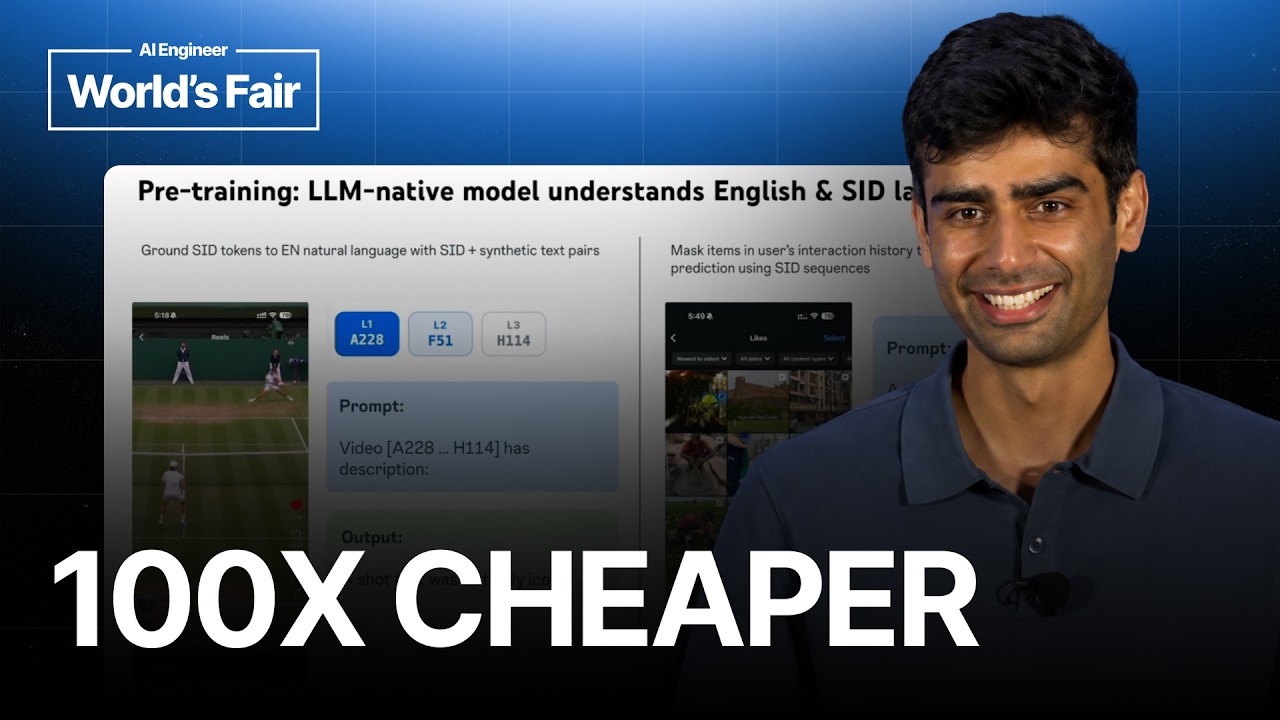
For pre-training, he gives two examples. In one, the model is prompted with a video’s semantic ID and a blank description, and it outputs a caption like ‘a shot that was instantly iconic from Wimbledon,’ which teaches it to connect semantic tokens with natural language. In the other, parts of a user’s interaction history are masked, and the model learns to predict them, which teaches it which videos get watched together in sequence.
For post-training, the model is an LLM reranker. It receives user information and 30 candidate videos and selects the top five, showing its chain-of-thought reasoning along the way. In his example, the model identifies the user’s topic interests, such as comedy, food, DIY, and wellness, along with their engagement style and creator affinities, and then reranks based on that reasoning. Because the model understands both English and recommendations, you can inspect why it made each decision.
Steerable and explainable feeds
He argues this opens new product surfaces. Instagram’s Your Algorithm shows what the algorithm thinks you like, and you can add or remove interests and talk to it in natural language. He sees a shift from black-box recommendation toward user control, where people steer feeds toward goals expressed in language rather than just likes or comments. In one demo, he adds an interest in the FIFA World Cup, and the model combines his history with that new input to decode a personalized recommendation, such as a free kick Messi recently scored. He points to related examples across the industry: prompted playlists from Spotify, custom feeds from YouTube, and Ask DoorDash.
Why feeds are far cheaper than chat
He applies the same token-in, engagement-out lens to AI chat apps and concludes that LLM recommenders are structurally more token-efficient. Content feeds such as Instagram, Facebook, TikTok, and YouTube use models with roughly 1 to 10 billion active parameters. Chat apps like Gemini, ChatGPT, and Claude serve models with roughly 10 to 100 billion. The crucial difference is in the output. A feed emits a semantic ID, which is a pointer to content that creators have already uploaded, so the supply is effectively free. A chat app must generate every token itself, often a few thousand per turn. As a result, he estimates that feeds can be up to 100 times cheaper per hour of consumer engagement.
Why LLM recommenders matter
He closes by noting that four of the ten most-used apps in the world are content feeds. Almost all of the growth in engagement and monetization on those feeds is driven by recommendation and ads models, and he expects LLM recommenders to transform both. He anticipates steerable and interactive recommendations, explanations of recommendations, and users gaining more control over their experience. He also expects research on consumer agents and recommendation agents to emerge over the next year or so, which he sees as an exciting intersection of LLMs and recommendation.