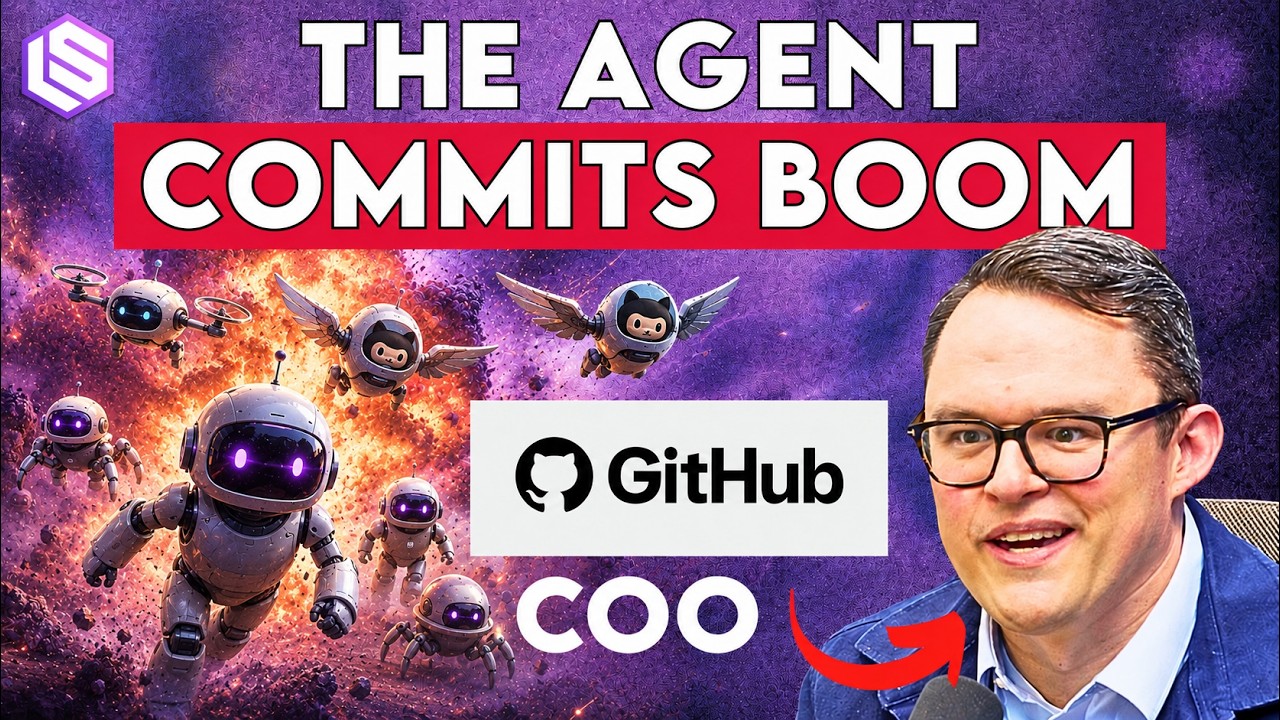
GitHub’s Agent Era: 14x Commits, 200M Developers, Copilot’s Next Act — Kyle Daigle
GitHub COO Kyle Daigle discusses the new era of AI agents from the inside. He covers how he uses AI for leadership, the shift from "mega-skills" to "micro-skills," and how GitHub is navigating a 14x growth in commits. The conversation goes deep on the evolution of Copilot, the future of PRs in an agent-driven world, the challenges of scaling, and Microsoft's vision for an ambient AI operating system.
AI in Leadership and Daily Operations
Kyle Daigle, COO of GitHub, has seen his own coding activity spike thanks to AI. He now spends time building agents and workflows that connect disparate data sources to enhance his leadership role. These workflows integrate everything from GitHub PRs, online posts, and personal Obsidian notes to corporate communications in Slack and Microsoft Teams transcripts (via Microsoft’s WorkIQ and MCP server).
A core principle for Daigle is what he calls a “recursive loop backwards.” Instead of just generating new content, he uses AI to analyze the recent past—what messaging was used, what worked, what didn’t—to inform strategy for the immediate future. This retrospective capability of LLMs is, in his view, incredibly valuable for leadership.
“I’m always looking at what had happened first. Like go back through the week and tell me what we did, what worked, what didn’t work… and then tell me in the next, you know, three or four days, what would you tweak.”
Internally at GitHub, the rollout of AI tools is guided by the principle of not forcing employees to change their existing workflows. The focus has shifted from creating large, monolithic “mega-skills” to building and sharing atomic “micro-skills” that perform one task exceptionally well. This approach makes the system more robust and adaptable.
Daigle even used this methodology to build an entire executive-level revenue planning presentation. By feeding the AI his notes and company context, it generated a deck that was so effective and “humanly bad” (i.e., not polished in a way that screamed AI) that no one in the meeting with the CRO and CFO suspected its origin. This demonstrates how AI is shifting roles like the Chief of Staff away from manual production and towards higher-level human connection and strategy.
The Evolution of GitHub’s Platform and the AI Era
GitHub’s platform has a long history of evolution, which provides context for the current AI-driven shift.
- GitHub Actions: Launched in 2018, it evolved from an earlier, insecure service that ran arbitrary Ruby code into a secure, containerized, general-purpose compute layer. It’s now the foundation for CI/CD, automation, and increasingly, agentic workflows.
- npm Acquisition: The goal was to ensure the stability and security of a critical piece of the internet’s infrastructure. Daigle notes the delicate balance of pushing security improvements (like 2FA and token invalidation) without causing a “snow day for developers” by breaking existing workflows.
- Dependency Management: The rise of AI agents brings concepts like “slop forks” and AI-powered vendoring to the forefront. While these ideas echo past practices, Daigle believes they don’t solve the fundamental security problem. He emphasizes that robust verification through static analysis and runtime testing remains essential.
The very nature of the pull request is being questioned in an era where agents might generate the majority of them. The core challenge is codifying trust. While human signals (like an approval from a trusted maintainer) are still the primary heuristic, the long-term solution involves providing maintainers with tools to define their own complex trust rules, rather than GitHub enforcing a single standard.
Scaling for 14x Growth: GitHub’s Hardest Era
Daigle candidly describes the current period as both GitHub’s “hardest and most exciting era.” The platform is experiencing unprecedented growth, with commit volume on pace for 14 billion this year, a 14x increase. This hyper-growth is breaking systems in new and novel ways, creating a “diagonal” scaling problem where simple vertical or horizontal scaling is insufficient.
Key challenges include:
- CPU Demand for Actions: The explosion of builds from developers and agents requires a massive expansion of compute resources, leading to a deeper integration with Azure.
- Database Bottlenecks: A monolithic permissions layer, internally known as “mySQL1,” is being painstakingly broken apart to improve performance and resilience.
- Monorepos and Push Sizes: The trend towards larger monorepos and the sheer size of commits and PRs generated by AI are changing fundamental assumptions about workload sizes, requiring re-architecting of core services like job queuing and Git infrastructure.
GitHub is tackling this by re-architecting services that have run for over a decade and committing to greater transparency with the community about the challenges and the work being done to ensure reliability.
The Future of Copilot and Ambient AI
GitHub Copilot is evolving far beyond its initial implementation as a code completion tool. The focus is now on a unified SDK and harness for a coding agent that operates across the entire software development lifecycle (SDLC) and on multiple surfaces (CLI, a new desktop app, cloud agents). The vision is to use agents for everything from security remediation and issue triage to documentation validation.
The ultimate goal for Copilot is to become a true partner that understands a developer’s intent and context. Daigle envisions a future where GitHub can “act like Kyle wants it to act,” leveraging a deep understanding of codified rules, memory, and project context.
Looking further, Daigle sees the future in ambient AI. This goes beyond myopic, task-specific agents to an AI that operates in the background with a complete context of a developer’s work—including spec docs, emails, and meeting transcripts. Projects like OpenClaw are interesting because they point toward this future. Microsoft’s investment in this area, including OS-level sandboxing, is about building the secure “new operating system for agents” that can function effectively and safely within an enterprise context.