Green AI: Making Machine Learning Environmentally Sustainable • Charles Humble • YOW! 2025
Charles Humble explores the significant environmental impact of AI, particularly generative AI, on global carbon emissions. He offers practical, actionable strategies across the entire AI lifecycle—from project planning and data collection to training and deployment—to reduce this footprint. Key recommendations include questioning the necessity of AI solutions, choosing open-source models, leveraging carbon-aware computing for demand shifting, employing model compression techniques like distillation and quantization, and integrating sustainability as a fundamental architectural principle in software engineering.
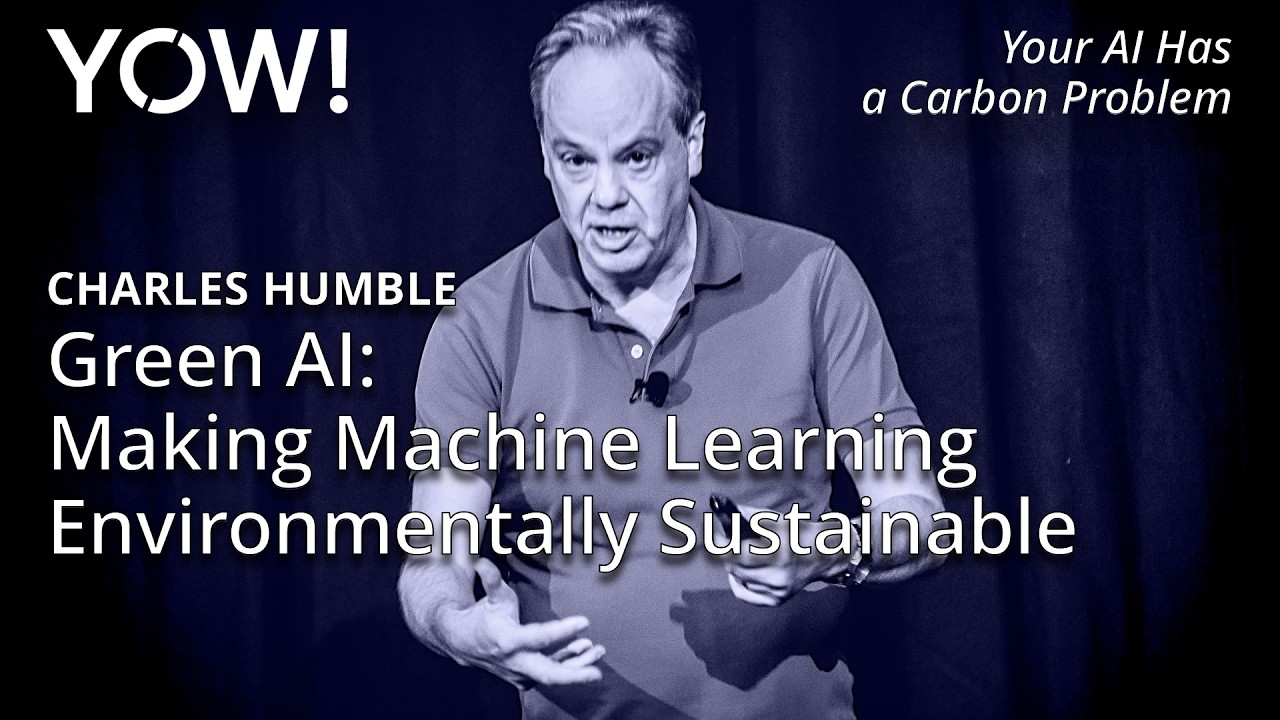
Charles Humble begins by recounting an anecdote where a young autistic boy defines AI as “a failed attempt to simulate human intelligence using a Turing machine,” setting a critical tone for the current AI hype cycle. He emphasizes the need to step back and consider the broader implications of AI, especially its environmental footprint, given the pressure to adopt it across industries.
The Alarming Environmental Cost of AI
Historically, software development followed Moore’s Law, with hardware advancements enabling more capable software. While this broadly applies to AI, the current surge in large transformer models, beginning around 2012 (initially with image classifiers), is primarily driven by scale rather than novel architecture. These models ingest vast amounts of data—often the entire internet—and require immense compute power, leading to significant energy consumption.
Humble highlights data from the International Energy Agency, revealing that the combined electricity usage of Amazon, Microsoft, Google, and Meta more than doubled between 2017 and 2021. Initially, this was attributed to the shift to public cloud, but major tech companies confirmed that their carbon emissions have surged specifically due to the construction and operation of data centers for generative AI. Microsoft’s emissions rose 30% since 2020, and Google’s surged over 50% since 2019, with 13% in 2023 alone, all attributed to AI.
This matters because most electricity grids worldwide rely on fossil fuels, leading to increased carbon dioxide emissions. While greenhouse gases are essential for planetary temperature regulation, their increased concentration since the Industrial Revolution traps more heat, leading to global warming. Humble notes that while climate predictions have improved (from 5-7°C warming in the 1980s to 2.4-2.9°C now), the 1.5°C target is unlikely to be met, with severe consequences for vulnerable populations.
He argues that the IT industry, including software engineers, has a crucial role in mitigating this. Global data center electricity consumption in 2022 was 240-340 TWh (1-1.3% of global demand), but when networks are included, this more than doubles to 700 TWh—equivalent to Brazil’s entire electricity consumption and twice that of the UK. This figure rivals the aviation industry’s greenhouse gas emissions. The IT industry is actively exacerbating this problem, primarily with AI, yet Humble believes a 50% reduction in carbon emissions is achievable simply by optimizing existing infrastructure, such as turning off unneeded machines.
Direct vs. Embodied Carbon
Humble distinguishes between direct emissions (from powering hardware) and embodied carbon (from manufacturing, transportation, and disposal). For end-user devices like mobile phones, embodied carbon accounts for a significant majority (e.g., 84% for an iPhone 13 mini) of its lifetime emissions. Therefore, extending the lifespan of these devices (ideally 10 years) is crucial. For data center hardware like GPUs and TPUs, the situation is more complex. While embodied carbon is still substantial, the energy efficiency gains of newer hardware, particularly in reducing cooling requirements (which can consume over half of a data center’s electricity), can sometimes justify quicker hardware upgrades.
Strategies for Reducing AI’s Environmental Impact Across the Lifecycle
1. Project Planning
- Question the Problem’s Necessity: Is the problem genuinely worth solving? Not building something is often the greenest option.
- Is an LLM the Right Solution? Generative AI is often the most computationally expensive and unpredictable solution. Simpler algorithms, like a few
ifstatements, might suffice. - Avoid Training from Scratch: Training is energy-intensive and ethically complex. If possible, avoid it entirely.
- Choose Models Wisely: Model choice significantly impacts carbon footprint. Closed-source models often lack transparency regarding their training energy use. Humble strongly advocates for open-source models due to their benchmarkability, stronger privacy guarantees, long-term support, and the fact that much innovation is now occurring in the open-source space.
- Relax Service Level Agreements (SLAs): Flexible SLAs allow workloads to run in locations with lower carbon intensity. Tools like
electricitymaps.comprovide real-time grid carbon intensity data. While Australia’s grid is generally high-carbon, running workloads in Southern Australia or New Zealand (if feasible) can offer greener alternatives. CDNs and caching can mitigate latency for non-deterministic workloads. - Demand Shifting and Shaping:
- Demand Shifting: Running tasks when green energy (solar, wind, hydro, nuclear) is abundant.
- Demand Shaping: Modifying application behavior to reduce energy consumption (e.g., an “eco mode” for AI features, or using APIs like Electricity Maps, WattTime, or Green Software Foundation to intelligently fall back to simpler, less carbon-intensive methods during periods of high grid carbon intensity).
2. Data Collection
- Question Data Volume: The “all of it” mindset driven by LLMs is often unnecessary. Smaller, custom language models are frequently more successful within enterprises.
- Leverage Open-Source Datasets: Platforms like Hugging Face and Kaggle offer hundreds of thousands of readily available datasets, saving collection effort and associated emissions.
- Non-Latency Sensitive Collection: Data collection and ingestion can be scheduled for times when green energy is available.
- Ethical Considerations (Side Quest):
- Informed Consent: Much data collection occurs without explicit consent, raising moral and legal issues, particularly due to model memorization. This poses significant risk of legal action.
- Human Labor Exploitation: Reinforcement Learning with Human Feedback (RLHF) often involves underpaid workers in countries like Kenya being exposed to disturbing content for data screening, a process also used in content moderation.
3. Training
- Renewable Energy for Training: Training is not latency-sensitive and can achieve 45-99% carbon reduction if run on 100% renewable energy. This requires resisting arbitrary deadlines often driven by marketing or FOMO.
- Federated Learning: Training models on edge devices (e.g., mobile phones). This approach, while potentially slower to converge, can be environmentally beneficial by reducing the need for data center cooling and offering strong privacy guarantees.
- Waste Heat Utilization: Exploring innovative ways to use waste heat from data centers, such as heating municipal swimming pools or domestic water systems.
- Model Compression Techniques: Reducing model size directly translates to lower energy consumption.
- Distillation: A larger “teacher” model trains a smaller “student” model until the student’s performance is sufficient. Tools like Amazon Bedrock (claiming 500% faster, 75% cheaper/less carbon) and V provide support for this.
- Quantization: Reducing the precision of weights and activation values (e.g., from 32-bit floating point to 8-bit or 4-bit integers). This is a mainstream technique, supported by tools like Google JAX for TensorFlow operations.
- Pruning: Removing unnecessary parts of the model (analogous to synaptic pruning in brains) to reduce its size, making it more efficient.
4. Deployment & Maintenance
- Inference Energy Consumption: Deployment often consumes more energy than training due to the sheer volume of inferences, making post-training optimization critical.
- Post-Training Compression: Distillation, quantization, and pruning can be applied after training to shrink models, reducing inference costs and carbon footprint.
- Speculative Decoding (or Sampling): A technique that speeds up inference by using a small, fast model to predict tokens and a larger model to validate them. This parallelizes the token generation process (typically serial), offering significant speedups (e.g., 2-3x on average, potentially 33x for Google’s Gemini), similar to branch prediction in CPUs.
Four Steps to Greener Computing (General Principles)
- Hardware Configuration: Use the smallest hardware configuration that can safely execute the job, avoiding historical over-provisioning.
- Location Choice: Run compute jobs in regions with abundant low-carbon energy and credible plans for grid decarbonization.
- Cloud Provider Selection: Choose cloud services from providers offering robust tooling for workload optimization (e.g., Google’s tooling) and operating in green regions. (AWS’s current tooling for workload optimization is limited).
- Carbon-Aware Computing: Implement strategies to shift and shape compute execution based on the real-time carbon intensity of available energy.
In conclusion, Humble urges the audience to adopt sustainability as a core architectural principle. He argues that sustainable practices in IT are not just environmentally beneficial but also lead to cheaper, faster, and better outcomes for users, with virtually no downsides except potentially a slightly longer development time. He recommends several books, including his own, The Developer’s Guide to Cloud Infrastructure, Efficiency & Sustainability, and Building Green Software by Anne Currie, Sarah Hsu, & Sara Bergman, and Not the End of the World by Hannah Ritchie, for further reading on the topic.
- Tags:
- Model Compression
- Generative AI
- Model Distillation
- Model Pruning
- Speculative Decoding
- Sustainable AI
- Federated Learning
- Ethical AI
- Green AI
- AI Carbon Footprint
- LLM Efficiency
- Carbon-Aware Computing
- Data Center Sustainability
- Renewable Energy
- Software Sustainability
- Demand Shifting
- Demand Shaping
- Model Quantization