3‑2‑1 Backup Rule Explained: Protect Your Data from Disaster
Jeff Crume outlines essential data resiliency strategies, starting with the 3-2-1 backup rule—three copies, two media types, one offsite—and expanding to include immutable or air-gapped backups, rigorous testing, and encryption. He emphasizes these principles for robust disaster recovery, ransomware protection, and minimizing costly downtime, highlighting the trade-offs in achieving high availability.
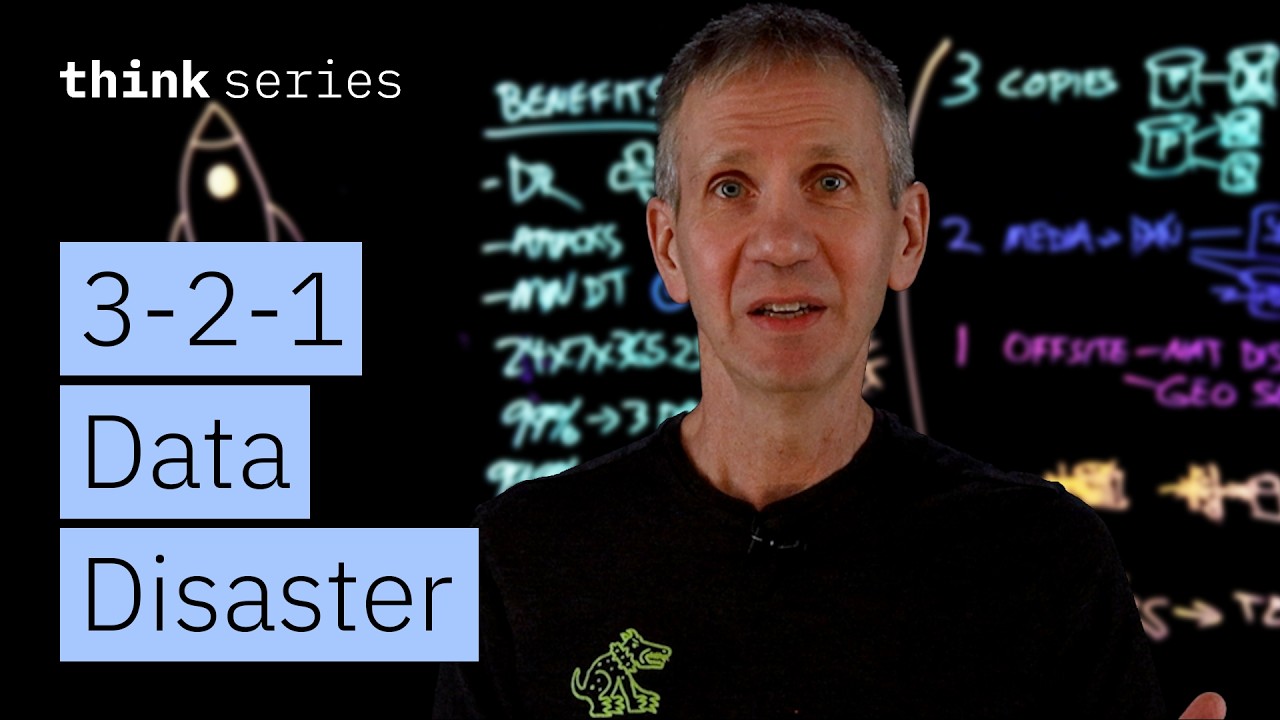
The speaker, Jeff Crume, highlights the critical importance of data resiliency for modern enterprises, describing data as “the lifeblood.” He introduces the foundational 3-2-1 backup rule and expands upon it with additional crucial principles to ensure robust protection against data loss, disasters, and cyberattacks.
The 3-2-1 Backup Rule
This rule outlines a set of principles designed to safeguard data from loss:
- 3 Copies of Your Data: Beyond the primary operational data, it’s essential to maintain at least two additional backup copies. The rationale is that if one backup fails, a second one provides redundancy. As Crume states, “if this thing goes down, your one backup turns into no backups,” underscoring the vulnerability of having only a single backup.
- 2 Different Types of Media: Store these copies on diverse storage technologies. This diversification (e.g., SSD, spinning disk, cloud storage) mitigates risks associated with hardware failures or specific media vulnerabilities. The speaker cites examples where a “bad batch” of one type of drive could compromise all backups if not diversified.
- 1 Copy Offsite: At least one backup must be stored in a geographically distinct location. This protects against localized disasters such as fires, floods, or earthquakes, which could compromise all data copies in a single physical location. Crume emphasizes that true geographical separation is key, noting that a backup “just across the river in New Jersey” from New York City is insufficient if both locations are susceptible to the same regional event like a hurricane or winter storm.
Extending the Rule: The ‘1 and 0’ Principle
Crume then introduces two crucial extensions to the 3-2-1 rule:
- 1 Immutable or Air-Gapped Copy: It’s vital to have at least one backup that cannot be altered post-creation.
- Immutable Backup: This functions like a “diode” – data can be written once but cannot be overwritten or changed. This is particularly vital for ransomware protection, as an attacker cannot encrypt an immutable backup once it’s been created. While new data can be appended, existing data remains unchangeable.
- Air-Gapped Backup: This implies a complete physical or logical disconnection from the network after a snapshot is taken. While offering extreme isolation, Crume notes a significant disadvantage: it becomes a static “snapshot” and “will always be constantly falling further and further out of date.” The immutable approach often allows for more up-to-date backups while retaining protection.
- 0 Errors (Test Your Backups): It’s insufficient to merely create backups; they must be periodically tested and verified for recoverability. Crume recounts a cautionary anecdote where a bank’s untested backups proved “useless” during a disaster. “It’s not enough to just do three, two, one, one. You also need to go back and periodically test those things, verify that recovery in fact, still works.”
Additional Best Practices
- Encrypt Backups: All backup copies should be encrypted to protect sensitive information if a backup falls into unauthorized hands.
- Eliminate Single Points of Failure: The overarching principle throughout these rules is to avoid any single point of failure, as these “will come back to haunt you.”
Benefits of Robust Data Resiliency
Implementing these strategies provides several critical benefits:
- Disaster Recovery Capabilities: Protection against unforeseen natural disasters and other accidental events, often summarized by “Murphy’s law.”
- Protection Against Attacks: Safeguarding data from intentional threats like ransomware and hacking. With robust backups, an organization can effectively refuse ransomware demands, asserting, “I got a copy of my data too, you can go pound salt.”
- Minimized Downtime: Essential for maintaining business continuity. Crume illustrates this with the concept of “nines of availability”:
- 99% Uptime (Two Nines): Roughly 3 days of downtime per year.
- 99.9% Uptime (Three Nines): Approximately 8 hours of downtime per year.
- 99.99% Uptime (Four Nines): About 52 minutes of downtime per year.
- 99.999% Uptime (Five Nines): Around 5 minutes of downtime per year. He emphasizes that achieving higher availability (more “nines”) comes with significantly increased costs and investment in backup infrastructure.
The speaker concludes that while outages are inevitable, a resilient environment—built upon the 3-2-1 rule and its extensions—is crucial for weathering these storms, ensuring business continuity and data integrity.