How Anthropic’s product team moves faster than anyone else | Cat Wu (Head of Product, Claude Code)
Cat Wu, Head of Product at Anthropic, discusses the radical shift in product development velocity, where shipping cadences have moved from months to days. She details the emerging skills required for AI PMs, emphasizing product taste, rapid iteration, and the importance of building for current, not future, model capabilities. Wu also explores Anthropic's unique mission-driven culture and provides practical advice for leveraging tools like Claude Code and Cowork to automate work and thrive in the AI era.
The New Velocity of Product Development
At Anthropic, the timelines for shipping product features have compressed dramatically, moving from six-month cycles to months, weeks, and sometimes even a single day. This acceleration is driven by rapid improvements in model capabilities and a culture focused on removing every barrier to shipping. To manage this pace, the team employs several key strategies:
- Low-Process Culture: The primary goal is to empower every team member to take an idea to production in less than a week. This involves minimizing process and overhead.
- Research Previews: Most features are launched as “research previews.” This branding manages user expectations, signaling that a feature is an early idea that may be iterated on or not supported forever. It reduces the commitment and friction of shipping, allowing for rapid feedback.
- Repeatable Launch Frameworks: A tight, repeatable process exists between engineering, marketing, and documentation. When an engineer has a feature ready, they post it to a dedicated Slack channel, and the marketing and docs team can turn around announcements the next day. The PM’s role is to establish and refine these frameworks.
- Clear Goals Over Rigid Roadmaps: Instead of multi-quarter roadmaps, the focus is on setting clear, high-level goals and principles (e.g., “our key user is professional developers,” “safely get to zero permission prompts”). This alignment allows team members to make independent decisions without being blocked by PMs or other stakeholders.
The Evolving Role of the AI Product Manager
The role of a Product Manager is changing quickly. As engineering velocity increases, the emphasis shifts from cross-team coordination on long-term roadmaps to enabling speed and defining what to build.
- Merging of Roles: Roles are blurring. PMs are doing engineering work, engineers are doing PM work, and designers are landing code. Anthropic prioritizes hiring engineers with great product taste, as they can often take user feedback and ship a solution end-to-end with minimal product involvement.
- Product Taste as the Core Skill: “As code becomes much cheaper to write, the thing that becomes more valuable is deciding what to write.” The most critical skill is having the taste and judgment to identify which user problems are worth solving and what the most delightful UX is to solve them.
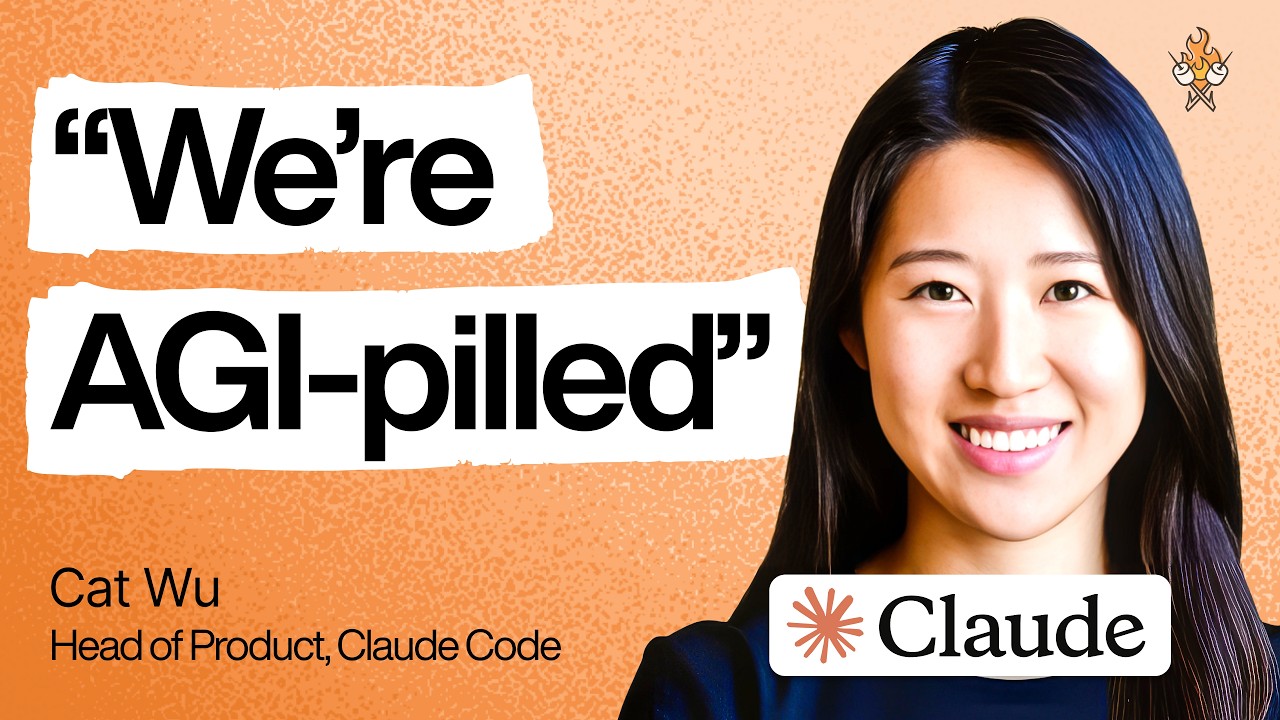
- Being the “Right Amount of AGI-Pilled”: It’s easy to design a product for a hypothetical, super-intelligent AGI where a single text box suffices. The real challenge is figuring out how to elicit the maximum capability from the current model. This means understanding its strengths, patching its weaknesses, and guiding users onto the golden path.
- Building Evals: Building evaluations is an underappreciated but crucial skill for PMs. Creating even a small set of high-quality evals helps quantify goals, measure progress, and give the team concrete examples of success and failure modes.
- Human-in-the-Loop: Humans still provide essential common sense, emotional intelligence, and stakeholder management that models currently lack. The PM’s role is to make the final decision, acting as a brainstorming partner with the AI to synthesize information and choose the best path forward.
Building for the AI Frontier
Building products on top of rapidly evolving models requires a unique approach.
I think it is very hard to be the right amount of AGI pled. It’s very easy to build the product for the super AGI strong model. The hard thing is figuring out for the current model, how do you elicit the maximum capability?
- Build for Today, Prepare for Tomorrow: It’s important to build products that may not fully work with current models. This allows you to identify the capability gaps. When a new, more powerful model is released, you can simply swap it into your existing prototype to see if it closes that gap, putting you ahead of the competition. Anthropic’s code review feature was built this way; it only became reliable enough to launch with the latest models.
- Shedding Features as Models Improve: Many product features are initially added as “crutches” to compensate for model weaknesses. For example, an explicit to-do list was added to Claude Code to ensure it completed all steps in a large refactor. As models like Opus 4 became more capable, they began managing these steps naturally, and the feature could be de-emphasized. System prompts are regularly reviewed and simplified as the model’s inherent capabilities grow.
- Introspecting on Mistakes: One of the most underrated AI skills is asking the model to reflect on its own mistakes. By asking why it made an unexpected decision, you can uncover flaws in the system prompt, harness, or its reasoning process, which is crucial for closing capability gaps.
Practical Workflows and Advice
- Claude Code vs. Cowork:
- Claude Code (CLI, Desktop, Mobile): Use for any task where the final output is code.
- Cowork: Use for any task where the output is not code, such as writing documents, creating slide decks, or managing communications.
- Automating with Cowork: To get the most out of Cowork, connect it to your data sources (Slack, Gmail, Google Drive, Calendar). For example, to create a presentation, you can give Cowork a narrative, links to drafts, and access to a design system template. It can then work overnight to research and produce a polished, 20-page slide deck.
- Advice for Thriving in the AI Era:
- Automate Your Tedious Work: Identify the repetitive parts of your job and use AI to automate them. This frees you up for more creative, high-leverage work.
- Aim for 100% Reliability: An automation that is only 95% reliable isn’t a true automation, because you can’t fully trust it. Invest the “elbow grease” to give the model feedback and teach it your preferences until it can perform the task perfectly.
- Build Apps You Use Daily: The most valuable learning comes from building and using AI-powered tools in your own daily workflow, not from building one-off prototypes that you never touch again.
- “Just Do Things”: The most important principle for working at AI-native companies is having a bias for action. If you understand the constraints and what you’re optimizing for, you should feel empowered to solve problems and get things done, even across traditional role or team boundaries.