What If Intelligence Didn't Evolve? It "Was There" From the Start! - Blaise Agüera y Arcas
Blaise Agüera y Arcas presents a groundbreaking perspective on the origin of life, arguing that it is an emergent computational phenomenon. Through an artificial life experiment named 'BFF', he demonstrates how complex, self-replicating programs spontaneously arise from random noise, not through mutation, but through a process of fusion and merger he calls symbiogenesis. This talk re-frames evolution, suggesting that life has been computational from its inception and that intelligence is a natural consequence of biological computers modeling each other.
Blaise Agüera y Arcas presents a new theory on the origin of life, framing it as an emergent computational phenomenon. The central thesis is that life is an embodied, self-constructing (autopoietic) computation that arises and complexifies not primarily through random mutation, but through symbiogenesis—the fusion of simpler entities into more complex ones.
Defining Life as Function
To differentiate living from non-living matter, the concept of function is key. While materialism correctly asserts that living and non-living things are made of the same atoms, it misses what makes them different. A broken rock is just two smaller rocks; a broken kidney is no longer a functional kidney. This function is an immaterial property, a “spirit” that relies on the physical matter but is not reducible to it. This idea was formalized by Alan Turing, but it was John von Neumann who connected it directly to life.
Von Neumann and Embodied Computation
Decades before the discovery of DNA’s structure, John von Neumann theorized what a self-replicating machine would require:
- Instructions for its own construction (like DNA).
- A Universal Constructor to follow those instructions (like a ribosome).
- A Tape Copier to duplicate the instructions for its offspring (like DNA polymerase).
Von Neumann’s profound insight was equating the universal constructor with a Universal Turing Machine, thus establishing that life is embodied computation. Unlike an abstract Turing machine, where the program and data are separate from the machine, in an embodied system (like a 3D printer printing itself), the computation and the physical medium are one. Self-reproduction, healing, and growth all require this form of embodied computation.
The BFF Experiment: Life from Noise
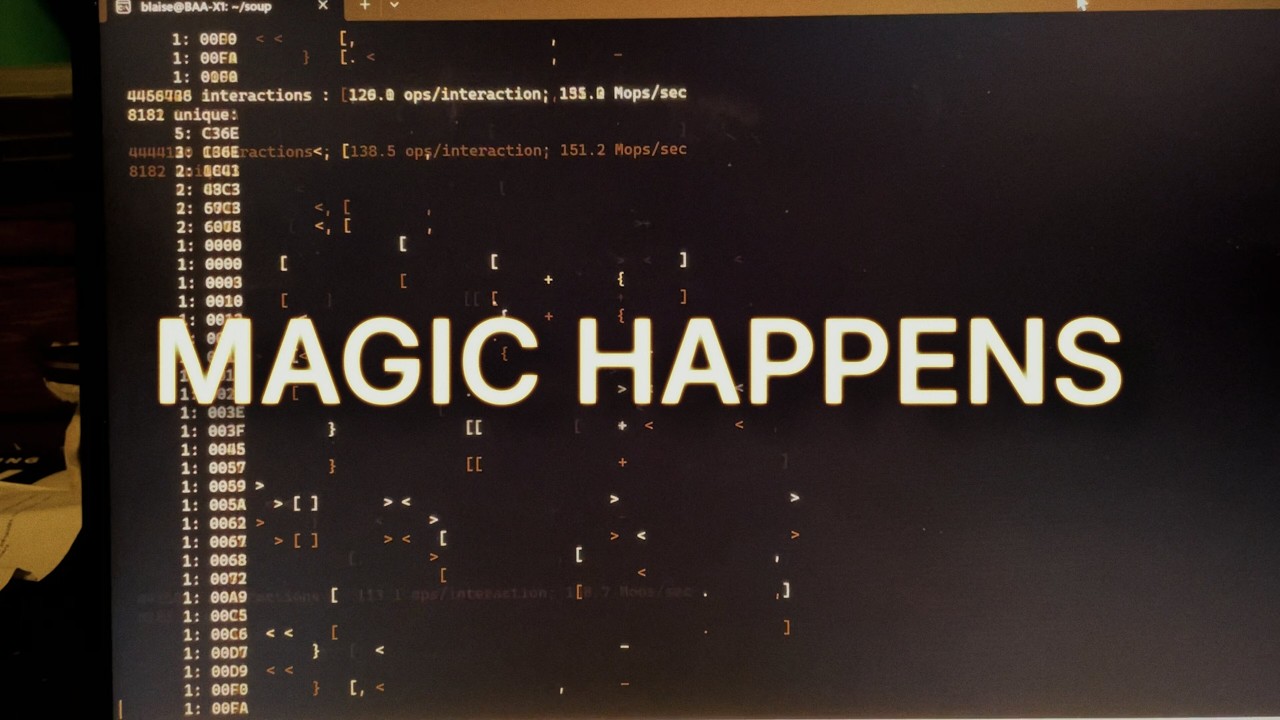
The talk details an artificial life experiment called “BFF” (Brainf***). The setup begins with a “soup” of random byte strings (tapes) in a modified, embodied version of the Brainfuck programming language. The only action is to repeatedly pluck two tapes, concatenate them, execute the resulting code, and return them to the soup.
After millions of interactions, a remarkable phase transition occurs. The system spontaneously shifts from a random “Touring gas” to an intensely computational state. This is visualized as a sudden, dramatic spike in the number of operations per interaction and a corresponding drop in the system’s entropy. The new state, structured at every scale, is argued to be a new phase of matter: life.
The Engine of Novelty: Symbiogenesis
A central mystery is that this complexification occurs even when the mutation rate is set to zero. If there’s no mutation, where does novelty come from? The answer is symbiogenesis. From the very beginning, short, unreliable replicators exist in the soup. Occasionally, two or more of these simple replicators fuse, forming a new, more complex entity that is more stable and better at replicating. This merger of smaller parts into a larger, functional whole is the true engine of novelty and evolution’s arrow of time.
A Mathematical Framework
This process is modeled with a system of equations combining:
- Population Dynamics (Lotka-Volterra-like): Describes competition and reproduction among existing species.
- Merger Dynamics (Smoluchowski Coagulation): Describes the fusion of entities, similar to how polymers coagulate or gelatin sets.
The observed phase transition is mathematically a gelation event. As proof, when the simulation is modified to block these symbiogenetic mergers, the phase transition to complex life never occurs, demonstrating that this mechanism is essential.
From Life to Intelligence
This framework has profound implications. Life was computational from the very beginning. Symbiogenesis creates progressively more complex, massively parallel biological computers. Intelligence emerges when these computers start modeling their environment, which most importantly includes other agents. This modeling of others is the root of what we call “theory of mind” and is the driving force behind the runaway evolution of intelligence in species like humans. Life and intelligence are not separate phenomena but are deeply intertwined on a continuum of computational complexification.