What a $42B Software Co. Really Spends on AI Tools | Mike Cannon-Brookes
Atlassian Co-Founder & CEO Mike Cannon-Brookes shares insights from a massive internal study of over 10,000 engineers using AI coding tools. He discusses the true measures of developer productivity, the future of developer roles, and why human-AI collaboration, powered by organizational context, is the key to the future.
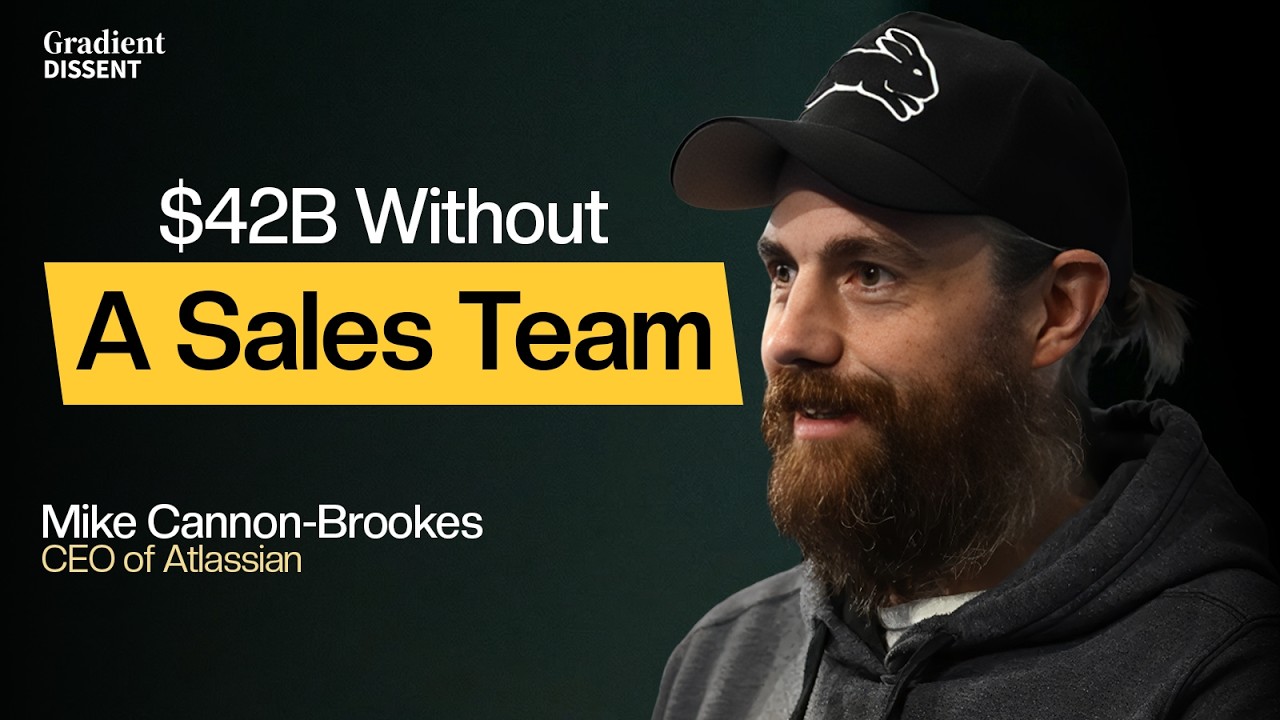
Mike Cannon-Brookes, Co-Founder and CEO of Atlassian, posits that AI is not a replacement for human creativity but a powerful accelerant. His perspective is shaped by running a company that has focused on connecting technology and business teams for over two decades and by conducting a massive internal study on AI’s impact on developer productivity. The core fear shouldn’t be replacement by AI, but “by somebody who’s really good at using AI.”
Measuring Developer Productivity Beyond Code Speed
A common mistake is to measure developer efficiency solely by how quickly code is written. True productivity lies in shipping customer value, which involves the entire team—developers, designers, product managers, and analysts. While AI coding assistants represent a significant inflection point in “coding speed,” this is only a small part of the equation.
Atlassian’s approach, bolstered by their acquisition of DX, focuses on a holistic view of engineering efficiency:
- Quantitative and Qualitative Metrics: It’s crucial to combine quantitative data (like pull request cycle times, based on frameworks like DORA or the newer DX4) with qualitative feedback from developers. Often, the best way to improve productivity is to simply ask engineers “what sucks about working here?” and fix those problems, such as a slow build system.
- Developer Joy: Atlassian tracks “developer joy” as a primary metric. The belief is that development is a creative profession, and developers are most productive when they are joyful and in a state of flow. Unproductivity, caused by broken builds or inefficient processes, leads to frustration.
- Perception vs. Reality: Initial studies show that while developers feel more productive using AI tools, this feeling doesn’t always correlate with actual output. This is because the workflow is shifting. Instead of building a mental model and then writing code, developers now review AI-generated code and must build the mental model retrospectively, which requires a different cognitive skill.
Atlassian’s Internal AI Coding Tool Study
With over 10,000 engineers, Atlassian is running a large-scale experiment, split-testing the world’s top AI coding tools, including GitHub Copilot, Cursor, Claude Code, and their own Rovo Dev. The goal is to rigorously measure the ROI and effectiveness of each tool across different contexts, as the cost can run into thousands of dollars per developer annually. The study analyzes which tools are used most, where they provide the most value, and how they impact both quantitative metrics and developer joy.
The Power of Context: The Teamwork Graph
The effectiveness of any AI tool is determined by its context. Atlassian’s key advantage is the Teamwork Graph, a massive knowledge graph with over 100 billion objects and connections.
- It maps the relationships between all work items across Atlassian’s products (Jira, Confluence) and hundreds of third-party SaaS applications like Figma, Google Docs, Slack, and GitHub.
- Initially built to connect disparate workflows, it has become the organizational memory that powers Atlassian’s AI, Rovo. By understanding the content and the relationships between pull requests, issues, documents, and designs, the AI can provide far more relevant and powerful assistance.
- This rich, permissioned context allows Rovo Dev to learn from a company’s entire history of solved issues and code repositories to generate code that aligns with existing styles and practices.
The Future is Human-AI Collaboration
The dominant future workflow will not be a magic “do the work” button but a continuous human-AI collaboration loop. AI will act as a partner or an intern, performing a task and returning for human feedback and direction.
A practical example from Atlassian:
- An AI agent brainstorms ideas on a Confluence whiteboard, pulling contextual data from the Teamwork Graph.
- The human team then comes in to discuss, vote on, and add their own ideas, providing crucial “human signal.”
- Another agent can then take this human-augmented brainstorm to generate a structured document or flowchart.
- A team lead might then record a Loom video discussing the document, adding their unique, unwritten “tribal knowledge” into the system.
- This entire process creates a rich, contextual artifact that improves the organizational memory for the next person or AI agent.
AI for Code Maintenance and the Future of Developer Roles
One of the most powerful and underappreciated uses for AI agents is in large-scale code maintenance. For tasks like refactoring an API endpoint across hundreds of repositories, a developer can provide a few examples of the change, and an agent can then intelligently find and apply that change across the entire codebase, turning a tedious task into a manageable one.
Contrary to the fear that AI will eliminate developer jobs, Cannon-Brookes believes there will be more developers in five years.
- Junior Developers: AI tools will make junior developers more productive than ever before. The idea that only senior engineers will be needed is flawed.
- Senior Developers: The role of the senior engineer will evolve. Their wisdom will be crucial for guiding juniors, ensuring developer accountability (you are responsible for the code you commit, regardless of its source), and performing the high-level “landscape architecture” of software design while AI handles more of the “gardening” (maintenance).
A Business Philosophy of Sustainable Growth
Atlassian’s success with product-led growth (PLG) was guided by a core philosophy: “grow longer, not faster.” The goal is to build a durable, multi-decade company, which requires prioritizing sustainable long-term growth over maximizing short-term revenue. This means balancing today’s needs with investments in future architecture and capabilities. Using a “seeding vs. harvesting” analogy, a business must constantly be “seeding” future opportunities rather than just “harvesting” the results of past efforts. This long-term view is reflected in focusing on leading indicators like monthly active users (MAU) as a measure of customer value, which ultimately drives future revenue.