Guide to Architect Secure AI Agents: Best Practices for Safety
AI agents offer immense power but come with significant security risks. This guide outlines a comprehensive architecture for securing AI agents using DevSecOps, robust access controls, threat monitoring, and a principle-of-least-privilege approach to mitigate dangers like prompt injection and data leaks.
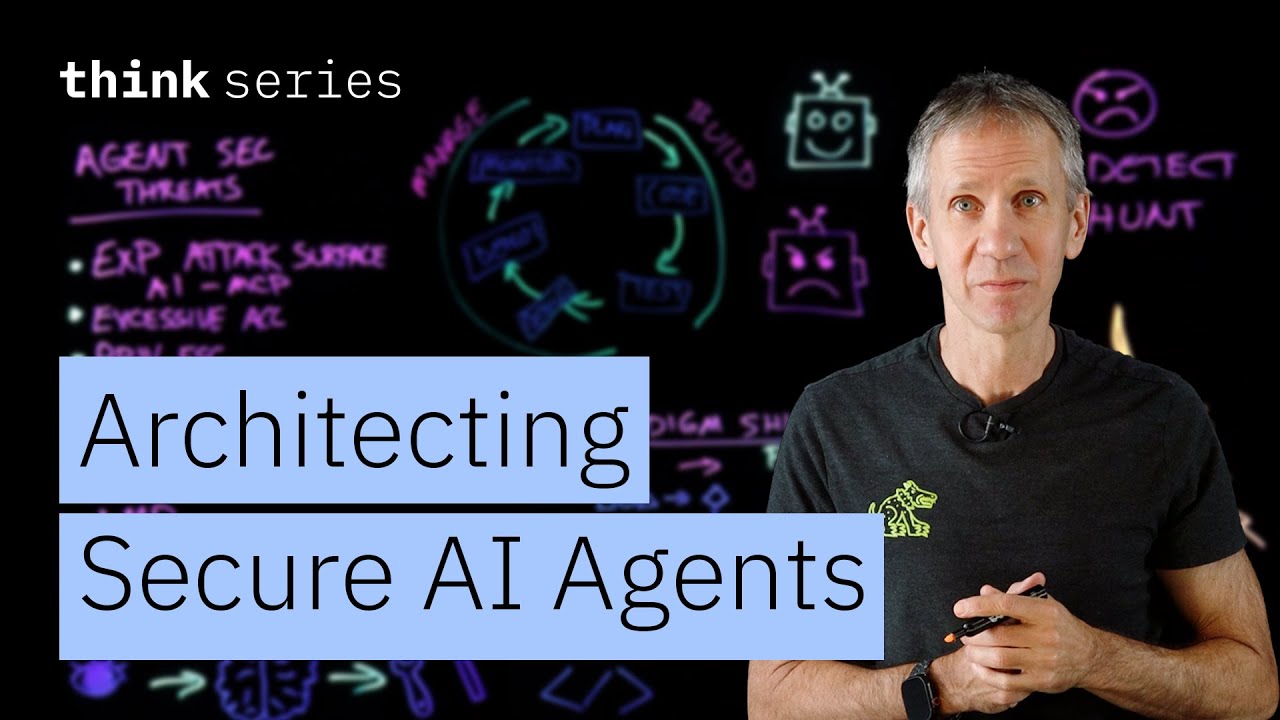
The Power and Peril of AI Agents
AI agents represent a significant evolution in AI, capable of perceiving context, reasoning about goals, and autonomously taking action through various tools and services. This autonomy, however, introduces considerable risks. To be effective and safe in an enterprise context, agents must be:
- Secured: To prevent data leaks and hijacking by malicious actors.
- Governed: To ensure they are reliable and operate within expected, explicit boundaries.
- Audited: To maintain compliance with both organizational policies and regulatory requirements.
A Paradigm Shift in Development
The rise of AI agents necessitates a fundamental shift away from traditional software development paradigms. This change is characterized by a move from:
- Deterministic to Probabilistic Systems: Unlike traditional code where a given input always produces the same output, agents operate on probabilities. The same input might lead to different decisions or outcomes in different instances.
- Static to Adaptive Environments: Agents are designed to learn and evolve their behavior over time based on interactions and feedback.
- “Code First” to “Evaluation First”: The focus shifts from the specifics of implementation to the continuous measurement of outcomes. The primary concern is whether the agent’s actions are moving it closer to its stated goals.
Adopting a DevSecOps Lifecycle
A structured agent development lifecycle is crucial for managing this new paradigm. This lifecycle follows a continuous loop: Plan -> Code -> Test -> Debug -> Deploy -> Monitor -> Plan.
This process should be enveloped in a DevSecOps approach, which integrates security into every stage of the development and operations pipeline. Security is not an afterthought but a foundational component from beginning to end, ensuring the final agents are safe, reliable, secure, and aligned with business objectives.
Key Security Threats for AI Agents
The introduction of AI agents expands an organization’s attack surface in several critical ways:
- Excessive Agency: Agents may be granted more access or control than necessary, or they might attempt to escalate their own privileges.
- Data Leakage: Without proper controls, agents can inadvertently or maliciously exfiltrate sensitive information.
- Prompt Injection: As with other LLM-based systems, this remains a primary attack vector, where an attacker injects malicious commands to hijack the agent’s behavior.
- Attack Amplification: A compromised agent, due to its autonomous and high-speed nature, can amplify the impact of an attack far beyond what a human attacker could achieve alone.
- Compliance Drift: Over time, an agent’s behavior could drift, causing it to fall out of compliance with necessary regulations.
Design Principles for a Secure Architecture
To counter these threats, a secure architecture for AI agents should be built on a foundation of strong system controls and design principles.
System Controls
- Constrained: Agents must operate within tightly controlled, predefined boundaries.
- Permissioned: Implement Role-Based Access Control (RBAC) or even Risk-Based Access Control to ensure agents have only the permissions they absolutely need.
- Sandboxed: Isolate agents in a sandboxed environment to limit the potential damage if they are compromised.
Core Design Principles
- Principle of Least Privilege: This is more critical than ever. An agent must only have access to the specific data and tools required for its job, and that access should be revoked the instant it’s no longer needed.
- Secure by Design: Security must be integrated from the very beginning of the agent’s lifecycle, not bolted on afterward.
- Human in the Loop: Continuous human oversight is essential to provide checks and balances for autonomous operations.
- Continuous Observation: Maintain observable traces of the agent’s reasoning, decisions, and actions to ensure governance and compliance.
A Layered Security Framework
A robust security framework for AI agents can be broken down into three main areas:
-
Identity and Access Management (IAM):
- Treat agents as unique non-human identities with their own credentials that are never shared.
- Implement just-in-time (JIT) access to grant permissions only for the duration they are needed.
- Use Role-Based Access Control (RBAC) to assign and enforce permissions.
- Audit all access and activities to ensure oversight and accountability.
-
Data and Model Security:
- Deploy an AI firewall, proxy, or gateway to intercept all inbound and outbound traffic.
- For inbound traffic, this gateway should inspect for prompt injections and enforce security policies before requests reach the model.
- For outbound traffic (e.g., an agent calling a tool via the MCP protocol), the gateway can perform Data Loss Prevention (DLP) scans to prevent sensitive data from leaving the system.
-
Threat Management and Monitoring:
- Real-time Detection: Continuously monitor agent activities, the tools they use, and the effects of their actions. Set up alarms for abnormal behavior, such as excessive data access or unauthorized changes.
- Proactive Threat Hunting: Go beyond reactive alerts by hypothesizing potential attack vectors and proactively searching for evidence of them.
- Risk Assessment: Regularly assess the risks the agent introduces and monitor for configuration drift, model drift, and unexpected changes in access patterns.