Why Uber, Nissan, and Mercedes Chose This Self-Driving Startup | Alex Kendall, Wayve
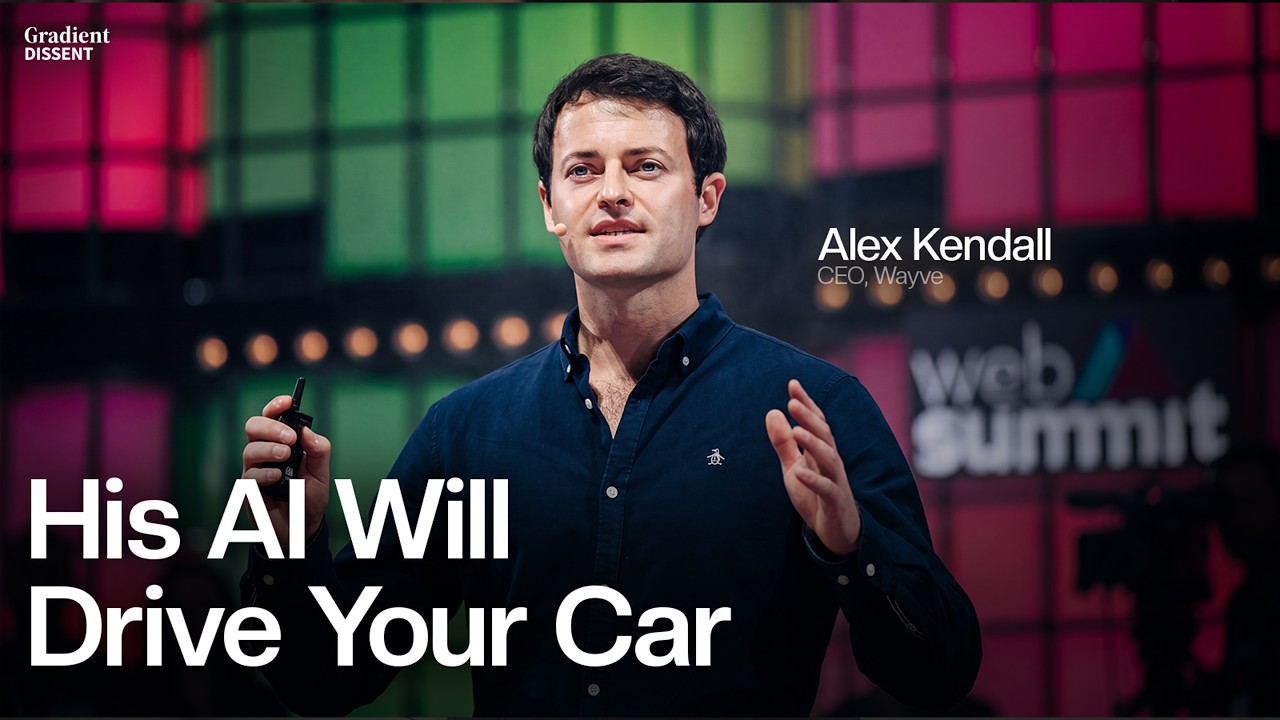
Wayve CEO Alex Kendall discusses their contrarian, AI-first approach to autonomous driving. He explains their journey from a garage prototype using reinforcement learning to developing a generalizable AI driver that has driven zero-shot in over 500 cities. Kendall emphasizes a strategy focused on licensing this embodied AI for mass-market consumer vehicles—a 100-million-unit-per-year opportunity—rather than building bespoke robotaxis, arguing that the future is an AI that can drive any car, anywhere.
The Wayve Thesis: An AI-First, End-to-End Approach
Alex Kendall, CEO of Wayve, details the company’s founding principle: treating autonomous driving as a complex reasoning and decision-making challenge best solved with end-to-end AI. This was a contrarian view a decade ago, starkly different from the prevailing “AV 1.0” paradigm which relied on expensive retrofit sensors, HD maps, rules-based systems, and significant infrastructure, limiting its scalability. Wayve’s mission was to create a generalizable AI model capable of driving any vehicle, anywhere, by learning directly from data. This approach aimed to transition the industry from expensive, geofenced vehicles to mass-market consumer cars with inbuilt hardware, capable of driverless operation.
Technical Journey and Breakthroughs
-
Initial Prototype: Wayve began in a rented house with a car in the garage. Their first experiment used on-policy reinforcement learning, rewarding the AI for distance traveled without human intervention. The breakthrough moment came when the model learned to lane-follow after only 10 corrective interventions from a human driver. This demonstrated the power of learning from raw sensor data with minimal priors, though the on-policy method itself was deemed unsafe to scale.
-
Scaling with Data and World Models: The team quickly moved to safer, more scalable methods like imitation learning and offline reinforcement learning. They pioneered the use of world models to learn through “dreaming”—simulating scenarios to understand the world from its experience. Learning in the chaotic environment of London proved to be a strategic advantage, forcing the development of a system that could handle complexity without relying on maps.
-
The Power of Language: Wayve integrated language into its vision-action model before the large-scale LLM boom. Initially a way to have the car explain its reasoning (e.g., “I’m going around a double-parked bus”), it evolved into a core training component. Language pre-training improved the model’s representation and reasoning. Kendall cites an example where the model learned to interpret the social cue of an oncoming car flashing its lights as a signal to proceed, a behavior it hadn’t exhibited before. Today, language provides performance boosts, better interpretability, and enables product features like personalization of driving styles.
Performance and Generalization
Wayve’s AI model has demonstrated remarkable generalization. In the “AI 500” roadshow, a single model was deployed across Europe, Asia, and North America, successfully driving zero-shot in over 500 cities—many of which had no prior training data. The model proved its robustness in extreme conditions, including 22-hour darkness and snow in the Arctic Circle and navigating Tokyo during a typhoon where public transport had shut down. This, Kendall argues, is a testament to the fact that they have built an AI capable of generalizing to any vehicle, anywhere.
Strategy and Market Vision
-
Licensing Model: From the beginning, Wayve decided not to build its own cars, focusing instead on being an AI company. The goal is to license its generalizable AI driver to automotive partners. This allows them to be hardware-agnostic and integrate into various form factors, from consumer cars and delivery vans to robotaxis and trucking.
-
Consumer Vehicles vs. Robotaxis: While the industry is excited about robotaxis, Kendall emphasizes the scale of the consumer vehicle market. With nearly 100 million cars produced annually versus fewer than 10,000 robotaxis, he sees integrating into mass-market consumer vehicles as the far larger opportunity in the short-to-medium term. The ultimate goal is for every vehicle to be capable of driverless operation.
-
Safety and Ethics: On the classic “trolley problem,” Kendall explains that the system is designed to always have a third, safe option called a “minimal risk maneuver.” This involves reducing kinetic energy and maintaining a predictable course to de-escalate a risky situation. The goal is to design the system so robustly that it never has to choose between two bad outcomes.
-
Infrastructure over Algorithms: A key lesson from the journey was the outsized importance of infrastructure. Kendall states that deep learning success is “1% algorithms, 99% infra,” highlighting the critical role of clean data, fast iteration loops, and robust evaluation tools over chasing shiny algorithmic innovations.