Why a One-Line Change Can Break Your Whole Stack - Cole Gannaway, Qodo
placeholder
Review is the new bottleneck
Code generation has accelerated faster than the industry has seen before, but the constraint has moved downstream to pull request review. Teams that want to take a ticket all the way to production find that writing code is no longer the slow step. The trust and verification layer is. Qodo focuses on that review stage, on the view that a complete software factory has many parts and that review is where the most leverage sits today.
The central argument is that whether the reviewer is a human or an agent, it needs as much context as possible to make good decisions, and most current tooling does not supply it. Green checks from builds, unit tests, and linters are not evidence that a change is safe. Reviewers routinely merge changes they have not read line by line, because they rely on those signals. Not all review tools or context sources are built the same.
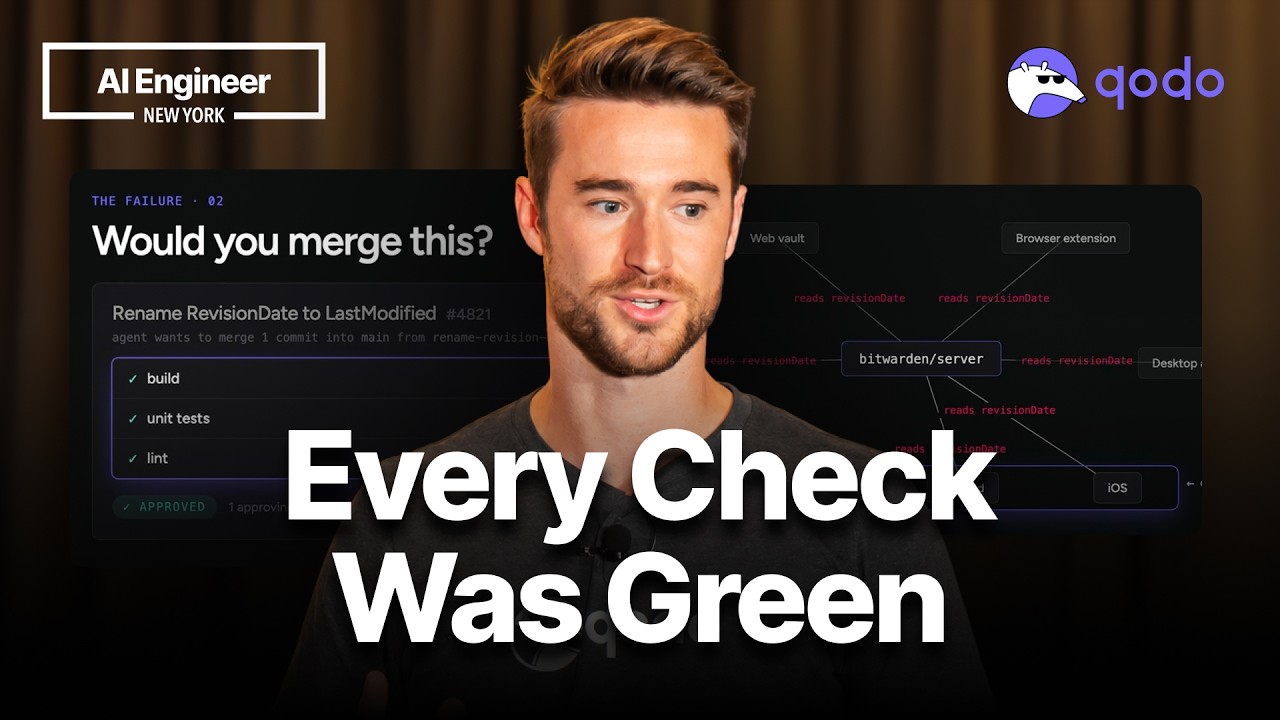
A one-line change that passes every check
The illustration is a single-line change to a data model in Bitwarden, the open-source password manager. On its face, the change looks correct. It is the adjustment the developer wanted, the build passes, unit tests pass, linters pass, and the natural move is to approve it. Nothing in the normal review flow signals a problem.
The problem is the blast radius. Bitwarden’s back-end server is connected to web clients, to mobile clients on iOS and Android, to MCP servers, and to the CLI. A single line changed in one repository affects all of them. Failures like this usually surface in production as a bug report, a user story, or a crashed web app. The goal is to catch them as early as possible, and in this case the existing tooling would have missed it.
Mapping the blast radius with a software graph
Qodo builds a software graph of the repositories a team is working on. It constructs this automatically and includes an integration surface, meaning it maps which components connect to which. Knowing that the server repo exists is not enough. What matters is knowing exactly which clients and services depend on it. Without that map, neither a human nor an agent reviewing a diff can reason about downstream effects.
When this graph is available to the review agent, a change like the data model edit can be flagged as high-impact before it merges, and the reviewer can give it closer scrutiny.
Custom rules and tribal knowledge
Not every review concern is purely functional. Senior reviewers bring taste, organizational conventions, and lessons from past incidents. The aim is to bring that human judgment back into the code intelligence layer, so the human is not the sole bottleneck on every change.
An example custom rule: any change to a public API must either add a deprecation flag or receive a more thorough review. Rules like this encode institutional knowledge that would otherwise live only in people’s heads.
Bringing context in before code is written
The ideal is to supply this information before the PR exists, and ideally before any code is generated. If the coding agent already knows about downstream effects, custom rules, and codebase conventions from an MCP server or codebase knowledge store, it has a much better chance of getting the change right on the first attempt. This does not guarantee correctness, and review still matters, but it shifts the odds considerably.
It is tempting to have the implementation agent also do the review, but the two jobs have different context needs. An implementation agent is juggling debugging, exploring the codebase, and writing code. Context windows are growing, yet important details still get buried in long sessions, and hallucinations still happen. A dedicated review agent works from a focused set of context and leaves room for information specific to the current run or review.
Don’t let the writer grade its own code
The agent that wrote the code should not be the one grading it, for two reasons. First, a separate reviewer has its own context window available rather than a window already filled with implementation work. Second, independence matters. Biases carry over when the same model and the same harness both produce and judge the code.
Independence can be achieved by varying the underlying model, whether Anthropic, OpenAI, or an open-weight model, and by varying the harness. Adversarial reviewers can examine the same diff and compare findings. When independent reviewers converge on the same issue, that is a strong signal it is real. When they diverge completely, the disagreement is worth investigating further.
Turning PR comments into rules
Postmortems are valuable, but many of their lessons concern organizational or process changes rather than code. The code-level lessons should be captured automatically and turned into shared organizational knowledge. Qodo can suggest a rule based on a comment left on a PR, and once accepted, that rule applies to every future PR.
The software graph closes the loop. Because the system knows the blast radius of a change, it can flag a large-impact change to the reviewer, whether that reviewer is a person or another agent, so it gets a closer look.
Checking intent against the ticket
In the Q&A, one participant asked whether many clients struggle with intent before any code is written. The answer was yes, and the failure often originates in the ticket itself, which may be vague or incomplete. The deeper problem is the link between the ticket and the implementation context. When that link misses the real intent, the agent learns the wrong thing and builds the wrong solution, which can look like over-engineering even when the root cause is a misunderstanding of the goal.
Qodo integrates with Jira and Linear and attaches ticket content directly to each PR review. It can highlight requirement gaps by comparing the change against the ticket’s acceptance criteria, which answers whether the work actually completes the ticket and whether the agent has drifted down a rabbit hole.
This also enables guidance during generation. Teams commonly configure a periodic review, with a skill that triggers a review at roughly the 25%, 50%, and 75% points of a run. Because context windows shrink as work progresses, a specialized review agent functions almost like a manager agent, pulling the implementation agent back from the wrong path or from over-engineering.
Where this leads
The next question is which changes can merge without a human reading them. Some teams already do this in practice. The open question is which changes should not, and blast radius data is the means of answering it.