Is AI Holding Kids Back from Learning? (Ep. 1036 with Jon Krohn)
Drawing on a wave of new studies, this piece examines whether AI stops children from learning and argues the answer hinges on how it is used. AI as a shortcut that outsources thinking undermines learning, while AI as a tutor that explains concepts and gives feedback can improve it. It covers a large natural experiment in China, a Turkish tutoring study, and practical takeaways that apply equally to adults using AI at work.
Widespread use, thin evidence
Student AI use has become nearly universal. A survey by the EdTech firm Chegg found that 80% of undergraduates in wealthy countries were using AI in their studies, and more recent polls in Britain and Germany put the figure at 93 to 94% of students. Until recently, rigorous evidence on what this does to learning was thin. The studies released over the past few months tell a more nuanced story, one that matters for adults as much as for children: the outcome depends on whether AI is used as a shortcut or as a tutor.
The Chinese natural experiment
The largest new study, published in June by researchers at Stockholm University and the University of Hong Kong, followed students in grades 7 to 12 in China, where roughly 80% of students reported using chatbots such as DeepSeek or ByteDance’s Doubao. Because students adopted AI at different times, the researchers could use a difference-in-differences design, comparing each student’s trajectory before and after adoption against students who had not yet adopted. That is a significant step beyond the one-off correlational snapshots typical of large studies of human behavior. The data spanned monthly closed-book exams, high-stakes entrance exams, and homework scores and completion times across nine subjects.
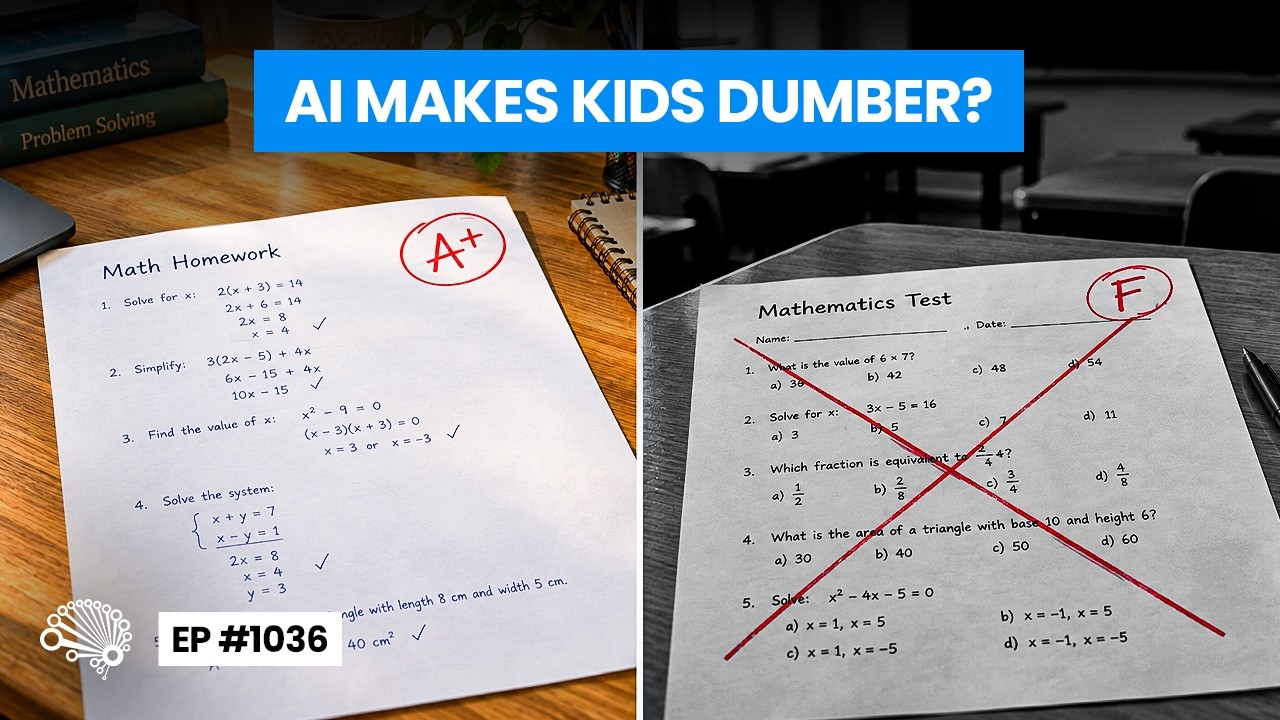
After adopting AI, homework scores rose 18% and time spent per assignment fell about 30%, from an average of 64 minutes to 45. That looks like a productivity miracle until you see the exams. Monthly exam scores fell 20% within six months, entrance exam scores fell 18% and 24%, and the full penalty emerged only after about two years. The pattern looks less like a productivity gain and more like cutting corners on homework. Homework scores had been a solid predictor of exam performance, but with AI in the mix that relationship has flipped: the students with the highest homework scores are now more likely to do worse on exams. A teacher using homework grades to gauge understanding is now reading a broken signal. The losses were largest in social sciences, followed by STEM and then languages, and were especially pronounced for junior students, high achievers, and boys.
Banning AI outright is not the obvious conclusion, though. The losses concentrated among most AI users, whose behavior looked like outsourcing: exceptionally short completion times paired with high homework scores. The remaining students, who spent 50 to 65 minutes on homework, roughly matching non-users, had exam scores effectively identical to non-users despite significantly higher homework scores. They appear to have used AI to explain concepts and get unstuck rather than to generate answers wholesale.
Tutor design versus answer machines
A field experiment with nearly 1,000 high school math students in Turkey, led by a researcher at the Wharton School, compared a standard GPT-4 chat interface with GPT Tutor, a version with safeguards designed to protect learning. GPT Tutor prompts ran to more than 500 words, compared with about 50 for the standard version. Practice performance improved by almost 50% with standard GPT-4 and by 127% with GPT Tutor. On the subsequent exam taken without AI, students who had used standard GPT-4 scored 17% worse than students who had never had access, while the GPT Tutor group was statistically indistinguishable from the control group. The Turkish study also found that AI users were overly optimistic about how much they had learned, and that even high achievers were overconfident. Weaker skills paired with greater confidence is a dangerous combination, and it is unsurprising given how flattering LLMs tend to be.
Evidence that AI can help
Several studies show promising gains. In a randomized experiment at Middlebury College, undergraduates learned an unfamiliar topic and wrote an analytic essay with or without generative AI, then took unaided assessments immediately and one week later. AI access raised immediate test scores by 0.27 standard deviations, and those gains persisted. Essay quality barely changed while students had AI but improved a week later when they wrote unaided. The delayed gain was larger among students who used AI to explain concepts (augmentation) than among those who had it generate text (automation), whose short-run gains vanished once the AI was removed. Students with AI shifted time away from drafting and toward reading and searching for information, and they reported enjoying learning more.
At Harvard, a randomized study of nearly 200 introductory physics students, published in June of last year, found that students learned more than twice as much from a custom AI tutor as from an active learning classroom, and in less time. That tutor was fed the lecturer’s own solutions and instructed to keep responses to a few sentences to avoid cognitive overload. In Nigeria, a World Bank randomized trial of a six-week after-school program using Microsoft Copilot powered by GPT-4 improved scores by 0.31 standard deviations, equivalent to roughly 1.5 to 2 years of business-as-usual schooling. That outperformed about 80% of educational interventions evaluated through randomized trials in the developing world. The World Bank team cautions that the results reflect the full package of structured prompts, curriculum alignment, teacher support, and peer learning alongside the AI, not simply placing children in front of a chatbot.
Desirable difficulty
Cognitive scientists call the productive struggle of learning ‘desirable difficulty.’ When AI removes that effort by producing the answer before a student has wrestled with the problem, the homework looks great and the learning does not happen. When AI is used to explain concepts, offer hints, and give feedback, it can be an outstanding tutor. So the answer to whether AI stops children from learning depends on how it is used.
Three practical takeaways
First, time on task is a useful warning signal. A student whose homework quality jumps while homework time collapses is probably outsourcing to AI. Second, tool design matters. The Turkish, Nigerian, and Harvard results all point toward AI configured to tutor rather than simply answer, so it is worth switching on the study or learning mode that many platforms now offer. Third, assessments completed without AI, such as in-class closed-book exams, matter more now, not less, because homework grades no longer reveal what a student knows. Oral assessment is one promising direction. Krohn’s co-instructor at Tulane University co-created oralexam.ai, a tool that has students discuss their submitted written work in a bespoke automated conversation.
These lessons are not only for kids. Every professional using AI at work faces the same trade-off between finishing a task faster today and building the skill to tackle harder tasks tomorrow. Try the problem yourself first, ask the model to explain its reasoning, and use AI to augment your thinking rather than replace it. Used that way, AI may be the most powerful learning tool humanity has ever had.