Can we AI our way to a more sustainable world?
Microsoft experts Doug Burger, Amy Luers, and Ishai Menache discuss the dual role of AI in sustainability. They analyze the environmental footprint of datacenters and explore how AI-driven optimization and materials discovery can be pivotal in decarbonizing global systems like energy, industry, and food production.
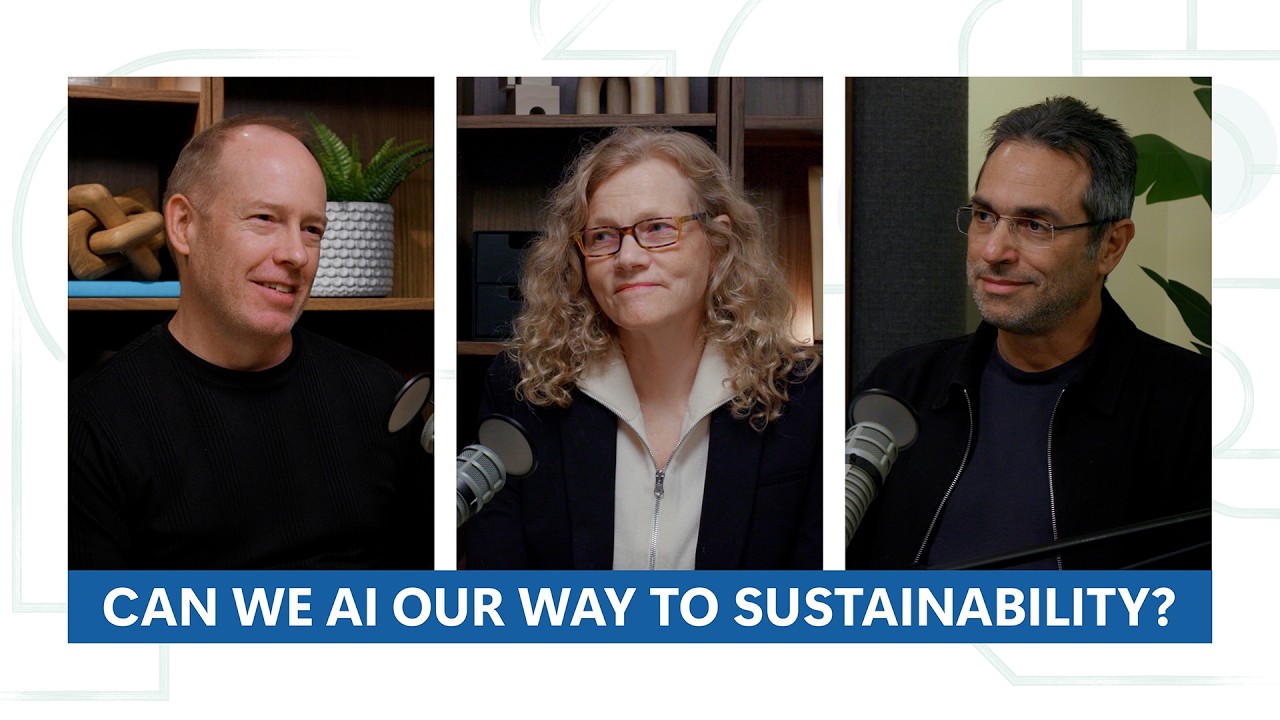
Microsoft sustainability expert Amy Luers and optimization researcher Ishai Menache join Doug Burger to explore the complex relationship between AI and climate sustainability. Luers posits that AI will be one of the most influential factors in our climate future and is a necessary tool to solve the climate crisis. The discussion moves beyond the direct footprint of AI infrastructure to its potential to decarbonize and optimize the world’s largest systems.
The Environmental Footprint of AI in Context
Amy Luers provides a data-driven perspective on the impact of datacenters, separating hype from reality.
- Global Emissions: As of 2024, datacenters account for less than 0.5% of total global greenhouse gas emissions. While their electricity use is projected to grow significantly (potentially doubling by 2035), their share of global emissions is expected to remain under 1%.
- Electricity Demand: The core issue is the demand for clean electricity. Globally, energy use accounts for 75% of all emissions. Decarbonization requires electrifying transportation and heating, which means the world needs massively more electricity, regardless of AI’s growth. The challenge is generating this electricity cleanly and delivering it where it’s needed.
- Local vs. Global Impact: While the global emissions percentage is small, datacenters are highly concentrated geographically. This can create significant strain on local grids and resources in specific communities. Microsoft’s “community-first infrastructure initiative” aims to address this by designing datacenter development to be a net positive for local areas, ensuring they don’t drive up local energy prices or strain water supplies.
AI for Optimization and Efficiency
Ishai Menache, an expert in mathematical optimization, explains how AI can drive massive efficiency gains, which is closely linked to sustainability. Mathematical optimization uses mathematics to find the best possible decisions when faced with numerous choices and constraints.
“AI can be the glue in this very compound, very complicated systems where there’s, like, distributed decision making… With this kind of combinations of advanced analytics and AI, we can actually get much further with more holistic and more global optimizations that are good for society.” - Ishai Menache
His team developed OptiMind, a small language model that democratizes this field by allowing non-experts to describe a complex problem in natural language, which the AI then translates into a formal optimization algorithm.
Examples of optimization in practice include:
- Datacenter Efficiency: Increasing the “packing density” of virtual machines on servers reduces power consumption per unit of useful compute. Optimizing the physical placement of server racks has reduced power fragmentation by 1-2%, a massive saving at the scale of the cloud.
- Supply Chain: Optimizing shipping logistics to minimize fuel consumption and emissions while meeting delivery goals.
- Prediction + Optimization: Combining AI’s predictive capabilities with optimization is particularly powerful. For example, predicting the lifetime of a virtual machine allows for much more efficient packing. Better demand forecasting in the supply chain reduces the need to build and maintain costly, energy-intensive buffer capacity.
Grand Challenges for AI in Sustainability
Luers identifies three “game-changing capabilities” of AI for sustainability:
- Optimizing Complex Systems: Managing systems like the global electricity grid, which is becoming more complex with the integration of variable renewable energy sources.
- Accelerating Discovery: Radically speeding up the development and deployment of new climate solutions, particularly in materials science.
- Augmenting Human Capacity: Enhancing the workforce and institutional ability to tackle these complex challenges.
These capabilities can be applied to three critical challenge areas to move the needle on global emissions:
- Electrifying Everything: The global electricity grid must more than double in capacity by 2050 to meet climate goals. AI and optimization are essential for managing this transition, integrating renewables, and ensuring grid stability.
- Industrial Materials & Chemicals: AI can accelerate the discovery of new, low-carbon materials. An example is the recent design of cement using algae, which is just as strong but generates 20% fewer emissions. Given that cement production accounts for ~7% of global emissions, this represents a significant opportunity.
- Low-Carbon, Resilient Food Systems: The food system accounts for about a third of global emissions, from fertilizers and methane to supply chain inefficiencies. Food waste alone contributes to 8% of emissions. AI can optimize supply chains, improve agricultural practices, and reduce waste.
The Path Forward: Resilience and Human Agency
The conversation concludes by addressing the societal implications of relying on AI to manage critical systems.
- Resilience vs. Optimization: There can be a tension between optimizing a system for pure efficiency and building in the redundancy needed for resilience. The solution is to incorporate resilience as a primary objective within the optimization problem itself, planning for uncertainty and “black swan” events.
- Human Agency: A key challenge is retaining human control and understanding as these AI systems become more complex. Menache emphasizes the importance of explainability, where AI can articulate why it made a certain decision and present alternatives, allowing humans to remain in the loop. The ultimate vision is a “unified decision intelligence platform” that makes these powerful tools accessible and allows humanity to manage its complex systems in a way that is not only efficient but also equitable and resilient.