Top Black Holes Physicist: GPT5 can do Vibe Physics, here's what I found
Theoretical physicist Alex Lupsaska shares his journey from AI skeptic to collaborator, detailing how advanced GPT models solved a year-long problem in quantum field theory concerning gluon scattering amplitudes, and then generalized the solution to gravitons, signaling a new era of AI-accelerated scientific discovery.
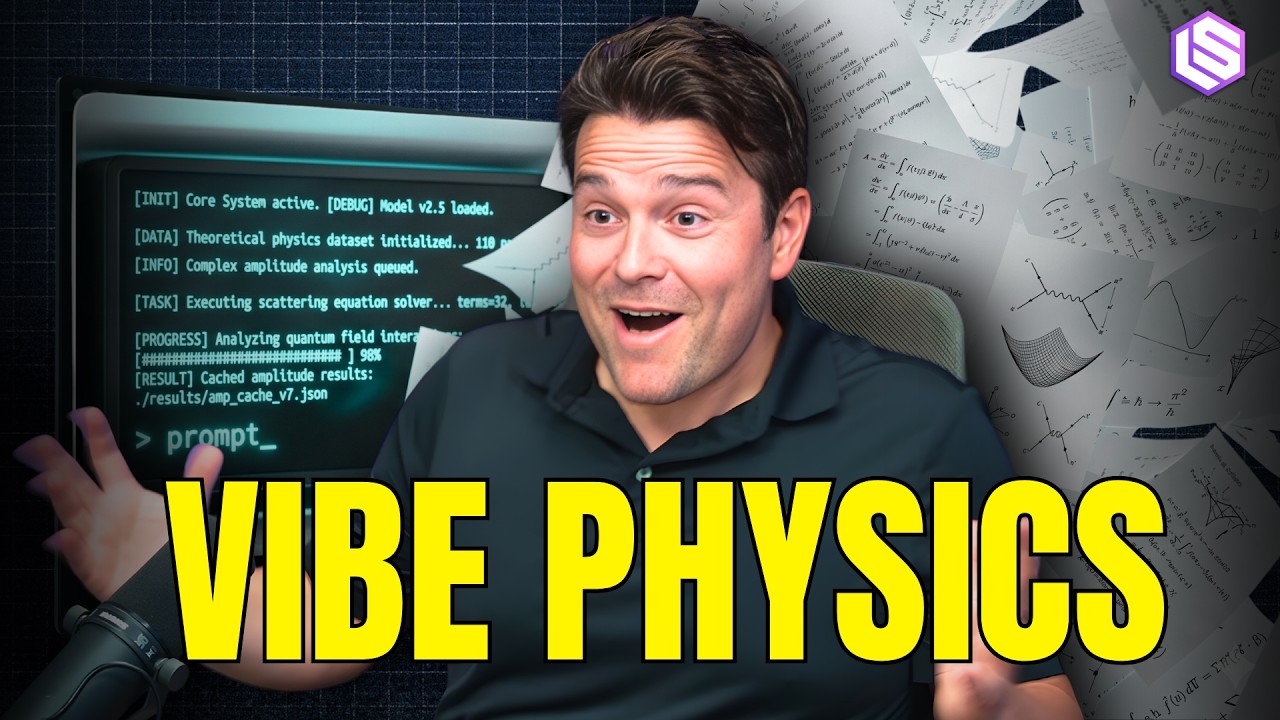
Alex Lupsaska, a theoretical physicist at Vanderbilt University and a fellow at OpenAI, describes a profound shift in his work, moving from a position where AI was useful for writing emails to a new reality where it acts as a superhuman collaborator in frontier physics research. This transition marks a significant milestone, where AI has surpassed human capabilities on specific, complex scientific tasks.
The Jagged Frontier of AI Capabilities
Lupsaska highlights a “jagged frontier” in AI progress. While for average users, the improvements from one model to the next might seem incremental—making email composition only slightly better—for those pushing the limits of science, the capabilities are exploding.
His personal “AI pilled” moment came when an advanced GPT model (referred to as GPT-4 in the transcript, though sometimes misspoken as GPT-5) was able to reproduce one of his most complex papers in about 30 minutes. This experience transformed his perspective, convincing him that AI would fundamentally change how research is conducted.
“When GPT-4 came out it was able to reproduce one of my best papers that took me a very long time to come up with in like 30 minutes. And that’s when I really became AI pilled. I thought, ‘Oh my god, this changes everything.’”
This realization prompted him to join OpenAI to be at the forefront of this revolution. He notes that many senior colleagues are now also recognizing this shift, with AI tools rapidly being adopted across the physics community. A recent example involved an AI model writing a simulation for the SYK model—a complex problem in quantum mechanics—in just 10 minutes, a task that had stumped research groups for a long time.
The Gluon Amplitude Problem
At the heart of the discovery lies a problem in quantum field theory (QFT), the framework that reconciles Einstein’s relativity with quantum mechanics. In QFT, physicists compute “scattering amplitudes”—complex functions that, when squared, give the probabilities of particle interactions.
- Particles and Forces: The strong nuclear force, which binds atomic nuclei, is mediated by particles called gluons.
- Helicity: Particles like gluons have a property similar to polarization called helicity, which can be right-handed (plus) or left-handed (minus).
- The Simplest Cases: For decades, it was understood that interactions where all gluons have the same helicity (e.g., all-plus) are forbidden; their amplitudes are zero. Textbooks and conventional wisdom suggested the same was true for “single-minus” amplitudes, where just one gluon has an opposite helicity.
- The Parke-Taylor Formula: The next simplest case, with two minus-helicity gluons (double-minus or MHV amplitudes), was famously solved in the 1980s. Physicists Parke and Taylor found that after a horrendously complex calculation involving many Feynman diagrams, the result simplified into a stunningly simple, one-line formula.
The Human Insight: A Loophole in the Textbooks
For over a year, Lupsaska’s collaborators—Andrew Strominger, Alfredo Guevara, and David Skinner—had been working on a key insight. They realized the long-held belief that single-minus amplitudes are zero had a loophole. The argument only holds if particles are in generic positions. In a special “collinear” regime where particles are aligned, the amplitude could be non-zero.
They began computing these non-zero amplitudes by hand, but the process was brutal. The complexity, represented by the number of Feynman diagrams, grew factorially with the number of particles (n). The resulting formulas were monstrously complex. For a six-particle interaction, the equation spanned a quarter of a page with 32 terms. They were stuck, convinced a simpler, Parke-Taylor-like formula must exist but unable to find it.
AI Enters the Fray: From Mess to Miracle
This is where AI intervened. Lupsaska proposed this “perfect problem” to tackle with AI.
- Simplification: They fed the known, complex formula for the five-particle (5-point) amplitude to ChatGPT. The model identified a special region of phase space where the cumbersome sum of eight terms simplified to a clean product of just three terms. This was a novel insight.
- Pattern Recognition: Encouraged, they provided the even more complex 6-point amplitude. The AI again found a dramatic simplification, reducing 32 terms to a product of four.
- The General Formula: The researchers then asked the AI to guess the general formula for an arbitrary number (
n) of particles. It returned a concise, elegant formula. Crucially, the AI’s proposed formula had linear complexity, not factorial. Doubling the particles only doubled the terms—the simplest possible behavior. - Proof and Verification: While the public model conjectured the formula, it couldn’t rigorously prove it. The team then presented the problem from scratch to a more powerful, internal OpenAI model. Over 12 hours, this model not only rediscovered the same formula independently but also generated the complete mathematical proof, which now forms the core of the published paper.
The final paper, “Single minus gluon tree amplitudes are non-zero,” presents a fundamental physics result. The discovery that these interactions can occur is significant, but the elegant formula describing them—found by AI—was the breakthrough that had eluded top physicists for a year.
Accelerating Science: The Graviton Generalization
Just three weeks later, the team published a second paper, “Single minus graviton tree amplitudes are non-zero.” This extended the finding from gluons (strong force) to gravitons (gravity).
This follow-up was remarkable for its speed and methodology:
- The entire calculation was performed by the publicly available GPT-4 model.
- The researchers simply “seeded” the model with their first paper on gluons and asked it to generalize the result to gravity, a mathematically distinct and more complex problem.
- The AI independently devised the necessary mathematical steps, including applying the “directed matrix tree theorem” in a way the human experts found surprising and novel.
- The result was obtained in days, with most of the three-week period spent by the humans verifying the AI’s work and writing the paper.
The Future of Scientific Discovery
This experience points to a new paradigm in science:
- The Role of the Researcher: The physicist’s role shifts from being a calculator to a collaborator, guide, and critic. The essential skill becomes not just technical proficiency but “taste”—the ability to ask the right questions.
- Accelerated Progress: AI dramatically reduces the time spent being “confused” and allows researchers to explore multiple potential solution paths simultaneously, acting as a scout in unknown intellectual territory.
- Training the Next Generation: Academia faces a challenge: how to train students when the “rite of passage” of arduous calculation can be offloaded to an AI. The focus may need to shift earlier towards developing research intuition and problem-selection skills.
- Beyond the Paper: Lupsaska speculates that the static, PDF-based academic paper may become obsolete, replaced by interactive models or “living papers” where readers can query an AI to unpack concepts at any level of detail.
The trajectory is clear. A year ago, AI was a helpful assistant. Today, it’s a collaborator solving problems that stumped world experts. The next step is to tackle questions that have stumped the entire scientific community for decades.