How Developers Secure AI-Generated Code: 5 Security Best Practices
Discover five essential principles for implementing shift-left security in AI-assisted software development. Jeff Crume explains how to secure AI-generated code by focusing on outcome validation, integrating security early, scrutinizing dependencies, validating intent, and maintaining continuous security practices for more trustworthy AI-powered workflows.
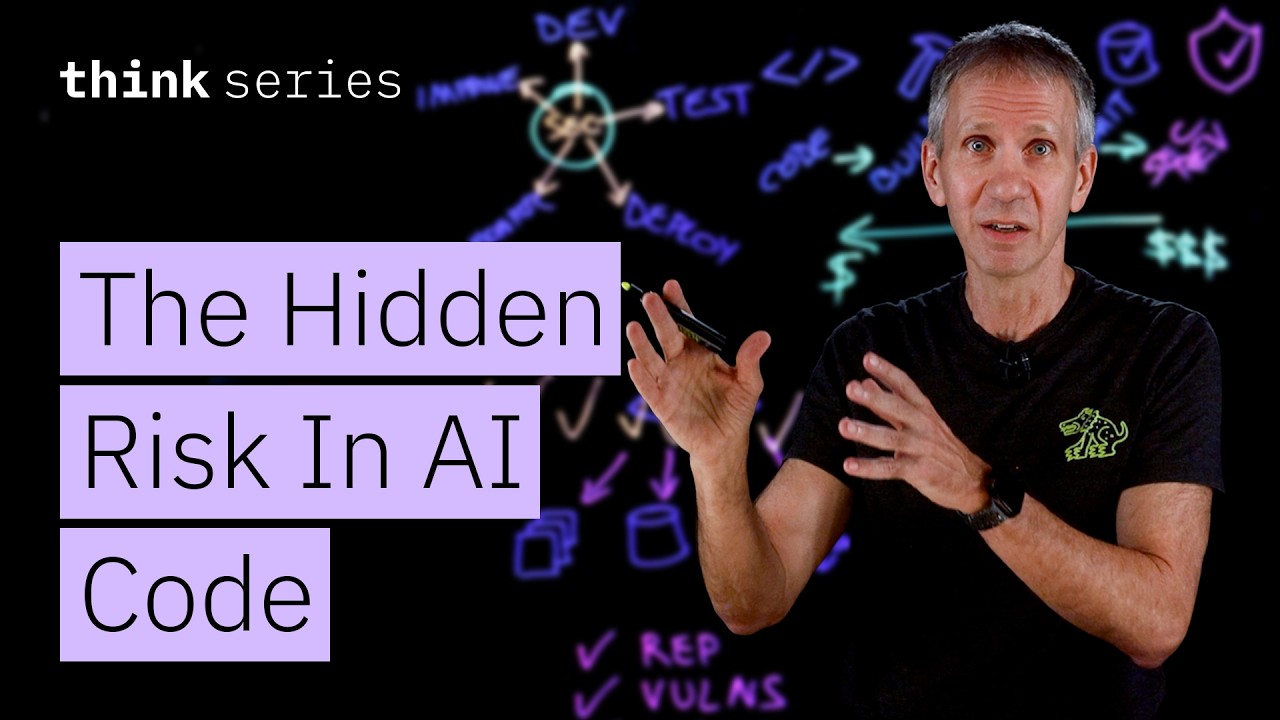
The rapid acceleration of software development by AI, enabling the generation of code, tests, agents, and workflows from simple prompts, presents a significant challenge to traditional security practices. Security models designed for human-written code and slower cycles do not scale to AI-assisted development. A retrofit approach to security at the end of the process degrades quality and halts progress. The solution lies in shift-left security, integrating security from the earliest development stages and maintaining it throughout the lifecycle.
In the AI era, shift-left extends beyond merely running security tools earlier; it demands rethinking what to validate, when to validate, and how to build confidence in AI-generated solutions. Five key principles are essential for improving the security posture of AI-assisted development:
1. Trust the Outcome, Not Just the Generation
AI-generated code often appears correct—it compiles, runs, and may even pass basic security tests. However, this superficial correctness can mask deeper security risks. Developers must move beyond verifying technical implementation to validate the outcome. This involves scrutinizing permissions, potential data leaks, and failure handling (ensuring systems fail safe rather than open). For instance, an AI-generated service might correctly retrieve customer data but possess overly broad access, leading to sensitive data exfiltration or vulnerabilities if authentication fails or malformed data is introduced. The crucial question is not just “does the code work?” but “does it provide expected results and behave securely under real-world conditions?”
2. Security Starts During Development
Historically, security reviews were often treated as an afterthought, occurring only after coding, component building, testing, and committing. This end-of-process checkbox approach is ineffective and creates severe bottlenecks in rapid AI development environments. The principle that finding bugs earlier makes them cheaper to fix applies equally to security vulnerabilities. Shift-left security embeds validation directly into the development process. This means automatically performing static source analysis, dynamic penetration testing, scanning for embedded secrets, and conducting policy and compliance checks as code is being created. The objective is to proactively mitigate risks and reduce unpleasant surprises later in the software lifecycle.
3. Validate Generated Dependencies
AI not only generates code but also introduces new dependencies, including packages, libraries, services, and integrations. While these dependencies add capability, each also introduces potential risk. Developers often focus on reviewing the generated source code itself, overlooking the underlying dependencies that AI seamlessly integrates. Given that many security incidents originate from the software supply chain, generated dependencies require the same rigorous scrutiny as the generated code. Validation must include assessing package reputation, known vulnerabilities, licensing compliance, source integrity, and adherence to organizational standards. In AI-assisted development, thorough dependency validation is a non-negotiable component of secure code generation.
4. Validate the Intent, Not Just the Code
Many critical security issues arise from incorrect assumptions or misunderstood requirements rather than technical coding flaws. An AI model might generate technically elegant code that adheres to best practices, but if the underlying requirements regarding data access, allowed actions, business rules, or protected information are misinterpreted, the solution can still violate security policies. For example, a generated workflow might correctly process financial data yet inadvertently expose it to unauthorized users. This represents an “intent problem,” not a coding defect. With AI’s ability to generate sophisticated solutions rapidly, developers bear increased responsibility for validating whether the AI has solved the right problem in the right way, ensuring clarity of intent.
5. Security Must Become an Ongoing Practice
Traditional security efforts concentrated near release are insufficient for AI-assisted development, which produces continuous change. Consequently, security validation must also be continuous, extending even after deployment. Security must be an integral part of every phase of the software lifecycle: development, testing, deployment, monitoring, and improvement. This requires continuous vulnerability detection (leveraging advanced AI frontier models), dependency monitoring and patching, policy verification and enforcement, and ongoing change validation. The goal is to maintain confidence over time, asking not just “did it pass once?” but “does it continue to be secure?” The discovery of a 27-year-old zero-day vulnerability by an AI model underscores that security is never a finished task; it must be a living, evolving part of the process.
Securing AI Agents
As AI systems become more agentic, performing multi-step work across diverse services, repositories, pipelines, and configurations, reviewing individual files becomes inadequate. Security increasingly depends on understanding the entire workflow and potential unintended consequences across interconnected systems. AI agents require robust guardrails to define appropriate actions, identities for accountability, access controls to limit their capabilities, and continuous monitoring with human oversight. Without these measures, agents can amplify risks rather than simply enhance productivity.
Conclusion
The new reality demands securing fast and validating continuously. AI accelerates code generation, leading to increased functionality and complexity—the enemy of security. Speed alone does not build value; trust does. Successful organizations will embed security directly into everyday development workflows, treating it not as a compliance exercise or a release gate, but as a continuous validation practice. The ultimate goal in the age of AI-assisted development is to confidently verify outcomes across an ever-expanding and increasingly complex codebase, faster than ever before.