Building Hardware is Hard but AI Agents Help, with Kishore Subramanian
Kishore Subramanian, CTO of Propel Software, discusses how AI is revolutionizing physical product development. He explains how Propel's AI platform, built on Salesforce's Agentforce 360, uses agentic AI to "shift left" quality control, reviewing engineering changes to prevent costly downstream errors in hardware, high-tech, and med-tech manufacturing. The conversation also covers best practices for deploying enterprise-grade AI agents and the surprising benefits of yoga and meditation for creative problem-solving in tech.
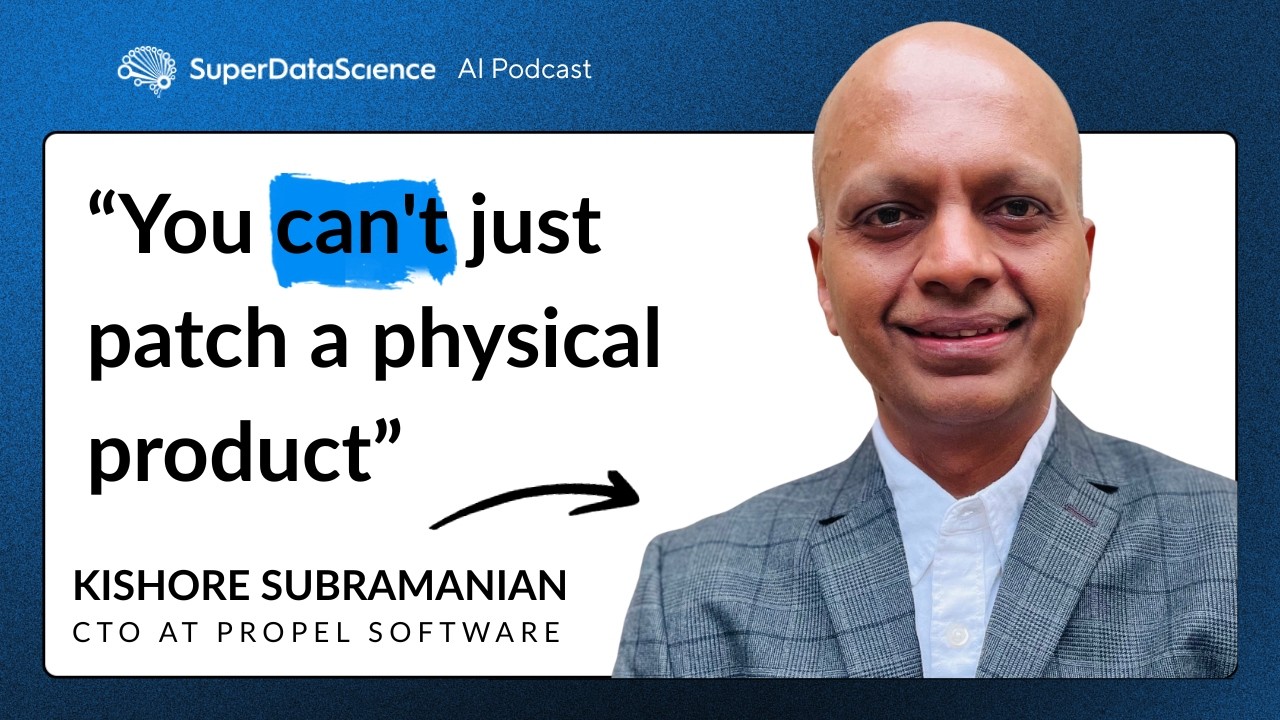
Kishore Subramanian, CTO of Propel Software, explains that his company operates like “Atlassian for physical products,” providing essential software for managing the entire lifecycle of hardware, from initial concept to customer delivery and beyond.
Product Lifecycle Management (PLM) for Physical Products
Product Lifecycle Management (PLM) and Quality Management Systems (QMS) are the backbone for companies that manufacture physical products, including high-tech, med-tech, and consumer goods. Unlike software where a bug can be fixed with a patch, errors in hardware can lead to enormous costs, such as massive factory recalls.
Propel serves as the system of record for all product information, including the bill of materials, design hierarchies, and manufacturing data. This is crucial for coordinating complex global supply chains. The platform is built on Salesforce, which provides the necessary extensibility to adapt to the different processes, data models, and regulatory requirements of various industries, from consumer goods to the stringent, FDA-compliant needs of medical device companies.
Propel One AI: Shifting Quality Left with Agentic AI
Propel One is Propel’s AI platform, designed to turn product data into actionable intelligence. A key application is the use of AI agents to improve the engineering change process.
In software development, a “pull request” is reviewed to ensure code quality before it’s merged. The equivalent in the physical product world is an “engineering change order” (ECO), where an engineer proposes modifications to the product’s design or bill of materials.
Propel One AI introduces “change review and quality agents” that analyze these ECOs early in the process. The agents can assess risks and downstream impacts, asking critical questions:
- Does this proposed change introduce a compliance issue?
- Does it rely on a part from a supplier affected by geopolitical instability?
- Will this change create an adverse effect later in the manufacturing process?
By providing this intelligence at the time of the change proposal, the agents help “shift left” the quality control process. This proactive approach prevents costly errors, saving significant time, money, and effort that would otherwise be spent fixing problems discovered much later in the development cycle.
Building Enterprise AI on Salesforce Agentforce 360
Propel built its AI solutions on top of Salesforce’s Agentforce 360 platform, which allowed them to go from concept to a customer-ready release in about six months. The decision was driven by several key advantages provided by the platform:
- Security and Governance: For enterprise clients, the intellectual property contained in product data is highly sensitive. Agentforce 360 provides a secure, governed environment, which is a critical advantage over some open-source agentic frameworks that may have known security vulnerabilities.
- Integrated Tooling: The platform includes essential components out-of-the-box, such as the Agent Builder, Agent Script for development, Data 360 for creating a data lake of product information and compliance documents, and the Atlas Reasoning Engine, which functions like an internal LLM to break down problems and orchestrate tasks.
- Speed and Focus: Leveraging this pre-built “plumbing” allowed the Propel team to focus on their specific domain problems rather than building foundational AI infrastructure from scratch.
Tips for Getting AI Projects into Production
Kishore offers a structured approach for moving AI projects from pilot to production, particularly for agentic systems:
- Model the Human Workflow: Start by analyzing how a human expert would perform the task you want to automate. Break down their process into discrete steps.
- Identify Automation Opportunities: Determine which of these steps can be effectively automated by an AI agent.
- Assess Data and Tools: Confirm you have the necessary data to support the AI’s function. Identify and build any underlying tools or building-block code required for the agent to execute its tasks.
- Build in Security Upfront: Security should not be an afterthought. It must be integrated into the architecture and design from the very beginning, especially in an enterprise context.
The Superpower of Meditation
Kishore, a certified yoga instructor, advocates for meditation as a practice that can significantly benefit professionals in AI and tech. He notes that the physical postures of yoga are traditionally meant to prepare the body to sit still for meditation. He personally finds that a daily meditation practice “unlocks creativity and a different level of thinking.” It provides sustained energy throughout the day and creates the mental space needed to detach from daily tasks and focus on bigger-picture problems, like understanding user needs and building better products.